Come Together

Las Vegas doesn’t have a lock on the meeting trade. Here’s how regional properties are getting their share of the MICE business.
Covid-19 may be years in the past, but its impact is still being felt in how we live, work and play. The pandemic made Zoom meetings and remote work a fact of life. But it also reminded us that people really do need people—not just on screens, but face to face.
In the post-lockdown era, in-person meetings and conventions are back—and booming. By one estimate, today’s trillion-dollar MICE industry (meetings, incentives, conferences and exhibitions) could triple in value by 2034 to $3 trillion-plus.
Las Vegas is arguably the MICE capital of the world, regularly hosting blockbuster expos that draw thousands or tens of thousands of participants. And while few mid-market and regional properties have the scale of a Venetian, Mandalay Bay or Caesars Forum, they can cultivate smaller conferences, retreats and seminars that really earn their keep.
MICE events do more than fill hotel rooms mid-week and in the off-season. They help build a more diverse customer base, increase brand recognition, and generate revenue, on and off the gaming floor.
‘David and Goliath’
“A regional property doesn’t have hundreds of thousands of square feet of exhibition space and a couple thousand hotel rooms—it may have 30,000 square feet of event rooms and 100 to 300 rooms,” says John Ruiz, principal and managing member of R2Architects. “Compared to the Venetian or Sands, that’s like David and Goliath.”
However, with the right ingredients, those properties can become destinations for “special events, concerts, niche trade shows and what I’ll call ‘micro-conventions,’” especially within a two-hour radius, he says. “They can put 1,000 people at 10-top tables for black-tie fundraisers or other galas. And they can pull it off in that sweet spot of 15,000 to 50,000 square feet of space.”
Successful meetings require fluid, multifunctional spaces, foolproof technology, a strong food and beverage component, and that little something extra: the mix of attractions and experiences that give a resort its personality. Of course, it all must be backed by peerless, end-to-end service. Whether master-planning new projects or designing renovations, the fundamentals include:
• Open spaces that can be divided by self-supporting modular panels or airwalls, according to client specifications. One planner may need a 25,000-square-foot exhibit hall for 3,000 patrons and vendors. Another may need four 6,000-square-foot venues for educational panels, breakout rooms or product displays.
• Solid tech infrastructure with ample bandwidth, enterprise-grade Wi-Fi, event apps, mobile powering towers and blip-free connectivity. As needed, raised-access floors protect and conceal power and telecommunication cables, HVAC equipment and so on. Overhead, modular rigging systems do the heavy lifting, suspending thousands of pounds of speaker systems, lighting, cameras and screens.
• Modular furniture and retractable seating that can easily transform the look and layout of a room. For instance, a registration area and coffee station that welcomes guests in the morning may later serve as a mix-and-mingle spot with cocktail bar. Later still, it can host a sit-down dinner and awards ceremony.
Clear sightlines and balanced acoustics are a must—no seat should be a bad seat. And talk about versatile: “Two days after the formal catered affair,” says Ruiz, “you could take all that out and put in a mixed martial arts ring.” Multi-use is paramount, because “storage rooms have no ROI. So furnishings, case goods and millwork that can wear multiple hats is critical, because we don’t have room to park this stuff.”
Ideally, an operator can invest both in dedicated convention space and a performance arena, “but that’s very difficult on regional marketplace budgets,” says Tom Sykes, principal of architectural firm WATG. “What’s usually built is a large ballroom that can accommodate a major conference, a dinner for 1,000 people or a 2,000-seat concert.” The space can be programmed for a wide range of events, but changeovers have to be quick and complete: “It can’t be a multi-day effort to change from a ballroom to a mosh pit.”
A Total Experience
The term “integrated resort” was coined at the dawn of Singapore’s gaming industry, in the early 2000s. Downplaying the casino component, would-be operators promised full-scale entertainment destinations with theme parks, waterparks, theaters, museums, rooftop pools, marinas, and acres of meeting space.
The IR concept, now widespread, refers to billion-dollar properties like Marina Bay Sands and Resorts World Sentosa, which opened in Singapore in 2010, and newer resorts going up from Chicago and New York City to Macau, the Philippines and recently, Sri Lanka and the United Arab Emirates. But smaller regional properties are taking a page from the IR playbook. Multiple entertainment options make for a more complete guest experience, which contributes to longer stays and has a compounding effect on revenue.
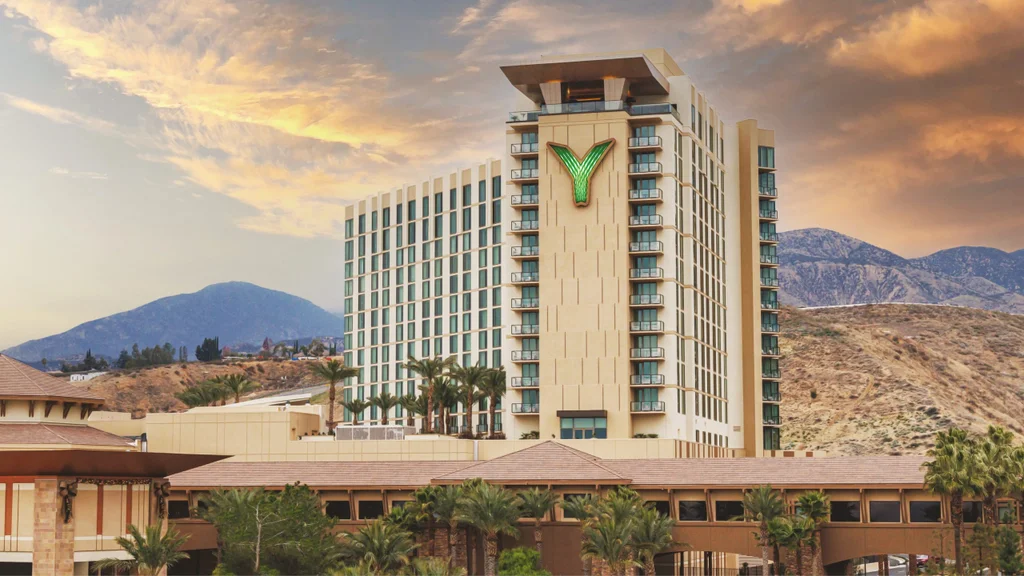
Take the Yaamava’ Resort and Casino, in Highland, California, owned and operated by the San Manuel Band of Mission Indians. Along with a 432-room hotel and 290,000-square-foot casino, it has abundant meeting space including the Enclave Ballroom. The 3,000-capacity Yaamava’ Theater attracts headliners like Ed Sheeran, Bob Dylan, Christina Aguilera and Sebastian Maniscalco. Set against the rugged San Bernadino Mountains, Yaamava’ offers almost a dozen restaurants and a retail corridor with six shops and boutiques. Rounding out the experience: a luxury spa and pool deck flanked by cabanas and native trees. VIP members also have access to the Palms Casino Resort in Las Vegas, also a San Manuel property, and Monarch Beach Golf Links, a championship course overlooking the Pacific Ocean.
On a smaller scale, Turfway Park in Florence, Kentucky features an 18,500-square-foot, 800-capacity event center with racetrack views and a grand staircase leading to the Paddock, an outdoor arena that hosts concerts, meet-and-greets and other special events. Guests can dine at three restaurants including the Homestretch, which offers views of live thoroughbred racing. On race days, the Churchill Downs property offers dedicated simulcast betting windows.
Oak Grove Racing, Gaming & Hotel, a CDI harness track about an hour from Nashville, boasts a unique meeting space in its Equestrian Center, with a championship show ring and semi-permanent bleacher seating for more than 1,000 spectators. It adjoins a five-story hotel, RV park and the Moonshine Amphitheater, an 840-seat performance arena that regularly hosts musical artists, from rappers to rockers to country artists.
A hotel is not always essential, provided a property forges partnerships with premium local establishments (Turfway Park in Kentucky partners with three Cincinnati Airport hotels). But Sykes believes a hotel is the “base component” for success in the meeting sector—the foundation that supports everything else.
For one thing, “casino rooms always have a much higher level of finish and appointments than non-casino rooms,” he says. “And casino hotels have a much higher percentage of suites than standard hotels. That feeds well into the business planner’s model: they want suites for break-outs and meetings or to entertain show managers, promoters, key guests and key speakers.”
Much is made of the “customer journey,” and designers ensure that the pathway unfolds in an intuitive way, from arrival to departure and all along the way. The meeting hall, hotel and casino should be proximal “without bumping into each other,” says Sykes. They are linked by “food and beverage, retail, outdoor or other amenities, nice shared amenities that are important to (all) market sectors.”
Meeting of the Minds
Once upon a time, MICE events were almost non-events at casinos, which emphasized gaming above all, and threw in food and entertainment almost as loss leaders. “They were non-significant revenue-makers from day one,” says Ruiz. Now, meetings are “another tool in the toolbox for general managers and the marketing team to drive revenue. The whole idea is to bring more people to a property and extend the amount of time they spend there.”
A robust meeting calendar also sounds good to those with the power to grant licenses—lawmakers and regulators. “Gaming operators are meeting with local elected leaders and saying, ‘I’ll build a hotel with meeting space to create more permanent jobs and more tax ratables for the community,’” says Ruiz.
One example is Cedar Crossing Casino and Entertainment Center, a Peninsula Pacific Entertainment (P2E) property slated to open later this year in Cedar Rapids, Iowa. Operator proposals were shut down twice by the Iowa Racing and Gaming Commission, in 2014 and 2017, before winning approval in 2025. Additions like a 1,500-seat entertainment venue, restaurants, an arts and cultural center and even a STEM lab may have helped push it over the finish line.
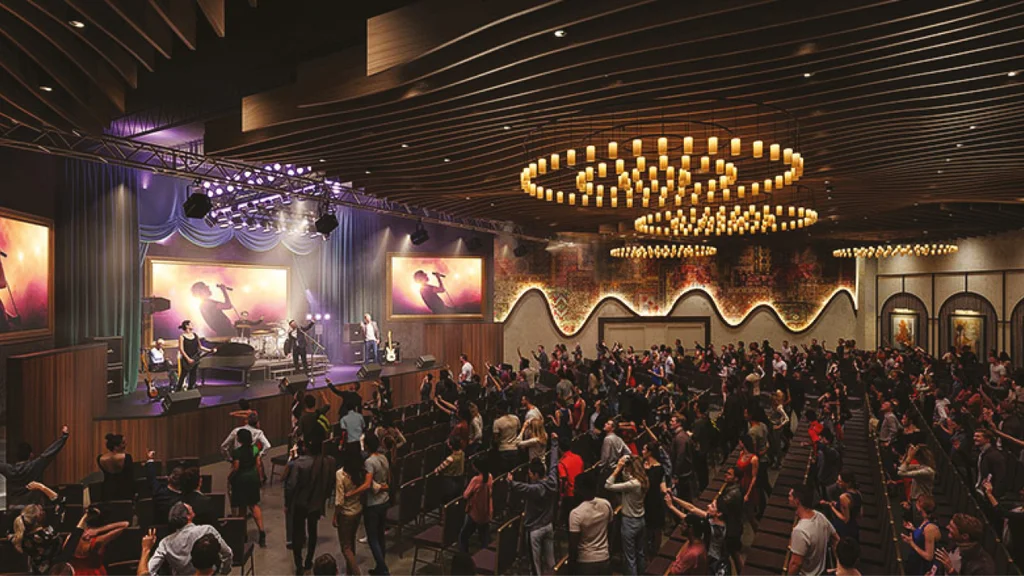
Cedar Rapids Mayor Tiffany O’Donnell calls the complex a key part of the city’s “revival” following historic floods in 2008. A study suggests the complex could draw 1.1 million visitors annually and contribute $80.2 million of new taxable revenue to the state. According to North Iowa Today, “Economic experts agree that the appearance of a large entertainment facility can create hundreds of new jobs and increase the flow of tourists. Analysts note that similar projects… often become a stimulus for increasing employment and local budget revenues.”
Sykes agrees: “Through Virginia, North Carolina and the Rust Belt, legislatures have approved casinos to create jobs” and fuel new regional business.
The ability to hold MICE events, from weddings and reunions to corporate bashes, helps resorts stand out in an increasingly crowded marketplace. Complementary amenities, exceptional service, trouble-free execution—and the marketing push to sell it all—make it easy for meeting planners to say yes, again and again.
Meeting Expectations
Q&A with Joe Barrafuldi, AIA, Principal, HBG Design
Casino Style: How can smaller properties build their MICE business?
Barrafuldi: The opportunity is often about understanding the market through a feasibility study, right-sizing the investment based on demand, and creating flexible, high-quality environments that support the type of group and event business the property can realistically attract.
Rain Rock Casino & Hotel in Yreka, California is a good example of a regional property using event space strategically, without overbuilding. Its approximately 4,000-square-foot banquet and event center is scaled for community gatherings, private events, meetings, banquets, weddings and local or regional group business. When paired with hotel rooms, boutique cottages, gaming, dining, outdoor amenities and a place-based design story tied to the Klamath River and Karuk culture, it becomes part of a larger resort experience rather than a stand-alone meeting room.
Talk about the technical infrastructure necessary for these events.
Meeting attendees expect reliability, flexibility and a seamless experience, so technical systems must be planned early and integrated into the architecture. At Sycuan Casino Resort (El Cajon, California), Oaklawn Racing Casino Resort (Hot Springs, Arkansas) and Four Winds South Bend’s Ribbon Town Conference and Event Center (South Bend, Indiana), ballroom flexibility depends on infrastructure that supports every configuration.
Divisible ballrooms can accommodate smaller meetings and events, but each setup still has to perform with the right acoustics, lighting, technology, service access and guest comfort. The best technical infrastructure is often invisible to the attendee, but it allows the operator to deliver events efficiently and consistently. From a design standpoint, that means acoustic separation, quality operable partitions, sound control, and finishes that support speech intelligibility and guest comfort, along with layered, programmable lighting that can shift from business-focused meetings to warmer receptions or entertainment events.
In large-volume spaces with fluctuating occupancy, HVAC zoning, air distribution, humidity control and quick recovery times are essential, so the room performs as well for a 50-person breakout as it does for an 800-person banquet or 1,500-person theater-style event.
Are geolocation and wayfinding capabilities important?
Wayfinding is critical. Even the most flexible event center won’t perform well if attendees feel disoriented or the staff must constantly redirect guests. But digital tools should reinforce a strong physical planning strategy, not compensate for a confusing one. Clear sightlines, logical adjacencies, strong landmarks, intuitive vertical circulation and well-placed signage remain essential.
Are meeting planners looking for spas, pools and wellness facilities?
Group travelers want a resort experience that supports networking, relationship-building, entertainment, relaxation and well-being. Meeting planners are paying attention: that broader experience influences attendance, satisfaction, repeat bookings and how attendees talk about the event afterward.
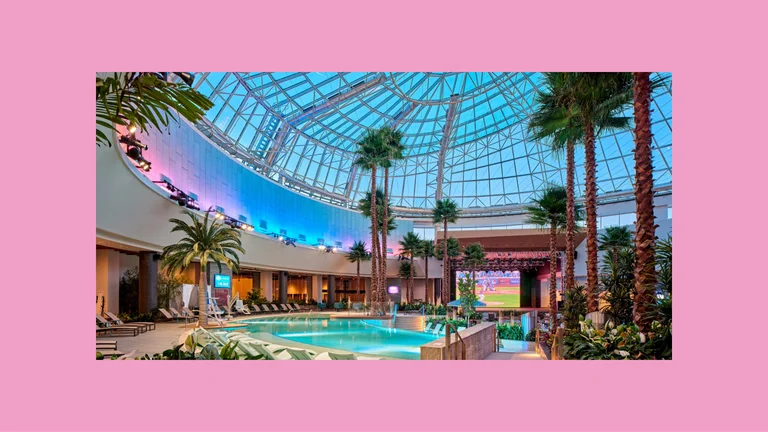
The key is to design recreational offerings as part of the event ecosystem, not as separate amenities. At Oaklawn, for example, guests have access to and views of the historic thoroughbred horse-racing track, the Forbes Four-Star Astral Spa, gaming amenities and upscale dining—all near the event and meeting space. Gun Lake Casino Resort’s Wawyé Oasis in Michigan blends a resort pool environment with large-format event and performance capabilities in one climate-controlled atrium.
This kind of multi-purpose amenity creates vast revenue-generating opportunities from one building investment. When a resort can offer an easy transition from meeting to dinner, spa, pool, lounge, entertainment or reception, it becomes more competitive as a group destination.