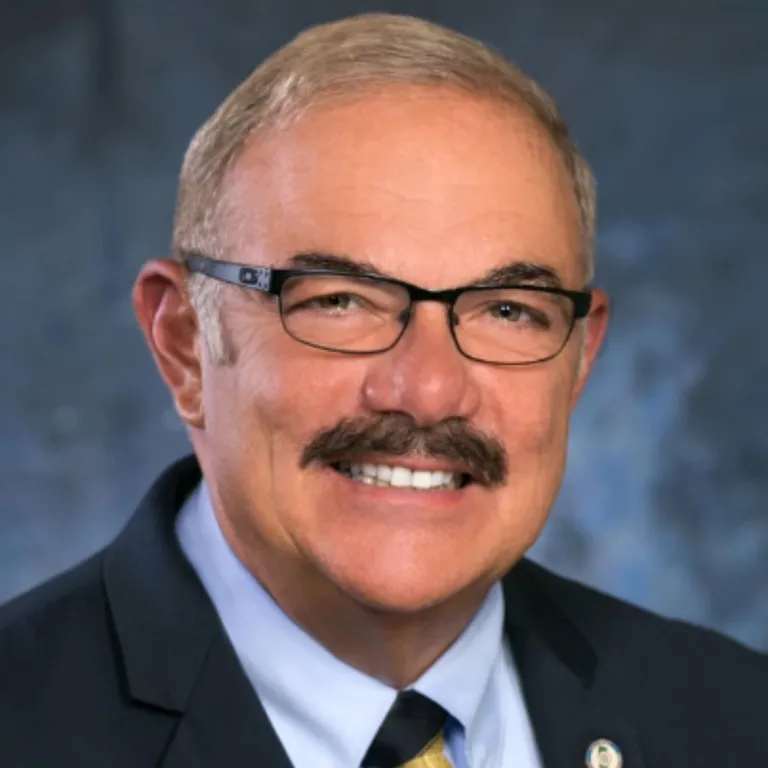
Paul Speirs-Hernandez

Founder, Steinbeck Communications and Red Wagon Institute

There are few figures in the gaming industry whose presence and mentorship are as widely felt as Paul Speirs-Hernandez, founder of Steinbeck Communications and Red Wagon Institute. Through these ventures, Speirs-Hernandez plays a big role in helping companies craft their communications strategies while also training employees from the frontline to the C-suite to become better leaders and teammates. He spoke with GGB’s Jess Marquez remotely in June.
GGB: You’ve been in the gaming industry for decades. How did you get your start? What made you want to come to Las Vegas?
Paul Speirs-Hernandez: I grew up in Salt Lake and did my undergrad at Southern Utah. I’d applied to five different grad programs and didn’t really care which one I went to, honestly. But on my way out of my apartment to turn in my keys, I checked the mailbox for the last time and there was a letter from UNLV. And that’s how I came to Vegas. I was supposed to be here for one year. And 35 years later, I’m still here.
You founded your first company, Steinbeck Communications, more than 20 years ago. How have things evolved over that span?
One of my pet peeves is when marketing or communications firms say, “We specialize in…,” then give you a laundry list. It’s like, well, you might generalize in all sorts of stuff, but you don’t specialize in anything. So one of the decisions we made really early on was to specialize in gaming. I came from an operator world at Excalibur and Mandalay, so it was natural to do some operator clients for a while. Then gradually, we moved strictly to doing B2B for suppliers. And that’s been the niche ever since.
You work with many of the biggest suppliers and industry trade groups. Can you talk a bit about that?
We do a lot of B2B work with suppliers like Aristocrat and JCM, with regulatory-focused agencies like GLI, then with groups that benefit the industry in different ways like AGEM and Global Gaming Women. And I love it. I get to see the whole world of gaming, how it all comes together and moves forward with those various groups. It’s not that they’re disparate, they just have different needs. We’re all working towards the same goal, and that’s been fascinating.
After a long run with Steinbeck, you founded your leadership training company, Red Wagon Institute, in 2017. What was the inspiration there?
Ever since I was a little kid at Excalibur doing my internal comms job, my philosophy was really, really simple: employees have to be the first audience in all communication. And I still believe that, because let’s be very clear: if your employees ain’t buying what you’re selling, nobody else is buying it either. Out of all the audiences you’re dealing with, you have to consider your employee audience first.
So it was a very natural bridge. Employees need to be your first audience, and I need employees to be the brand ambassadors to create this training program that helps facilitate that. When everyone is a leader, then all of that falls into place, where the employees understand the mission and the goal and the communication and the importance of successfully delivering that. Customers can also have an enjoyable experience by the people who are delivering that.
Your philosophy in training is that everyone needs to be a leader, from the front line to the CEO. Could you expand on that?
Everyone needs to be a leader, meaning that everyone needs to have the leadership skills to be the very best that they can be in whatever it is that they’re doing. So if I’m the front desk attendant or if I’m supervising 700 people, I need every single person to be the very best that they can be and able to lead in that area. That’s very important. At the same time you need to fulfill the role that you have, right? Those aren’t two different things. They really go together. Because if I understand my role and I’m going to be the best leader I can be in that role, that’s where the magic happens. There are other approaches to this, where leadership is for a select few people and the focus is on those people. I completely disagree with that. You have to have everyone understand what leadership is, so they can fulfill that leadership call when the time comes.
Two other aspects of leadership training you often talk about are intentionality and consistency. What do those tenets mean to you?
We look at leadership as an infrastructure. No one is going to buy or rent a building and then do nothing with it. You have to do basic maintenance… I just don’t understand the philosophy of hiring people and letting them do their thing. Hire people and let them do good work, but at the same time, invest in that infrastructure of leadership continually to ensure that communication is happening correctly, that teams are happening correctly, that people understand their roles, that people are being informed about decisions, and that everyone still has the willingness and ability and permission to lead.
When you just leave things be, that’s when silos get created, fractures are created. And ultimately, cracks that could have been fixed with some Scotch tape and some little bit of plaster are now chasms.