Friction-Free Design

Artificial intelligence is at the forefront of technologies streamlining the casino design process.

While the casino industry has gone through expansions and contractions like any other business, one thing that has remained constant is the demand for architecture and interior design projects.
Opportunities are abundant these days for ground-up projects in new jurisdictions, but even if that were not the case, existing properties seek out design professionals for major renovations, new casino spaces, and new restaurants, lounges and other amenities. That has not changed.
What has changed is the way those professionals accomplish each project. Advancing technology spearheaded by artificial intelligence has streamlined the design process, completing projects with efficiency and on a vastly improved timeline.
“Focusing strictly on the aesthetic side of casino design, artificial intelligence has completely reimagined the concepts of mood, feel, and visual storytelling,” says Michael Powell, senior project manager and associate at R2Architects (R2A).
“Instead of spending weeks hand-crafting a single photo-realistic rendering, design firms use AI as an infinite mood-board and a real-time canvas. Casino clients rarely buy into basic floor plans, sketches or ‘clay’ models—they buy into a feeling of the guest experience, energy, and escapism. AI has shifted rendering from static snapshots to live, emotional previews.”
Powell says technology has particularly streamlined renderings representing “complex, opulent materials” like backlit onyx, polished brass or massive chandeliers. “Historically, setting up these textures in rendering software required heavy computational power and hours of manual adjustments,” he says.
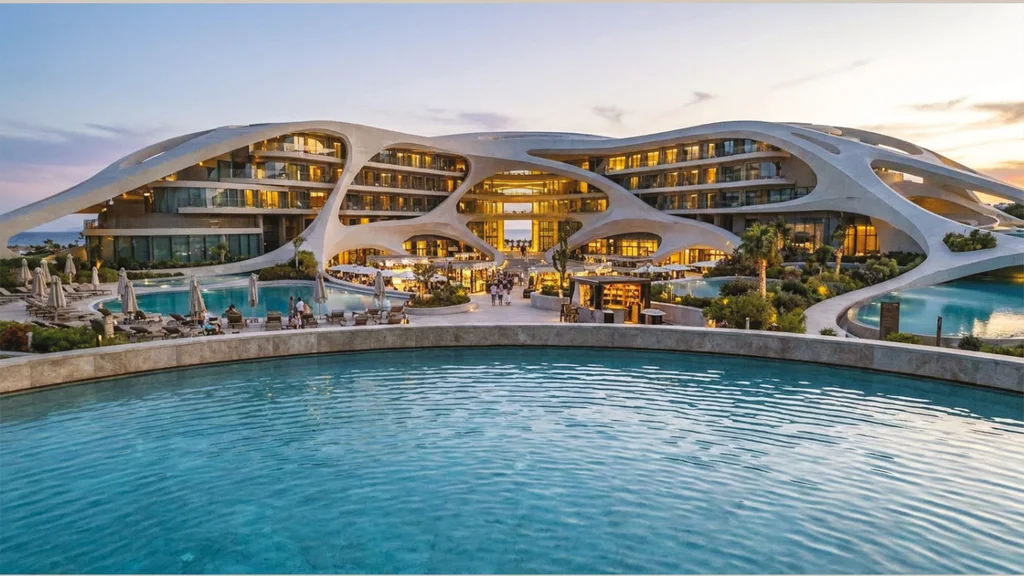
“AI allows designers to type descriptive prompts to generate custom items instantly. What once took weeks or even months to get direction from a client, followed by hand sketches, weeks of 3D modeling and final tweaks can now be accomplished in hours, if not minutes.”
“Five or 10 years ago, the early stages of a gaming or integrated resort project were much more linear,” says Tom Sykes, principal at architecture firm WATG and Wimbley Interiors. “We would move from briefing and research into diagrams, plans, sketches, models and then renderings. Today, AI and computational design allow us to explore a much broader range of possibilities earlier in the process, from guest journey and arrival sequences to massing, visualization, operational flow, and experience design.”
Nathan Peak, AIA, president of HBG Design, adds that the introduction of AI technology does not replace the human element in design. “While AI has increased the speed and options available to us in our ideation process during conceptual design, it has not diminished the importance of authentic, original design by our staff of professional architects and interior designers,” he says.
“It’s imperative that they continue to engage in their own discovery to grow professionally. In this sense, AI is used to enhance, rather than replace, creative processes and is primarily used for brainstorming, research, and illustrating design options, allowing our team to explore more possibilities with clients in a shorter timeframe.
“We view AI as a tool among many, useful for ideation and streamlining tasks, but always requiring human oversight and creative control to maintain the integrity of our work… We lightheartedly talk about AI as ‘almost intelligent.’ It’s strictly a tool. We give it very specific parameters and provide explicit guardrails, never assuming every answer generated is correct. In essence, all AI-assisted results are subject to the same rigorous vetting and review standards as any other project deliverable, ensuring that AI does not replace the team’s QA/QC process.”
WATG’s Sykes agrees. “The most important shift is not that AI ‘designs’ the casino. It does not. Gaming design still depends on human judgement, operational intelligence, cultural understanding, hospitality expertise and the choreography of emotion, movement, and revenue-generating space. But AI helps us test, visualize and communicate ideas faster. It also elevates our insights on guest behavior, revenue adjacencies, and operational choreography earlier in the process.
“This is especially valuable in gaming environments where the relationship between patrons, entertainment, dining, retail, VIP experiences and back-of-house operations is highly complex.”
“AI is not replacing the designer; it is removing friction from the design process,” says Sean Harry, managing principal, digital + data + AI practice leader at WATG.
“In gaming, where every movement, view corridor, threshold, and guest decision matters, this means our teams can study more options, challenge assumptions earlier and arrive at stronger solutions with greater confidence. Design decisions influence dwell time, circulation, spending behavior, operational efficiency and even guest psychology. AI allows us to evaluate more of those interdependencies earlier and with greater clarity.”
Saving Time
If there’s one thing the AI tool has done, it’s save time, and, with the assistance of other advancing digital technologies, improve efficiency within a given project.
“AI and advancing technologies have shortened project timelines, particularly in the early stages of conceptual design, by enabling rapid assistance in generating design options for client presentations,” says Peak at HBG. “For example, we can now respond with immediate changes to renderings in real time, based on client feedback via AI prompts and scripts.”
Peak adds that AI can map out all details of a project and present a more complete picture to the client. “It gives us an advantage in the speed at which we’re able to illustrate potential solutions our clients are seeking,” he says.
“For instance, if we’re doing a renovation, when it comes to very specific carpet patterns, signage, or a cage design, we can take a photograph of an interior space and combine those visuals with quick sketches and original design narratives using AI, to rapidly combine elements and ideas that our clients can react to much faster than we were able to do previously.
“AI tools enable our teams to start design conversations earlier with our clients without extensive initial data collection. Especially by employing illustrative, image-based AI tools, we can move the design process forward early, before full site measurements are completed, which is more efficient and effective. Data collection is still necessary, but it’s no longer the first step, which accelerates the overall process.”
“AI can compress the distance between idea and understanding,” says Harry at WATG. “That is where the time savings are most powerful: clients can see, assess, and respond to a vision earlier, and our teams can move forward with greater clarity. AI speeds up understanding, but it also raises the standard. Clients now expect richer visualization, faster iteration, and deeper insight earlier in the process.”
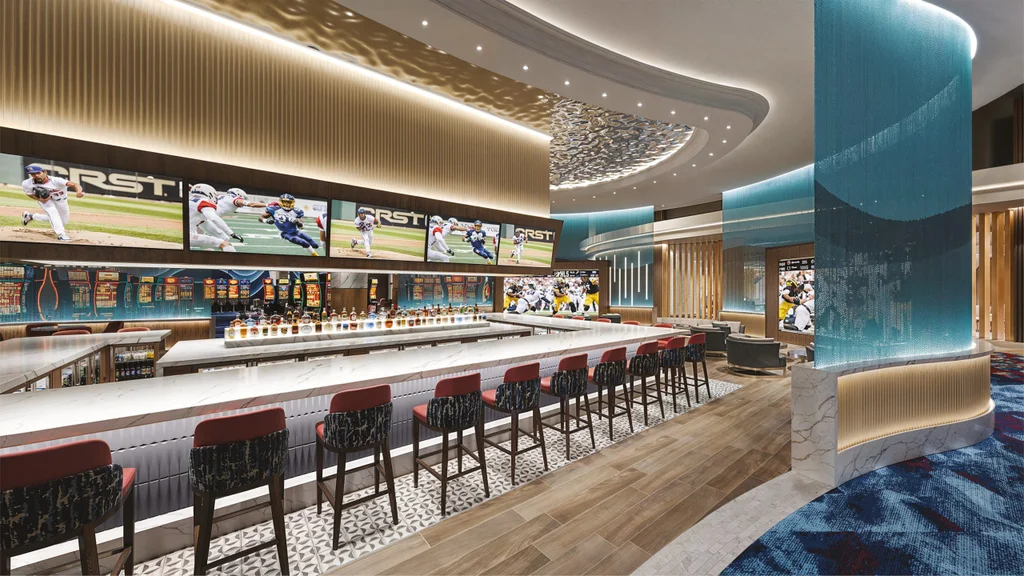
Emona Vitarelli, senior interior designer at R2 Interiors (R2I), says AI has speeded things up particularly during the conceptual and visualization phases of a project. “Clients can now review realistic imagery, material concepts and design alternatives much earlier in the process, which accelerates decision-making and reduces lengthy revision cycles.
“That said, while technology has shortened many aspects of the process, the overall project timeline is still influenced by permitting, procurement, construction logistics, and supply chain conditions. AI helps us move faster and make better decisions, but successful projects still require thoughtful planning and collaboration.”
Vitarelli says tasks that have become “dramatically more efficient” thanks to AI include concept generation and visualization, material and finish exploration, rendering production, design option iterations, coordination between disciplines, and developing presentations.
“Tasks that once required days of rendering or drafting can now be completed in hours, allowing designers to spend more time focused on strategy, creativity and guest experience rather than manual revisions,” she says. “Additionally, coordination between architecture, interiors, lighting, branding and operations has improved because technology allows teams to work more collaboratively and evaluate decisions earlier in the process.”
“The tasks we are streamlining are the repetitive and iterative ones, not the judgement calls,” comments Harry at WATG. “AI can generate options; it cannot understand a client’s ambition, a community’s concerns or the subtle psychology of a gaming floor without experienced designers guiding it.”
Harry’s role at WATG and Wimberly Interiors is to lead the firm’s global digital and data strategies, and to integrate AI, along with other emerging design technologies, into a unified digital ecosystem. “Our AI strategy is led internally, with external collaboration where it adds value,” he says. “We are not treating AI as a one-off training exercise; we are embedding digital, data, and AI capability into the way the firm works.”
One of Many Tools
AI is one of many tools driving the efficiency of modern casino design. “Technology has transformed both the creative and operational sides of the industry,” says Vitarelli at R2I. “Faster computing power and advanced software allow us to work in increasingly immersive and data-rich environments. We can now develop highly detailed 3D models, real-time walkthroughs, lighting simulations, and photo-realistic renderings much more efficiently than in the past.
“Cloud-based collaboration has also changed the way teams communicate across disciplines and locations. Clients, consultants and contractors can review information in real time, which improves transparency and coordination throughout the project life-cycle. Most importantly, technology allows us to spend less time on repetitive production tasks and more time focusing on storytelling, guest experience, and strategic design thinking.”
“Technology has made design more integrated, more visual, more collaborative and more evidence-based,” says Sykes at WATG. “Faster computing, AI, parametric modeling, VR, AR, and real-time design tools allow our teams to work across geographies, test ideas faster and involve clients in a more immersive decision-making process.”
AI and other modern tools have created a casino design discipline that will continue to evolve in years to come. “We foresee increased efficiency by AI acting as an additional layer of review, freeing up staff for other tasks, and laying the groundwork for more interactive client relationships using collaborative AI tools,” says Peak at HBG.
“That said, we can’t stress the continued reliance on human oversight for quality assurance and validation enough. Our goal is to shape a shared vision with our clients; AI tools provide more opportunity for design professionals to connect with clients. It mobilizes a more collaborative design approach in real time that accelerates our connection to a client’s vision.”
“We’re seeing the industry move toward workflows that are a lot more integrated, faster, and just smarter overall,” says Lindsay Mazzeo, senior interior designer at R2 Interiors. “AI is going to keep playing a bigger role in things like visualization, documentation, coordination, and even helping teams make better decisions earlier in the process.”
“Plain and simple, AI is a game-changer,” says Powell at R2A. “It collapses the timeline between imagination and technical execution, shifting architecture and design from static structures to reactive, high-revenue environments. In a billion-dollar industry where every square foot must generate maximum profit, AI removes the guesswork from human behavioral design while unlocking unprecedented visualization.”
“The future is not about asking AI to design a building,” says WATG’s Harry. “It is about creating a smarter design ecosystem—one where data, performance, creativity and human expertise are connected from the first idea through delivery.
“The most powerful AI systems in design will eventually learn from operational outcomes—how guests move, where revenue concentrates, how energy is consumed, and how resorts evolve over time. In fact, this is currently on our roadmap for new services that we may offer to clients.
“Technology has changed the conversation from ‘look at this drawing’ to ‘step into this experience.’ That is a major shift for hospitality and gaming design, because the guest journey is something you need to feel, not just read on a plan.”