Free Play: Entrenched and Entitled

Players have come to expect free play as a reward for their slot wagers. Is that a good thing for casinos?
Loyalty rewards for slot players have certainly evolved from the days when marketers sent out direct-mail coupons to players month after month as a perk for their repeat play. Some loyalty rewards have remained in place, from merchandise gifts to direct cashback through the credit meter.
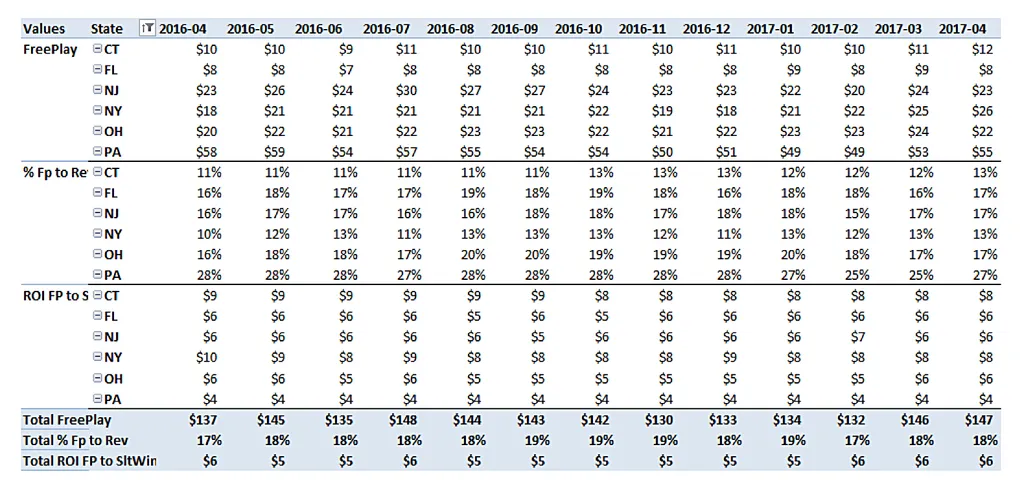
But these days, the king of the slot loyalty game is free play—non-negotiable bonus credits that do not actually become a reward until they are wagered through a slot machine at least once. For casinos, it is a low-cost player perk with tax benefits—particularly in jurisdictions that deduct the cost of free play from gross slot win, reducing the total on which casinos must pay often-onerous gaming taxes to their states.
Tax benefits aside, the fact free play must be played through translates into a reinvestment in the player that is cost-effective. Coupons can be cashed at the cage and carried out of the casino. Cashback directly to a credit meter, likewise, can be cashed out immediately. Physical gifts are carried off the property—or, nowadays, often shipped directly to the players’ homes at the casino’s expense—without any requirement for additional wagers.
For players, free play is easy to earn, and lately, has become ubiquitous, to the point players see it as an entitlement—it’s a perk they expect, in return for their repeat play.
For most operators, that’s just fine.
“Over the last 20 years or so, free play has become pretty much a fundamental tool in our marketing arsenal, probably similar to most casino properties, at least in the United States,” says Mark Birtha, president of Hard Rock Hotel & Casino Sacramento.
“It’s definitely something that our guests are quite familiar with, and for whom it obviously has a lot of appeal. So, we use it regularly, and it’s something we find is pretty effective in terms of driving trips and overall loyalty with our guests.”

“Free play is vital,” says Jake Joyce, senior vice president of marketing for Live! Casino Hotel Philadelphia. “I got into the industry in the early 2000s, when it was first taking off, and it’s been one of the greatest tools to develop loyalty in our industry, in our sector.
“That being said, the devil’s in the details, and how you use it and optimize it into your programming is just as vital in terms of generating success or not.”
Buddy Frank, owner of consultancy Slot Strategies and formerly a longtime executive who headed slot operations at several Reno casinos before retiring as slot operations VP at California’s Pechanga Casino, agrees that the way free play is used is a determining factor in its success.
“The ‘pro’ is that free play is the single most productive tool in the history of casino marketing; the ‘con’ is that careless, unmonitored awarding of free play is an exorbitant expense and a colossal waste of money,” Frank says.
“You could also call it ‘good free play vs. bad free play.’ With the excellent analytical tools available today, like QCI and Gaming Analytics, operators can fine-tune their use of free play to gain the maximum returns in profitability and customer satisfaction. This requires strict and timely monitoring of play patterns and careful analysis of free play redemption.”
Bouncing Back
Free play is a much more effective tool than its forebears, “bounce-back” coupons—so named because players would be required to bounce back to the casinos to redeem the rewards. “Essentially, you would you would go to a casino, you would come home, then you open up the mail and get a check for $18.42,” recalls Andrew Klebanow, principal of Klebanow Consulting and a 40-year industry veteran.
“This would stake you on your next visit, and the amount could change based on coin handle. Customers would come in with their casino check, go to the cage, take their money, and theoretically go play slot machines. But casino managers were always wondering, ‘Gee, is my money walking out the door as opposed to going back into my slot machines?’”
In many cases, that money did walk out the door. Advantage players in the early days would often go on “coupon runs” to collect their cash, not necessarily reinvesting it in casino play. Casinos would eventually verify this through careful examination of data, aided by the latest technology. But even in the early days of player tracking in the 1980s and early 1990s, operators figured out the pitfalls of coin coupons through simple observance.
“They would employ people to stand by the casino cage and watch customers,” says Klebanow. “They saw some money walk out of the building, and other people would sit down and play slot machines. So, over the course of the 1980s and into the 1990s, casino managers were clamoring for slot manufacturers to come up with a way they could award non-negotiable slot credits instead of cash. The problem was that back then, machines were not talking to each other or to the central casino management system in a standard manner.”
That problem, of course, was solved by the SAS protocols first introduced in 2004, and most recently updated in 2018. With machines and systems able to communicate with each other, the free play system was enabled, and free play could be added to the credit meters of machines from any manufacturer.
The advantages for operators were immediate. Not only were free-play rewards guaranteed to stay in the casino, but as a promotional expense, it was much cheaper than the more traditional rewards.
“I could give you a complimentary meal,” says Klebanow, “but I’ve looked at hundreds upon hundreds of income statements for casinos over my career, and less than 10 percent of those casinos have a food and beverage department that is operating profitably. Even if you go back to the days of cashback, if I gave you a dollar in cashback, it was cheaper than a dollar in comps. The cashback cost me a dollar. A dollar in comps costs me $1.20 or $1.30, because my food and beverage department is not operating profitably.”
Joyce adds that cashback remains an option even for casinos that depend on free play. “Cashback has a higher perceived value,” he says. “You use it very strategically. There’s no breakage usually in cashback like there is in free slot play. It’s also harder to tie cashback promotions to time-based, play-based incentives and other triggers, versus free slot play.
“Historically, though, when you give people more free slot play, they come in—they become more loyal. I think that has changed over time. Now, data science has become better. We’ve become more personalized, down to using your app and your phone and seeing your behavior, and what engages you with our brand. We all have largely the same slot machines on the floor, so how do we use our marketing tools to differentiate ourselves and our experience?
“(Free play) is just one piece of the pie, but it may not be as big as it was a decade ago.”
In jurisdictions like Pennsylvania, where Joyce markets the Live! casino, regulation has made free play a more attractive piece of the marketing pie. Since the free-play expense is deducted from gross slot win, the state’s casinos, with an effective 54 percent slot revenue tax, can remain competitive with neighboring New Jersey, where the tax rate is 8 percent.
“I’m not sure we could survive if it was any other way,” Joyce says. “I do not think we would be able to compete with Atlantic City. We have a 50-plus percent tax rate, and I can see the bridge outside my window to my right towards New Jersey. It’s a less than a one-hour drive, and I’m paying 8 percent tax. So, my reinvestment capabilities are so much greater (with free play).”
The Pros and Cons
Most operators feel that free play, managed appropriately, is here to stay as a positive promotional tool. “Free slot play is generally worth the promotional expense, provided it’s strategically managed,” says Joyce.
“When used correctly, it drives player engagement, increases true frequency, and enhances customer loyalty. But like any promotional expense, it must be carefully structured into your ROI programs. Free slot play is probably one of the most valuable tools for that, so I think we’re going to continue to see its use down the road.”
Free play also has become an absolutely essential tool in competitive markets—Live! Philadelphia, for instance, competes with nearby properties including Rivers Casino Philadelphia, Harrah’s Philadelphia, Valley Forge Casino and Parx, all less than a half-hour drive from each other.
“How you use free play in terms of differentiation among your competitors is critical if you’re in a highly competitive environment,” Joyce says. “And as it relates to us, we pulled back our free slot play 20 percent last year, and we still grew our slot coin-in by 6 percent. Free slot play generates more coin-in, so it’s very unusual to drop 20 percent in free play and grow coin-in at the same time.
“That doesn’t mean we reduced our reinvestment, it just means we reduced our free slot play. We might have used other things like comps, coupons, hotel stays, dining offers and so forth as part of our entire mix of the reinvestment pie. We were able to capture an additional 1 percent in market share over that same 12 months.”
The reinvestment mix, including the use of free play, differs according to the market, adds Birtha, who currently operates in the competitive Northern California market and has worked in similarly competitive markets in Las Vegas, Atlantic City, Tucson and Ohio.

“I think it matters whether or not you’re in a competitive marketplace,” Birtha says. “Northern California is definitely a competitive marketplace, and so free play becomes one tool that I think guests are looking at as an entitlement, because it’s been around so long.
“In Northern California, we’ve all come to the realization that by all means, free play is an acceptable reinvestment if it’s used effectively. And that’s a big if, of course. I think it definitely varies by marketplace. It depends on the regulatory and tax environment that you might be in.
“Certain marketplaces clearly look at it differently. Some include (free play) in their tax calculations; some allow you to do certain amounts and not do certain amounts, or have limits based upon the marketplace and the regulatory environment. So that’s always a factor that needs to be evaluated in terms of whether you use free play or some other promotional allowance-type product.”
The level of competitiveness in the market also determines how much of a reinvestment is made in free play, Birtha adds.
“It’s been around for quite a long time and it’s an expectation, and then it just becomes a matter of how much of your overall marketing spend and reinvestment that free play qualifies and quantifies into, because again, typically the more competitive the market you’re in, the higher your reinvestment is probably going to be.”
Another factor, he adds, is the knowledge inherent in the player base. Birtha says when he worked in Cleveland from 2014 to 2018, the market was relatively new, “so free play wasn’t as much of an amenity, per se, as I’ve seen it in other markets where gaming has been around 30, 40, 50 years or more… Then, it just tends to be a much more normal marketing tool that we use to be competitive and to give our guests what they want—and most importantly, that we are reinvesting at the appropriate amount from a bottom-line perspective.”
For the player, one negative effect of the free play phenomenon is its effect on slot hold, particularly in tourist markets like the Las Vegas Strip. “If I have a theoretical hold of 8 percent and I’m only holding 6.5 percent because of all the free play that marketing is dumping into the system, what do I do as a slot director?” says Klebanow. “I change the PARs on the machines or buy machines with a higher hold to compensate for the amount of free play being dumped into the system.”
“No matter where free play is used, it does have an effect on hold,” says Joyce. “Casinos that issue a lot more free slot play tend to tighten their floor to offset to offset that reinvestment… That being said, though, it’s not something that’s talked about at the property level, at least not for us. We tend to use free slot play more according to what kind of player you are. If you’re a slot-dominant player, you’re going to receive free slot play.”
“It depends on your management philosophy,” says Birtha. “It depends on the competitiveness of the market, and on the tax rates.
Every operator subjectively needs to answer that (slot hold) question depending on the criteria that are in front of them to operate their facility competitively and to meet the guest needs.”
Here to Stay
Regardless of slot hold, market competitiveness, or other promotional tools available, it appears free play will occupy a central role in slot marketing for the foreseeable future.
“I think we’re set in our ways with free play,” says Klebanow. “Every casino has to come up with a free play matrix, and maybe it’s rewarding players at 8-11 percent of their theoretical win, or we’ve already figured out whether we’re going to give free play offers out once a month, four times a month—every casino’s got a matrix of how they want to reward their players. But no, I did not see free play going away.”
“I think there will always be some sort of free play element in marketing,” says Birtha. “I think there’s still room for evolution in how we use it, how much we invest in it, how smart we can be with it. I think artificial intelligence will be very much an interesting tool to use in the future… Instead of getting an incentive based upon your average daily theoretical, it might be driven based purely on your play while you’re on the property.”

“In my career, we’ve given away everything from T-shirts to steak knives, George Foreman grills and Novato watches to players,” says Frank. “While those items were well received, it seems to make no sense, since casinos are not clothing stores or kitchen outlets. Our customers are there because they enjoy gaming. Why not give them what they want, as long as there is a beneficial return to both the players and the casino?”
“I still think free slot play at the end of the day is probably the No. 1 tool to drive a visit,” says Joyce. “It’s a known quantity.
The (comped) hotel room, of course, usually has terms and conditions—days or room types that you may not favor when you want to go. But to the proverbial gambler, free slot play is probably still going to remain one of the No. 1 tools to drive loyalty.”