Bringing Brands to Life

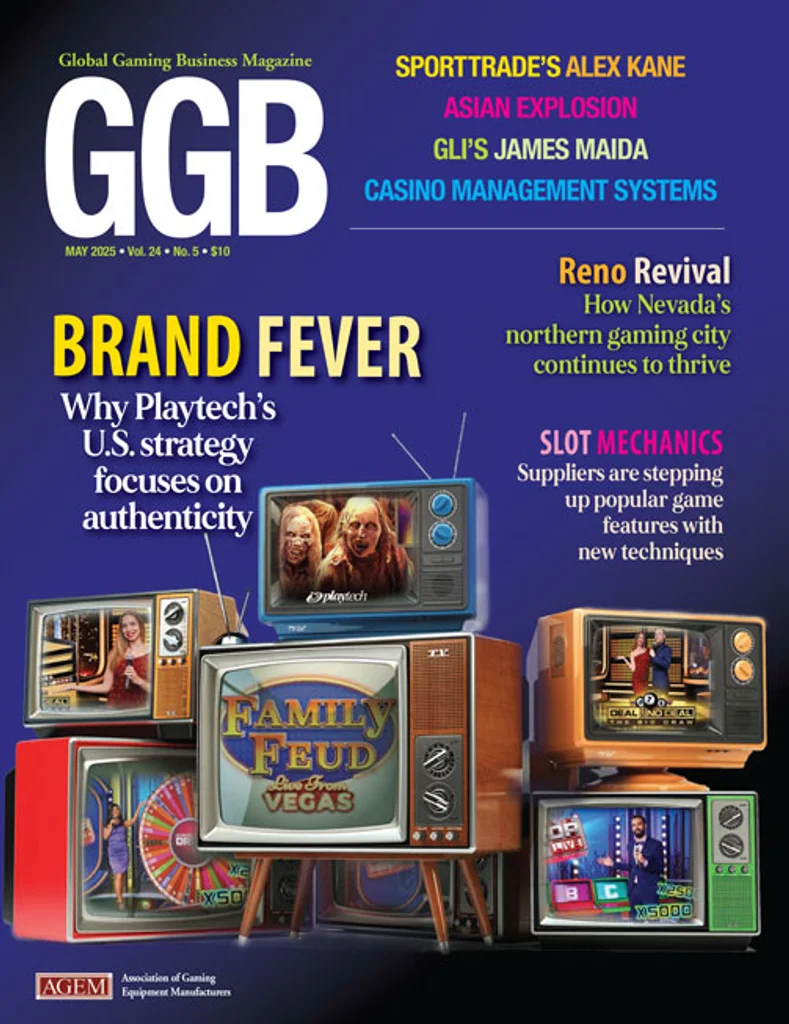
When it comes to game design, it’s Playtech’s job to be bold, especially when an iconic brand is involved. In the U.S. market, it is seeking out deals with studios, broadcasters, athletes, artists and more that enable the supplier to shape interactive gaming content. And it’s building on strong foundations.
In Europe, the supplier has worked with iconic partners—from Marvel and DC Comics to more niche partners including jockey Frankie Dettori. That gives Playtech its own combination of experience, performance, global reach and strong relationships.
Playtech, of course, offers a range of solutions from across multiple channels, spanning sports betting, platform and slots, and Shimon Akad, Playtech chief operating officer, believes leveraging that experience working with top-tier intellectual property owners is crucial as it expands in the U.S.
“Central to our strategy for U.S. growth is Playtech’s commitment to delivering top-quality gaming experiences,” Akad explains. “By collaborating with leading brands and licensees, we are introducing the most engaging and innovative products, technologies and brands to new markets and audiences—expanding our reach not just within the U.S., but on a global scale.
“Our ability to connect intellectual property with audiences worldwide is driven by exceptional game development, as well as our incredible partnerships with operators,” he continues. “We take pride in creating games that authentically capture the lore and worlds that fans cherish, and our longstanding success demonstrates that we’ve been doing this effectively for many years.”
But for the supplier, creating slots using third-party intellectual property isn’t just a brand licensing deal. Far from it.
After all, “a brand licensing deal” suggests something static—a T-shirt or a coffee mug with a well-known character or logo emblazoned across it. What, then, is Playtech doing with its partners?
“In gaming, we’re entrusted with dynamically interpreting IP, often more than once, across multiple games set within the same universe,” explains Aaron Berndtson, Playtech’s head of strategic partnerships and entertainment, U.S. “Whether it’s new artistic interpretations, or usage of official video and audio clips and still photography, the process is far more involved and meaningful than a simple static licensing arrangement.”
Careful Handling
Authenticity is key, and a genuine partnership between the IP owner and Playtech is the only way to achieve this, its team argues. It’s far from a hands-off process, and instead one in which the owners play an active role.
Sometimes it’s a case of hunting down specific opportunities and pitching Playtech’s capabilities. Sometimes, brand owners have a vision and want a partner capable of bringing it to life. That is something Berndtson particularly enjoys, seeing it as an opportunity to expand the fandom using Playtech’s platform.
Take Playtech’s partnership with Fremantle to develop games based on Family Feud. Fremantle’s executive vice president for partnership solutions, Erika Gadecki, says the studio wanted to ensure Playtech’s team members could “capture the essence of the show and what has made it a huge success on TV,” and the level of access they provided shows their investment in the project.
After almost 50 years on air for the game show, there was plenty to draw from, but sitting through some reruns isn’t enough. Fremantle went as far as inviting Playtech’s team to Atlanta to watch the filming of Family Feud.

“This enabled the game developers to closely understand and interpret what they could incorporate into the game,” Gadecki explains. “From small set elements to lighting changes, sound effects, presenter inflections at key moments, all the nuances of the show and the secret sauce was shared, extracting the carefully crafted DNA from the show.
“Playtech then took this into their world, bringing the Fremantle team along with them on that journey with regular update meetings that kept everybody in the development process.”
That, she adds, ultimately maximizes both companies’ strengths. However, the next iteration of this partnership—combining live dealer play and an in-person experience—remains under wraps for now.
Breathing New Life into the Undead
If Family Feud presented an opportunity to revitalize a beloved game show, AMC’s The Walking Dead required Playtech to convert an intense, action-packed drama into a thrilling slot experience.
“The process for the IP has always been the same, which is, how do you translate these sort of thrills and the danger of The Walking Dead into a game like this?” says Clayton Neuman, vice president, head of games and franchise for AMC Networks.
“It’s really just about focusing on iconic characters and their relationships—Rick, Michonne, Carol and Daryl—placing them in the context of these unforgettable moments from the show and then pairing that with a proven mechanic that works.
“What it really comes down to is a collaboration between AMC and Playtech, where we bring our expertise in the IP and the show, they bring their expertise in the mechanics. It’s a conversation and it’s compromise and it’s figuring out what works. And thankfully, it’s been a really fruitful collaboration.”
Berndtson adds that The Walking Dead is a well-established franchise with significant brand recognition, not to mention a heritage in slots, whether that’s as a land-based game, free-to-play gaming or online casino. Crucially, it continues to grow—the core series finished in November 2022, but six spin-offs have emerged to continue that show’s storylines.
“We entered this really great second chapter of The Walking Dead universe where the mother series has ended, but now we’ve launched three new series that focus on fan-favorite characters and put them in unique environments, and we’re telling new stories with that,” Neuman explains. “So while it is something that’s well established and recognizable, it’s also something that we can create new content based off of, and it prevents it from getting stale.
“At the same time, next year is the 15th anniversary of The Walking Dead’s premiere, on Halloween, actually,” he continues. “So we’ve got 15 years of content, and we can tap some of those earlier seasons, tap into that nostalgia that people feel for the early days of the show.”
In his eyes, this offers the best of both worlds, as opposed to something that’s purely trading on nostalgia or something that’s new and developing such as ongoing TV shows.
Getting On with the Show
With Banijay’s Deal or No Deal, the challenge is heightened. Unlike Family Feud, the formats are widely mined by the industry, without scope to innovate around the product. Unlike The Walking Dead, there isn’t an ongoing and evolving franchise to renew the offering.
The Deal or No Deal brand in particular has been widely used since the earliest days of iCasino in Europe, to the extent that the senior vice president of gaming and gambling for Banijay Rights, Mark Woollard, admits it’s difficult to find new and exciting ways to repackage the product.
This puts more pressure on Playtech to create something different, which led to Live Deal or No Deal–The Big Draw. The game show’s iconic suitcases are present and correct, in a live-dealer game show format, featuring bingo mechanics to ape the show’s process of eliminating boxes to leave players with their prize.
“Deal or No Deal was made famous as a linear TV format, so when trying to truly replicate this experience, there isn’t a more natural piece of IP than one involving the live studio environment,” Woollard says. “This allows fans to engage in a real-time ecosystem, as if they were playing the actual show.
“We try to allow a partner to do what they do best: develop exciting products while staying close to the core pillars of the IP. We want our collaborators to innovate and keep pushing the limits of our brands while staying close to what the fans want to see.”
Balancing Act
How and what those collaborators can do depends on the IP and its owner, though potential hurdles must be addressed before deals are finalized. It could be talent constraints, or any territorial limitations on where the game can be offered.
Sometimes it goes even deeper—such as if a franchise features an iconic car, for example. That might need a separate license if it is to be featured in a game.
“Of course, it’s always a balancing act,” he explains. “The IP owner is, fundamentally, the proprietor of the property, and we consistently respect their guidelines, boundaries and feedback.
“That said, Playtech is a trusted leader in game development. Not every symbol, aesthetic or mechanic will resonate, but our experience and proven results have earned the confidence of IP owners.”
Not every partnership is a slam dunk. Without naming names, Berndtson notes that some simply haven’t worked.
“The biggest lesson I’ve learned is to never make assumptions—whether you’re the IP owner or the licensee,” he says. “These franchises are cherished because of the creativity and care that shaped them, so when in doubt, it’s always crucial to ask questions and ensure the integrity of the brand is preserved.”
Sometimes, despite everyone’s best efforts, certain brands simply don’t translate well. This could be due to a demographic mismatch, IP fatigue, or even reasons that are hard to pinpoint. “When something isn’t working, it’s better to accept reality rather than trying to force a solution,” Berndtson says.
What do you do in those situations? “If you’re going to fail, fail quickly.”
Blurring the Boundaries
In the last edition of GGB, Bluberi Director of Product Research Allen Schultz pointed out that licensed brands appear to be taking a step back in favor of original titles. He suggested that proprietary themes and brands are superseding licensed brands on casino floors across the U.S.
But to Playtech, strong brands are absolutely crucial for the nation’s nascent iCasino market as entertainment breaks out of the TV and movie screens to new channels and formats. “While the market is still in its growth phase, the appeal and potential returns are undeniable, making this an incredibly exciting time,” says Akad.
IP in gaming comes in peaks and valleys. “I think right now we’re coming out of a valley and we are hitting the gas pedal on a peak pretty quickly,” he says. He points to how slots based on The Walking Dead and Breaking Bad have climbed the Eilers & Krejcik slot rankings.
“I think it shows that we are leaning into an upcoming peak in IP-based gaming,” Akad says. “The reason we do that is the same reason that our operator partners are interested in it—incredible user acquisition tools.
“You are able to lean into pre-existing universes that people love, and it naturally lends itself to more and more revenue and co-marketing opportunities.”
The fact AMC is extending its partnership with Playtech embellishes his point, with new Walking Dead games to hit the market tapping into the spinoffs and fans’ favorite characters.
“And then, in addition, I think you’re going to see us experiment with some more creative formats outside of the tried-and-true slot mechanics, other things happening through an RNG lens,” Akad adds.
And for Fremantle’s Gadecki, the online marketplace’s development—and IP’s upward trajectory—has prompted the broadcaster to think bigger.
“Working closely with our highly experienced agents in this space, PrimeTime Play, we have been keen to explore partnerships with the best of the best so that our brands are treated with care, ensuring faithful representation of our assets within a new environment,” she explains. “Our Family Feud partnership with Playtech is a great example of this.
“When you consider the combination of their pedigree and market-leading live game development capabilities, plus their global reach, plus our global entertainment brands, you start to see how powerful the partnership can be.”
For Berndtson, this is evidence of the “remarkable” transformation in entertainment, and how it is consumed.
“The boundaries between gaming and content are continuing to blur,” he says. “Interactive experiences built around iconic worlds and cherished characters are shaping the future of entertainment.”