Engagement Points

How kiosks shape the casino experience
A casino-goer wandering the floor will inevitably see the typical sights—the clattering of chips at the tables, the vibrant colors of slot machines, and the ding ding ding of a winning spin somewhere in the labyrinthine rows of machines.
The kiosks scattered throughout a casino property and the associated resort are less obvious but no less important. Kiosks keep a casino patron’s experience smooth and seamless. They’re a core part of the ecosystem, and they have to serve a hyper-specific role on the floor. GGB spoke with three kiosk experts to understand the ever-evolving role these machines play in the modern casino experience.
Redefining the Kiosk
Victor Newsom, senior vice president, product management and payment solutions at Everi, emphasizes the importance of a widening definition of the word “kiosk.”
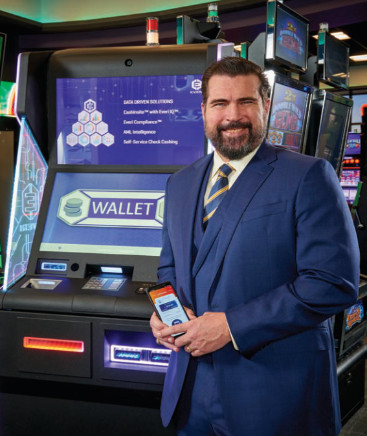
“Typically, you think of a box that has certain components in it, and that box does something, whether that’s ticket redemption or bill breaking,” Newsom says. Naturally, the boxes Newsom mentions don’t adhere to specific formats, especially in the digital age.
“We’ve seen form factors shift from just a box to a multitude of sizes. I have, for example, a printer and a POS terminal at a gaming table. It has all of the software and capabilities of a full financial kiosk right there at the gaming table. So, a miniature kiosk.”
Self-service and other capabilities are more broadly distributed across the casino floor, thanks to the shifting form factors.
Paul Allen, director of product management for Pavilion Payments, further cements this idea by highlighting the various services that help operators keep customers happy.
“We leverage our VIP Preferred ecosystem to deliver seamless and secure transactions,” Allen says. “It’s a comprehensive suite of services, including secure check processing, flexible deferred settlement options, and an extensive suite of iGaming products. VIP Mobility, our cashless app solution, enables patrons to fund their play through their mobile device.”
The goal of these combined services, whether in a kiosk or a mobile device or both, is to create a hassle-free environment in which operators can develop a seamless player experience.
Francis Keyser is Everi’s senior vice president of product management. He oversees the company’s UX division across various areas, including fintech and loyalty.
“I think the word kiosk is outdated, to a degree,” Keyser says. “I think about these machines and capabilities as engagement points. What is the engagement point of that customer, and how should I service their needs at that point?”
Reframing the idea of a kiosk this way can enable casinos to widen their perspective beyond the casino floor. Sure, the machines will stay, and they’ll allow in-person engagement points for customers on property. Off-property, a customer might be able to use their phone as an engagement point even without the hardware of a physical kiosk nearby.
With a fresh perspective on what comprises a kiosk, companies like Everi and Pavilion can iterate on core functions and features to elevate the experience for customers and players alike.
Time is of the Essence
“While it sounds contradictory,” says Allen, “the goal of a kiosk is for the user not to spend time on it. I like to think of the experience like a round of golf: the less strokes, the better the game.”
Kiosks should allow patrons to get in and out with as few steps and taps of the screen as possible, so simplicity is key.
“The vital step is to make sure those features are not confusing or hard to use,” Allen says. “That way, you lessen time on the kiosk and increase time on the floor. You must research and understand if new features are ones that people actually need and can actively use versus just a cool-sounding idea.”
Keyser agrees, noting that an all-in-one kiosk with a myriad of functions sounds great, but in practice doesn’t serve the right purpose.
“If you create an all-in-one unit, you’re going to have one person at a kiosk for an hour,” Keyser says. “They’re going to be doing everything they want to do—buying tickets, getting money, booking rooms, etc. You don’t want them at a kiosk doing these things for valuable time that could be spent on the floor or at other amenities. You want them to go up and complete that transaction for that moment.”
The obvious comparison here is slot machines. An EGM should have features that keep a player interested and don’t require them to get up if they want to keep playing. One example is the advent of charging ports or wireless charging pads built into a cabinet.
Kiosks, on the other hand, should include features that streamline whatever process they’re meant to assist with.
Newsom’s team takes this to heart in product design and functionality. “If we want to minimize time engagement on a casino floor, we might support a standard stand-alone ATM,” he says. “The normal business course will see that ATM do 300 to 3,000 transactions per month for a smaller ATM-only machine. Meanwhile, our biggest kiosks—the large ones you see in the center of a casino floor—might do 50,000 transactions per month.”
This point doesn’t just come down to a user’s time spent at a kiosk. The software and hardware relationship is key to optimizing a kiosk and, in turn, allowing customers to quickly accomplish their current tasks.
Worlds Collide: Software and Hardware
A physical casino floor contains entire ecosystems of hardware and software. Every point of contact for a casino patron has some sort of software behind it, be it a slot machine, a table game with a progressive jackpot, or a self-service payments kiosk. The interplay between software and hardware is incredibly important when a casino wants a machine to meet certain benchmarks or fulfill specific goals.
Software needs to be easy for the end user to grasp, and kiosks always have two end users: the operator and the patron.
“For operators, we try to break down that experience by module,” says Keyser. “So, instead of having to see everything all at one time, what are you trying to do right now? Set up a promo, run a campaign, run a drawing, work on your branding? We try to make each of these things (and other functions) feel like its own distinct experience for the operator.
“On the digital side of things, whether it be cash access, digital products, loyalty cash, or loyalty products, how can I create engagement for them? How can I create excitement? How can I create welcoming messages like, ‘Welcome to the casino?’ These are the new things that you can do. Please try them out, because you also have a shortage of employees. How can I take some of that load off the casino?”
Casino players require a slightly different approach.
“We boil it down to the most common things a player wants to do,” Kesyer continues. “Then we put those toward the front end of the design while also making them as entertaining as possible.”
 To Allen and Pavilion Payments, the hardware-software relationship is supportive and symbiotic. “You have to use each as a tool efficiently to make a cohesive and beneficial product,” Allen says. “Without patented and copyrighted Bluetooth Low Energy (BLE) support on our bill acceptors, we wouldn’t be able to provide such low-friction cashless gaming options in our VIP Mobility app or offer tablet-powered jackpot processing services that can pay out right through the kiosk.
“The main overlap in needs between operators and patrons are convenience, reliability, and security. Recognizing these needs as actual features is step one. Operators want to clear up cage lines so their patrons can spend more time enjoying the amenities and gaming floor. They don’t want players to lose time at an EGM they’re invested in.”
The marriage of software and hardware can move services previously found at a cage to a kiosk, preventing long delays in a customer’s gaming or entertainment time.
Thoughtful software might seem like a given in our electronics-powered era, but hardware needs to be specific and strategic as well.
Newsom says, “We pay close attention to how a machine is optimized biomechanically to account for how humans interact with devices. We’re looking at details like how you insert bills or tickets with your right hand or take things out with your left. The height of the monitors, the viewing angle, these are all important considerations. We take in as much data as possible to optimize the form factor of a given kiosk.”
Kiosk size and footprint are essential. At a casino, floor space is worth a lot.
Pavilion Payments pays attention to these details when designing its products. The company’s three models have different footprints and features. The LSA 6000, for example, is a small-footprint full-service ATM with various features. The LSX is slightly bigger and adds more functions, such as a coin hopper, card reader, and TITO processing. The biggest model is the LSK 2500, which Allen says is a “large, high-capacity, full-featured kiosk with the same functionality as the LSX4100, but adding significantly increased capacity.”
Constant Improvement
A wide range of products and their associated features can be a real difference-maker for a company trying to sell kiosks. Kesyer says most customer queries come in a similar shape: “Why can’t I just do X?” or “I need to accomplish X.”
The kiosk-maker’s job, then, is to help the customer solve the issue insofar as it can be solved within regulatory, technical and compliance limitations.
 “We’re in over 300 jurisdictions, and each has its own rules,” Keyser says. “All of those variables need to be taken into account. We know the customer is thinking about improving the end-user experience, so we have follow-up questions we explore with them. What kind of guest experience are you trying to construct? What data do you want out of this project? What are your staff’s skill sets?”
Newsom explains that these questions lead to a never-ending cycle of innovation and improvements. “We constantly find ways to tweak what we’re doing to squeeze in another transaction or increase the value of a customer’s hardware investment. There’s always a ‘whoa’ moment when we add a feature, then realize the screen options need to change, for example.”
Companies like Pavilion Payments and Everi incrementally improve over time and release tentpole features as they become available. While kiosks may not be as flashy as their EGM counterparts, they are still a deep well of innovative potential.
Pavilion Payments, for example, is working on a “Wallet-less” solution, which recently received approval from Apple, according to Allen. “A patron will now be able to fund an EGM directly through their phone’s existing payment setup without needing to download an app.”
Kiosks and their inherent functions aren’t going anywhere, but the way customers interact with the engagement points they provide will constantly be changed and improved.