U.S. IN FOCUS


Caesars Taps Jay-Z for Times Square Casino Presentation
Shawn Carter, better known as rapper and entrepreneur Jay-Z, has sold millions of records, performed at the world’s most iconic venues and married Beyonce.
On July 23, though, the billionaire mogul hosted another milestone performance, looking far from flashy dressed in a suit and stuffed into a nondescript meeting room.
Jay-Z’s Roc Nation company is partnering with SL Green and Caesars Entertainment for the Caesars Palace Times Square (CPTS) bid to obtain one of three downstate New York casino licenses. Representatives were on hand for the project’s first community advisory committee meeting.
“I’m trying to reserve myself – it’s a very good idea,” Jay-Z said quietly, searching for the right words. “Very good alignment for us to fulfil the promise of Times Square.”
He added that his proposal “is not coming to compete with Broadway”, as local actors’ unions and theaters have contended. Rather, CPTS would be “additive” to the industry, he said. One of his first calls, he noted, was to Disney CEO Bob Iger to work out a solution to keep “The Lion King” musical at the site.
Caesars is the biggest-name casino operator among the eight bidders, which really might be seven with the Bally’s proposal all but dead due to zoning issues. Caesars, in its presentation, boasted of 53 properties across North America with more than 50,000 employees. This breadth of destination and regional casinos is noteworthy, as Caesars is pitching CPTS as a mix between the two.
It would be a destination luxury resort, but with bare-bones amenities, meant to drive traffic to local businesses. Instead of a new development, CPTS is a retrofit of an existing office building at 1515 Broadway. With fewer than 1,000 hotel rooms, just four restaurants and no retail space, it is among the smallest-scale projects left in the field. Its central Times Square location, though, is the most recognizable.
“The Caesars brand is reserved only for our flagship luxury properties, which is exactly how we are positioning CPTS,” said Brian Agnew, Caesars senior vice president of corporate finance. He later added that CPTS “will be on par with the quality of a destination like Caesars Palace Las Vegas,” but “in a New York way.”
To help sell the community involvement aspect, Agnew revealed that Caesars will expand its rewards program so that members can redeem points at local businesses, an industry first.
“We are creating an ecosystem where all businesses in Times Square become part of this project,” Agnew said. “We just provide the gaming in a converted office building and all of our neighboring businesses become our partners.”
Resorts World NYC Leans into Tax Generation for CAC Pitch
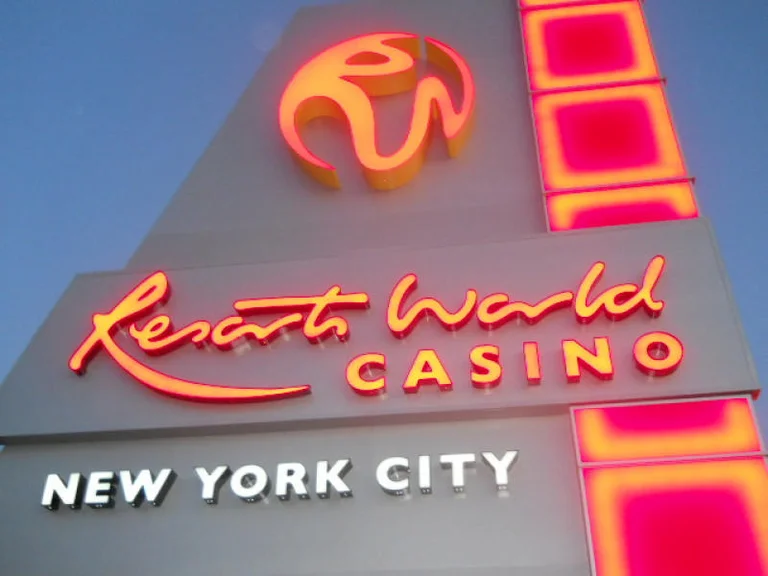
The community advisory committee phase of the downstate New York casino licensing process continued last week, with Resorts World New York City as the latest focus.
Representatives from Resorts World and parent company Genting were on hand to explain the details related to the property’s sprawling $5.5 billion expansion plan, if it is awarded one of the state’s three new casino licenses. Eight bids were submitted last month for the licenses.
Leading the Resorts World presentation was Kevin Jones, chief strategy and legal officer for Genting Americas. Jones explained how, at 73 acres, the former Aqueduct Racetrack is by far the largest parcel of all potential bids. Its location minutes away from John F. Kennedy International Airport was also a focal point.
“Aqueduct offers a scale and connectivity that no other site in New York can match, period,” Jones asserted.
If Resorts World’s bid was to be distilled to just one sentence, it would likely read something like this: “Our existing infrastructure allows us to start paying even more taxes than we already do, quicker than anyone else!”
By far the biggest selling point of the project is the fact that Resorts World is already the biggest direct and indirect taxpayer in New York state. The video lottery terminal facility brings in annual gross gaming revenue of nearly $1 billion annually, and thus has contributed over $4.5 billion to the state in taxes since 2011.
If awarded a full casino license, Resorts World is projecting annual revenue of $2.2 billion by 2027. For almost a year now, the casino has been touting potential tax benefits approaching $1 billion per year. Company officials declined to confirm those numbers Monday and will give more up-to-date estimates in the coming weeks.
Speed to market is also among Resorts World’s touted advantages. When the property was awarded a VLT license in 2010, Genting expanded it more than necessary in hopes of future growth. It then opened a 400-room Hyatt in 2021.
If awarded a license, executives say the property would simply fill out all of its available space with 4,000 slots and 250 tables, allowing it to begin operations by July 2026. That’s a full year before the next-fastest speed to market, fellow racino MGM Empire City, which is pitching mid-2027.
After that first phase, the rest of the expansion facilities would be built gradually over the next five years. By 2030, the finished facility would feature 6,000 slots and 800 tables, which would make it the biggest casino in the U.S. if it comes to fruition.
“No other proposal can come close to our speed to market,” Jones enthusiastically told the committee.
Resorts World’s presentation was flashy, extensive and well-prepared. The combination of the high tax revenue, existing relationship with the state, and speed to market makes Resorts World an apparent frontrunner in the race among bidders. Yet an ugly facet of its business has made news some 2,500 miles to the west.
For multiple years, Resorts World Las Vegas has been embroiled in an anti-money laundering controversy related to multiple illegal bookmakers who were allowed to frequent the resort despite the casino’s knowledge of their background and source of funds. This includes Matt Bowyer, the bookie who accepted action from baseball star Shohei Ohtani’s former interpreter Ippei Mizuhara. RWLV even hired Bowyer’s wife, Nicole, to be her husband’s personal host.
The casino in late March was fined $10.5 million for historic AML failures, which represented the second-largest fine ever levied by Nevada regulators. Former RWLV president Scott Sibella, who was at the center of the scandal, also had his gaming license revoked. Alex Dixon was brought in as president in January, only to be quietly fired and demoted by May.
Cedar Rapids Casino Cleared After Opponent Drops Challenge
The Cedar Crossing Casino and Entertainment Center in Cedar Rapids, Iowa now has a clear runway, after rival Riverside Casino dropped its lawsuit appealing Cedar Crossing’s license. If Riverside is truly bowing out, it would finally provide clarity for the multi-year battle to bring a casino to Cedar Rapids.
When Cedar Crossing was awarded its license in February after nearly a decade of lobbying efforts, Riverside filed suit, saying that a 2021 vote authorizing gaming in the county was unlawful. That argument was rejected in June, and Cedar Crossing is now on track to open on New Year’s Eve 2026. Cedar Rapids Mayor Tiffany O’Donnell posted about the news on Facebook.
“With no appeal filed by Riverside, it’s official: we’re going vertical in Cedar Rapids,” she said. “Watch the casino rise in the coming weeks.”
Titus’ Tax Bill Picking up Sponsors
The FAIR BET Act from Nevada Rep. Dina Titus, which was crafted in response to a provision in President Donald Trump’s One Big Beautiful Bill that capped tax deductions at 90 percent of gambling losses, is continuing to build momentum. The bill now has a total of 10 sponsors, including Titus.
That range of support now includes six Democrats and three Republicans, according to Covers. Florida’s Darren Soto and Pennsylvania’s Chris Deluzio, both Democrats, are the latest to sponsor the legislation. If passed, the bill would restore the previous 100 percent deduction for losses.
The gambling world has been up in arms since the passage of the OBBB, as the loss deduction change seemed to catch the industry off-guard. It would mainly affect a small portion of gamblers who itemize their returns, mostly professionals. But it would force many people to pay taxes on income that wasn’t earned — for example, a gambler with $10,000 in winnings and losses could only deduct $9,000, meaning taxes would be owed on $10,000 of “fake” gross income.
Slot Tax Reporting Threshold Could Raise to $2K Next Year
The $1,200 IRS tax-reporting threshold may be history, according to several interpretations of a clause tucked into President Donald Trump’s so-called “Big, Beautiful Bill” signed into law early this month.
Among the many tax implications included in the federal statute is Section 70433. The segment refers to “Application to Reporting on Remuneration for Services,” or Section 6041(a) of the IRS tax code.
The language raises the reporting minimum from $600 to $2,000, referring to the amount of earnings required to generate a Form 1099, the IRS tax form logging income other than wages, salaries and tips.
The American Gaming Association has interpreted that to include income from gambling that is reported through the W-2G form. Slot players who generate a win of $1,200 or more have been required to fill out a W-2G provided by the casino, which then generates a Form 1099 that is sent to the customer for tax reporting purposes. (Gambling losses can be deducted from that amount to the point where no tax is owed.)
In a statement Tuesday, an AGA spokesperson said the section “applies to any reporting under section 6041 of the Internal Revenue Code. The slot threshold is tied to that section of the code.”
A link to further explain the interpretation is published on the AGA website, found here.
However, some tax experts disagree with the AGA’s reading. In an interview published by Casino.org, Russ Fox of Clayton Financial and Tax said the tax provision applies only to 1099-MISC filers. The filing threshold for a 1099, beginning next year, will increase by $1,400 to $2,000.
The tax reporting threshold for a slot or other gambling win, Fox said, will remain at its current levels (slots at $1,200, keno at $1,500, and table games at $600 when the payout is at least 300 times the amount of the wager). He said the issuance of a W-2G comes under §3402(q) of the Tax Code, which was not changed in the new law. “Thus, beginning in 2026, a W-2G must still be issued at $1,200 for a slot win,” Fox told Casino.org.
U.S. Representative Dina Titus of Nevada has been a big supporter of raising the slot tax reporting limit. She agrees with leaders in the gambling industry who believe the limit should be increased to keep up with inflation.
Although the new threshold could be $2,000 starting in 2026, Titus believes it should be even more. There’s already talk about increasing it to $5,000.
In actuality, $1,200 in 1977 dollars is $6,365 today.
Torch Skill Games Ruled Illegal in Tennessee
A Tennessee appellate court has held that so-called skill games manufactured by Missouri-based Torch Electronics are illegal slot machines.
A three-judge panel of the Chancery Court ruled July 14 in favor of the Shelby County District Attorney’s Office in a case against Torch Electronics, the D.A.’s office said.
Torch manufactures what are called “No Chance Games,” which are similar to slot machines and are often found in gas stations and convenience stores. The company argued that Tennessee’s gambling statutes are unconstitutionally vague, and its machines were not actually gambling devices.
But D.A. Steve Mulroy said the court’s decision affirms that these machines are illegal under Tennessee law, and law enforcement agencies are within their rights to crack down on them.
“The court made it clear: these machines are illegal,” Mulroy said in a statement to Memphis CBS affiliate WREG, “and we have the authority to go after those who profit from them. These operations are not just about games — they’re often linked to more serious crimes like money laundering and firearms offenses. We will continue to enforce the law to protect our communities.”
Bally’s to Rebrand, Relocate Casino Queen Marquette Riverboat
The Casino Queen Marquette riverboat in Iowa will be rebranded as a land-based casino known as Bally’s Marquette, as part of a $21 million overhaul project. Work began on the move late last year, and the new casino is expected to open in early 2026.
Bally’s Corp. acquired the riverboat when it merged with Queen Casino and Entertainment last year, although both companies are technically owned by a hedge fund controlled by Bally’s Chairman Soo Kim.
“We’re proud to honor Casino Queen Marquette’s deep-rooted connection to the community while ushering in an exciting new era as Bally’s Marquette,” Robin Corbeil, general manager of Casino Queen Marquette, said in a statement. “This transformation brings the entertainment experience our guests love onto land — making it more accessible, more comfortable and more dynamic than ever before.”
Atlantic County Receives PILOT Settlement
Atlantic County has received a $15 million settlement from the state of New Jersey after the former sued in relation to tax shortfalls stemming from Atlantic City’s unique payment-in-lieu-of-taxes program.
The county successfully argued that the system, through which casinos pay property tax based on GGR, was not generating as much as a typical system would. This was further exacerbated by 2021 amendments that removed iGaming from that calculation. The settlement was reached in April and the state had until August 1 to make the payment, per the Press of Atlantic City.
“We fought for more than seven years to make our county taxpayers whole,” Atlantic County Executive Dennis Levinson said in a statement. “With this settlement, Atlantic County will have received close to $59 million more than it would have had we not challenged the state over the PILOT legislation.”