
The Regulatory Trilemma

Gaming’s approach to problem gambling is difficult and can be designed as a three-legged stool. Supporting each leg can be difficult because every jurisdiction is different. Dr. Kahlil Simeon-Rose explains how regulatory bodies can share thoughts and procedures, but all has to be crafted to the policies of the jurisdiction.

Gaming policymakers are asked to do three things at once: reduce gambling-related harm, preserve adult autonomy, and sustain a viable licensed market that generates public revenue.
From a poor starting point, reform can advance all three. But no regime can maximize all three indefinitely. At the frontier, gains in one require concessions in another. That is the regulatory trilemma.
Policy debates often obscure this point. The narratives should sound familiar:
“New restrictions will protect players while preserving consumer choice.”
“Higher taxes will fund public services without weakening the licensed product.”
“Free markets will increase public revenue without increasing harm.”
Regulatory Reforms
Sometimes reforms to a badly designed system really can improve every goal. Eventually, however, the trade-offs become unavoidable. We see this clearly in some of the business models that are deployed. A government monopoly combines harm reduction with public-revenue maximization, but at the cost of consumer choice and commercial activity.
A “Reno Model”-style approach focuses on harm reduction while preserving individual choice, but it will not nearly maximize public revenue as all parties must invest substantial resources in maintaining the prevention and support systems. A free-market model maximizes liberty and gross revenues, but builds no safety net for harmed players and families.
Of course, these models are reductive archetypes. No real jurisdiction occupies a model perfectly. Just like no single approach is a morally correct answer. Nevada will make a different choice from Norway, and the UK of today looks different from the UK of yesterday. As they should.
Not every jurisdiction should choose the same model and in fact, every jurisdiction should be choosing a different model. A whistle-to-whistle ban on gambling ads in Great Britain reflects their values as much as slot machines in the grocery store reflects Nevada’s, and neither makes sense for Hawaii.
The lesson is not that markets have nothing to teach one another. It is that jurisdictions should borrow mechanisms, not policy packages. Evidence travels; social preferences do not.
A failure to understand this issue is pervasive in academic work, where researchers have often strayed from narrow views on science to naive views on global policy that ignore social trade-offs.
Policymakers should understand their choice, and in doing so, the regulatory task can become more clear and more tactical.
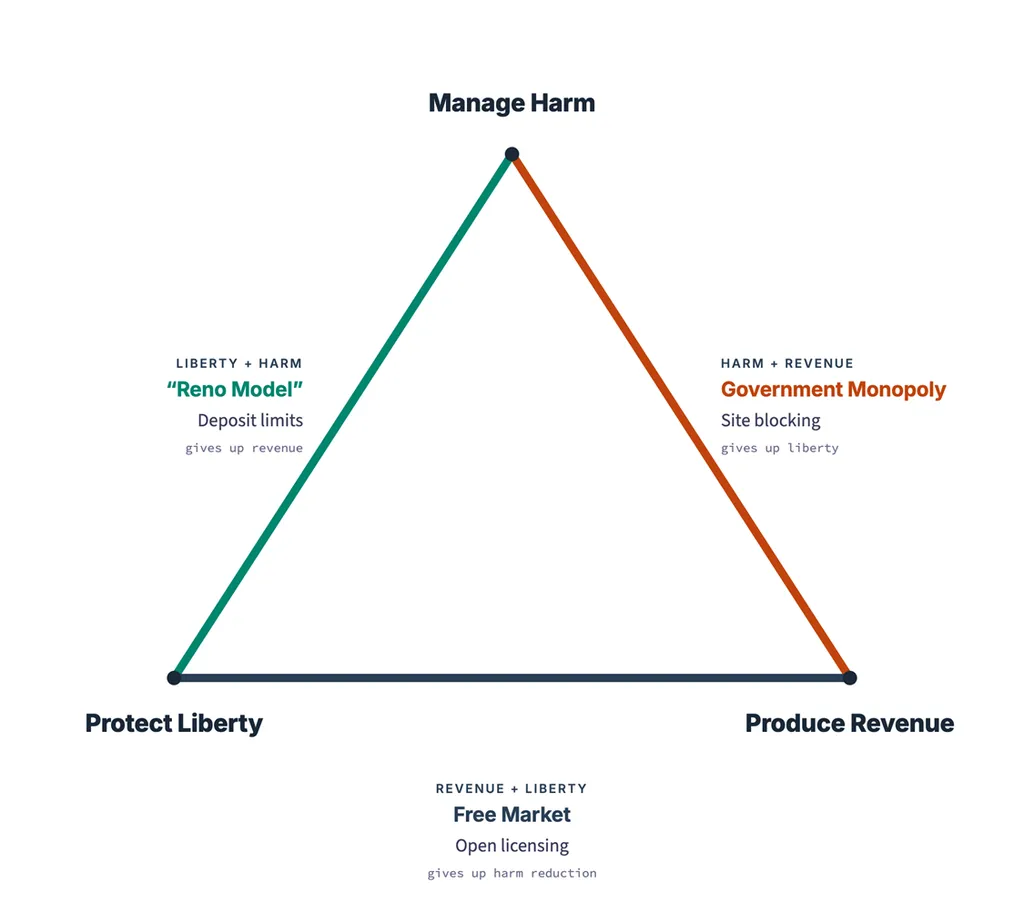
Difficult Choices
Policymakers must choose how they weigh the three objectives. Regulators must then execute that mandate as effectively as possible. With a well-defined mandate, regulators can be sure that their market is “Pareto optimal”—where policymakers can’t improve one objective without negatively impacting one of the others.
Many gambling markets remain well inside that frontier. They tolerate restrictions that reduce freedom without preventing much harm. They prohibit products that consumers then pursue offshore. They layer on new responsible-gaming interventions while ignoring the execution effectiveness of existing programs. These are the areas that need immediate focus and resource dedication.
Consider casino self-exclusion. It is a targeted, evidence-supported intervention for people who actively want help restricting their play. Yet the average program remains poorly understood and administratively onerous. Enrollment can require an in-person visit, confusing paperwork or an unnecessarily punitive process. Exclusion may not travel across operators, products or neighboring jurisdictions. Enforcement is often inconsistent. The underlying policy may be sound while its implementation leaves every objective worse off.
Two gaps recur across gambling markets: too much play takes place outside the licensed system, and too few players engage with the protections inside it.
Protecting the Vulnerable
The first is the channelization gap.
High channelization should be table stakes for any serious discussion of online-gambling policy. In my recent letter to the editor in International Gambling Studies, I argue that responsible-gaming policy should face a two-part test.
First, does the licensed market provide meaningful protections?
Second, how much gambling actually takes place in that market?
Policymakers that devote extensive attention to the first question and almost none to the second are making a serious unforced error. In principle, a demanding regime that achieves only 30 percent channelization can protect fewer consumers than a somewhat less restrictive regime that achieves 95 percent.
Channelization estimates should of course be treated cautiously but imperfect measurement does not justify ignoring an outcome that is fundamental to the success of the entire regulatory system.
Ontario offers a useful, if imperfect, illustration. In 2026, an Ipsos study found that 91.1 percent of surveyed online gamblers reported using regulated sites, up from 83.7 percent a year earlier. Those figures do not prove that Ontario achieved a literal Pareto improvement. They do not establish that aggregate harm remained unchanged, and self-reported channelization estimates have important limitations.
But the direction is difficult to ignore. Competitive licensing appears to have moved a substantial share of gambling into a market with regulatory oversight, responsible-gaming safeguards and public-revenue contributions.
That looks like movement toward the Pareto frontier.
Communication Key
The second recurring problem is the engagement gap.
The subtle part of the regulator’s job is interpreting the social contract of gaming in its market: which parts of the trilemma are priorities, how heavily they are weighed and which constraints are politically nonnegotiable. Once those choices are understood, the task becomes more tactical. Regulators can look for improvements that advance one objective without materially damaging another.
For many North American markets, responsible-gaming communication offers an especially promising opportunity. Most markets can communicate with players in a more useful and engaging way. Clearer language, better timing and messages connected to players’ actual interests can improve decision-making without restricting adults’ choices or materially affecting public revenue.
That engagement gap has motivated my work developing Playbook RG, an open-source system for responsible-gaming marketing.
Most responsible-gaming programs reach only a small share of the people they are intended to help. Depending on the product and jurisdiction, studies suggest that only 1 percent to 23 percent of players use operator-provided tools. In one survey of 4,795 U.S. casino loyalty-program members, only 2.38 percent reported picking up a responsible-gaming brochure and 0.26 percent reported speaking with a GameSense advisor.
Those figures do not establish whether the underlying programs are effective for the people who use them. They show how few players even reach that point. Common tactics often fail a basic adoption test: players must perceive the intervention as both useful and easy to use. Traditional messages can carry stigma, rely on vague slogans and appear at moments when players have little reason to pay attention.
Consumer-first responsible gambling brands like Playbook RG respond with positively framed gambling-literacy content designed for different audiences and integrated into everyday operator practice. The objective is not to persuade competent adults not to gamble. It is to give them information they can recognize, understand and use.
Good regulation begins with political candor about what a market values, followed by disciplined execution. The trilemma cannot be solved. But policymakers can choose their trade-offs openly, and regulators can then focus on moving their market towards the frontier.
Kahlil Simeon-Rose, Ph.D. is an Associate Professor in the Carson College of Business at Washington State University, specializing in gambling studies and public policy.
An active contributor to both policy and practice, Dr. Simeon-Rose has advised courts, regulators, and leading operators on economic and responsible gambling issues globally.