The New Era of Casino Loyalty

Today’s valued players expect more than a comped room or meal. Their rewards lie in access and experiences
Those four pillars comprised the architecture of casino loyalty programs throughout the 2010s.
That era is over.
Those pillars remain in every program, joined by new categories. As a result, the underlying logic of what rewards are for has shifted. It’s no longer just about earning a comp, but about earning an experience. Operators who see the shift are dominating. Those clinging to the 2010s playbook are faltering.
Changing Nature of Comps
The 2010s rewards economy was a comp ledger: comped rooms, buffet vouchers, dining credits and free-play allocation, and tier-mapped offers in the mailer. Each was a fungible form of reinvestment, redeemable on property.
Even upper-tier benefits were comp extensions: the Diamond comped room, the dedicated host line, the waived resort fee. The math was linear: the more a player wagered, the more comp dollars came back, and the more the program kept them coming back. Reward equaled comp.
A loyalty program was a structure for reinvesting in a player in forms the property had available. Rooms it hadn’t sold. Meals it could comp. Free play funded by the marketing budget.
Now that model is falling apart. The math has flipped; costs now exceed benefits. Priorities have shifted, and those who profit value influence or flexibility over money.
Free play has compressed. Pete Landi, founding partner at ESC Strategy Group, has been conducting deep research into Las Vegas players clubs. He frames it this way: Baseline reinvestment in Las Vegas has dropped from around 10 percent in the mid-2010s to roughly 3 percent today.
“It resembles credit-card levels of loyalty: ‘Okay, you made 2 percent cash back. Great,’” he says. “That’s sort of what it feels like.”
Regional reinvestment has been running higher, but is moving in a similar direction. The slot floor is keeping more in parallel: average real holds in Las Vegas have moved from a 6-7 percent budget assumption a decade ago to 11-12 percent today, with high-denom games going from roughly 4.5 percent to 9 or 10 percent. Players are getting less back from a machine that is keeping more.
Meanwhile, Las Vegas hotel room inventory surged. As gaming reinvestment tightened, comp rooms flowed freely. “We’ve ratcheted up to extract more money from every customer,” Landi says. “Now, the only lure left is free rooms.”
In regional and tribal operations, the comped room continues its traditional work, extending play time for time-constrained guests. In both markets, the comped room itself has become part of a bundle that includes waived resort fees, complimentary valet, late checkout and suite upgrades. The comped room is only one element of the package.
The food pillar weakened in Las Vegas as more top-tier restaurants became the norm, while more traditional middle-American dining options remained at regional operations. Food comps now required a bigger wallet to qualify. Even so, in regional markets, the weekly F&B credit (even at upper tiers) began to read as maintenance rather than a benefit.
Confronted by these changes, operators aggressively sought new reward categories beyond their properties.
Cruise Control
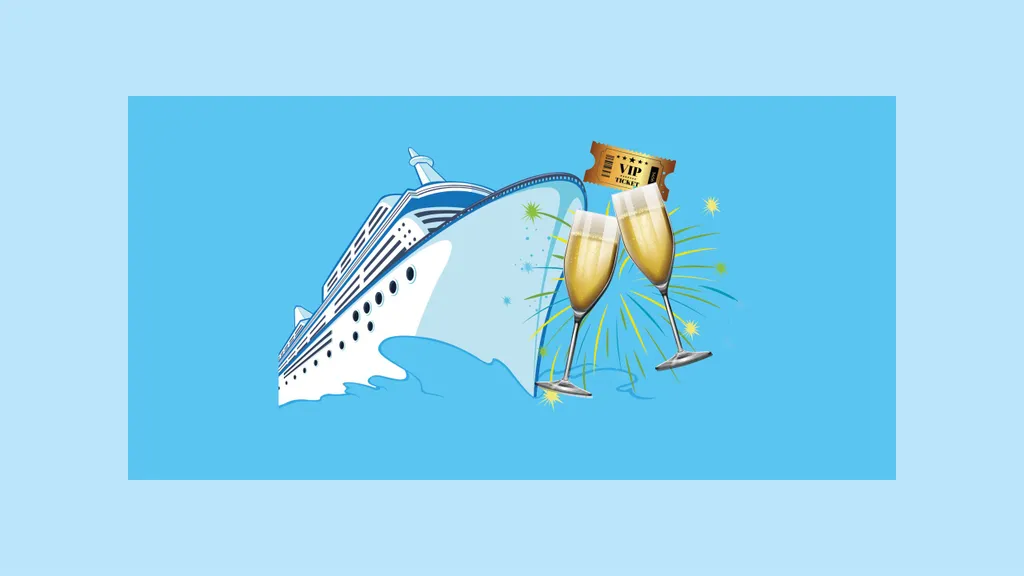
Cruise partnerships are the most under-discussed of the expansions. Landi keeps returning to MGM as a case study. Top-tier MGM players receive annual cruises, which he describes as lucrative. Cruise lines have formed partnerships with casinos across the nation. Operators are now using cruise certificates as tier benefits and special-event hooks.
As the customer’s value increases, so do the accommodations, from interior staterooms to ocean-view and balcony staterooms. A cruise certificate event is seen as a high-value reward, yet costs the casino property close to nothing, typically generating incremental revenue for the casino property through the trip to pick up the certificate.
The category has expanded to smaller regional and tribal operators. The cruise lines have their own acquisition incentives. They need qualified gaming players, and partnering with a regional casino gives them that at lower cost than direct acquisition. A regional client I worked with this year added cruise certificates to upper-tier benefits through partnership work. The reaction from top players was sharper than for any free play offer the property ran during the same period. Cruises have become attractive enough to become a business outside of a typical travel agency. The online platform URComped brokers cruise-certificate programs to operators of any size.
Cross-property partnerships have done something larger structurally. MGM’s relationship with Marriott Bonvoy is a strong example. Thousands of room nights move through the partnership annually with bidirectional point conversion. The Caesars-Wyndham partnership runs the same play with different brands.
Rewards have shifted from comps to experiences. The comped room now arrives bundled with experience layers—valet, suite upgrades, the chef’s table, a cruise certificate.
Network value itself has become a category of reward. Caesars, MGM, Penn and Boyd aren’t selling stand-alone locations. They’re selling a network of locations any cardholder can access. A regional player at Harrah’s Cherokee or Horseshoe Indianapolis earning Diamond status gets the hub-and-spoke benefit when they travel to Las Vegas, New Orleans or any preferred destination. When Landi’s in-laws, who play at Beau Rivage in Mississippi, flew out to stay at Aria, the property bumped them up to a panoramic suite. The Mississippi spend paid for the Strip room. The Vegas spend pays for the next trip back to Mississippi.
For stand-alone properties, the response is to partner with destination casinos. The regional property partners into Las Vegas rather than the chain network feeding out. Iowa-based Wild Rose Casinos added Vegas trips through a partnership with Circa last year.
You’re Invited
Another rapidly growing category, though less visible from outside any single program, is event invitations as tier-guaranteed rewards.
Event invitations used to be at the host’s discretion. A host with a budget for a player party would compile a guest list from recent play and send invitations. Inclusion was based on who the host knew and on what the player had been earning.
That model is largely obsolete at the chains. At top tiers, event access is tier-mapped—structural, not discretionary. Reach Diamond at Caesars, you’re guaranteed event allocations. Advance access. Reserved tickets. Confirmed seating. Sphere allocations. F1. Championship fights. Strip property exclusives. Invitations are a tier-given right, not a host’s whim.
At regional and tribal scale, the model is expressed differently. Cruise certificate events. Private chef’s tables. Host-led backstage experiences at touring acts. Property anniversary events. Dinners with the president. In each case, inclusion is tied to tier achievement, and the player understands the invitation as a benefit of their loyalty rather than a one-off gift.
This shift is important, because it redefines the nature of the reward. Instead of focusing on a comp dollar at an event—a free meal or a free play voucher—the true reward is now the invitation itself. Access and recognition are the new currency. It serves as evidence that the player has reached a level where the property values their presence enough for exclusive experiences.
“Undifferentiated programs yield undifferentiated results.”
Chris Province, founder, Player Performance Group
Rewards have shifted from comps to experiences. The comped room now arrives bundled with experience layers—valet, late checkout, suite upgrades, waived fees. The comped meal is now a chef’s table. The cruise certificate (or Vegas trip) is the experience. The Sphere ticket or suite at a headliner concert is the experience. The host call has been augmented by the event invitation, which is now an experience the player counts as a benefit of their tier.
The 2010s rewards programs tallied earned comps for players. In the 2020s, loyalty programs are built around experiences. This fundamental shift means program designers must now ask, rather than how much comp the player earns, what unique access and experiences are we offering to recognize and retain top players?
This evolution raises an important question: What happens when everyone starts using the same reward formula?
Opportunity in Differentiation
Read the lineup of new categories and notice that within any given competitive set, the menus look structurally identical. Competitors are often running parallel playbooks. The differentiation the expanded menu was supposed to deliver has been competed away by the speed of imitation. “Undifferentiated programs yield undifferentiated results,” quips Chris Province, Player Performance Group founder.
He pairs the diagnosis with a number worth considering. In most casino databases, 90 percent of revenue comes from the top 10 percent of players. Recently, I pulled a decile report for a regional client and found that 30 percent of revenue was concentrated among 17 players. The curve is steeper in smaller markets than the industry-wide accepted 80/20 rule.
“Our industry’s critical error? Thinking every player belongs,” Province says. “The top performers build ‘glass doors,’ or properties that control which players are on the property at any given time. Varying offer flights. Selective offer suppression. Private player events when the math says so. Glass doors yield the entire asset base—not just rooms and restaurants, but every seat on the gaming floor.
The opportunity lies in differentiation. Chains now offer similar partnerships and event allocations, making it difficult to stand out. Regional operators who are first to introduce cruise events, Vegas giveaways or tier-based event invitations can capture competitive advantage before others follow.
The client I mentioned earlier is leaning into this. Faced with new competition opening at year’s-end, the response wasn’t to flood the market with free play. That’s not the defense of a community casino. Instead, the response was to layer Vegas trips, cruise certificates and accelerated tier progression into the upper-tier benefits, categories no other property in the market currently offers.
Combine that with what Province calls the personal touch: “We can reach out and invite our best players to the property for something special and to pick up a voucher for an amazing cruise, a fresh pair of summer sandals or personalized leather luggage tags.” That’s a differentiation argument the property didn’t have before.
Reaping the Rewards
The original four categories haven’t gone away. The logic underneath them has.
Rooms, food, beverage and free play are still part of every program, and new categories have joined them. The change that matters most is underneath the menu, not the menu itself. Rewards have moved from comps to experiences. Operators who understand that shift are designing programs that earn access, invitations and curated experiences. Operators who don’t are still allocating comp dollars against ADT and wondering why the math isn’t delivering retention the way it used to.
The four pillars will still be part of loyalty programs in 2030. So will the new ones. What will separate winning operators from those sliding is whether they build their program as a comp ledger or as an experience portfolio.
Undifferentiated programs yield undifferentiated results. A bigger menu doesn’t change that math. It just gives operators who understand the shift more ways to win, and those who don’t more ways to be the same as everyone else.