Self-Exclusion: Does It Really Work?


For Americans of a certain age, the phrase “Just say no” brings to mind former first lady Nancy Reagan, urging young people to avoid drug use. The message flooded newspapers, magazines and the airwaves in the 1980s, simplifying the complex issue of drug abuse into a catchy phrase. While memorable, the campaign had limited success in the war on drugs.
With the explosive growth of gaming—especially online—self-exclusion is a simplified message to help problem gamblers. Does it really work?
That depends, say researchers and counselors. Evidence suggests self-exclusion alone is not as successful as more robust treatment programs paired with long-term exclusion.
The U.S.-based National Council on Problem Gambling (NCPG) defines the disorder as “gambling behavior that is damaging to a person or their family, often disrupting their daily life and career… Gambling disorder is a recognized mental health diagnosis.”
According to the NCPG, 2.5 million U.S. adults (1 percent) are estimated to meet the criteria for a severe gambling problem in a given year. Another 5 million to 8 million (2-3 percent) have “mild or moderate gambling problems” resulting in an estimated national social cost of $14 billion.
Research shows the longer someone self-excludes, the more success they have in recovery. It supports the use of self-exclusion as a tool when paired with other methods such as intervention, counseling and therapy. It also advocates reducing barriers to self-exclusion and treatment—for example, simplifying the actual self-exclusion process and providing insurance coverage for treatment. Taken together, these tools help people spend less to gamble, and decrease the need for formal treatment.
But legislative or regulatory action is needed to close the loopholes that currently prevent the formation of a simplified, national process.
Much like drug abuse, problem gambling knows no boundaries of age, race, sex, religion, socioeconomic status or other factors. “Just saying no” isn’t always easy to do.
The concept of self-exclusion is simple: Remove the person from the temptation or the temptation from the person. That can be difficult, as Jaime Costello, director of programs at the National Council on Problem Gambling, explains.
“I always use the example of, ‘I eat a lot of chocolate,’” she says. “If I could just get the one store in my town to stop selling me chocolate, I would be OK. When I drive to another town, I can get some chocolate, but sometimes I would say, ‘It’s not worth it.’ It reduces that temptation.
“Unfortunately, often the majority of people that use (self-exclusion) are far along and really struggling with their gambling.”
Not All Self-Exclusion Schemes Are Equal
When the concept of self-exclusion began around the turn of the 21st century, individuals who felt their participation was getting out of hand had to go to each casino in their vicinity and ask to be banned. If they missed one property, well, they could still gamble in that facility.
In 2018, the United Kingdom launched the first national multi-operator online portal, GamStop, where players could self-exclude from apps and websites with just a single request. Sweden and Australia soon followed.
One of the most successful self-exclusion schemes in Europe is CRUKS, the Centraal Register Uitsluiting Kansspelen, a self-exclusion system and database in the Netherlands. “Anyone registered in this system cannot gamble anywhere in the Netherlands,” explains Ilan Sluis, senior spokesperson at Holland Casino, the Dutch state-owned company with a legal monopoly on gambling in the country. “You can register yourself, or an operator can register you compulsorily.”
Self-exclusion terms are six months, one year or five years. In many states in the U.S., self-exclusion can be a lifetime ban if requested.
Much as the European Union is a political and economic union of individual, sovereign nations, the United States is a nation of individual states, each with its own leadership, culture and populace. In both the EU and U.S., that individuality means a hodgepodge of laws, rules and protocols around the process of self-exclusion. A national or international database of self-excluders does not exist. Each state or sovereign nation, including tribal nations, is siloed from the rest. Implementation also differs by platform, with online apps and land-based casinos providing different levels of ease and effort.

“If you’re self-excluded in New Jersey, you can drive to Pennsylvania and play at a casino there,” says Jonathan Aiwazian, founder of idPair, a technology company created to promote responsible gaming with advanced data anonymization, security and analysis. “(Self-excluding) didn’t really solve your problem, which I believe is a reason that people don’t even sign up, because they know, even if I sign up, there’s X casino or Y casino 10 minutes across the border.”
And if the process isn’t simple? “I’m not going to sign up for two states,” says Aiwazian. “I’m not going to drive over there and sign up in person like you have to in Rhode Island. I’m not going to go to law enforcement and self-exclude like you have to do in Louisiana. It’s very difficult for someone to get comprehensive protection with self-exclusion in its current form.”
Even in Nevada, players face difficulty self-excluding. The state does not have a mandatory, statewide self-exclusion list for land-based casinos, but rather a self-limiting process that lets people opt out of things like direct-mail marketing that would encourage gambling. Someone who wants to self-limit can still enter casino gaming areas. And they need to replicate the process at each facility to opt out.
One Gambler’s Story
“I never went through that process,” says Ted Hartwell, director of storytelling and development at the Nevada Council on Problem Gambling and a recovering problem gambler.
Hartwell seems the antithesis of the stereotypical problem gambler. Arriving in Las Vegas in 1991 out of graduate school with degrees in anthropology, Hartwell was hired by the Desert Research Institute, a nonprofit environmental research organization. He came from a family of professional musicians and was a cellist himself. He was a founding member of the Las Vegas Philharmonic.
And he had been gambling since he was 10.
“My father is the one who introduced me to a lot of different types of gambling, and we know today this is a major risk factor for developing a gambling problem later in life,” Hartwell says. “And while that didn’t happen until really, I guess, my late 20s, the first problematic behavior where I started to use gambling to escape was I developed a really weird voice disorder. I’d been singing semi-professionally until that time, and over the course of about a year, I was no longer able to lecture comfortably. I could no longer sing, and I would isolate myself playing video poker.”
In the early 2000s, Hartwell’s habit turned into a full-blown addiction.
“When I first came clean to my wife, I was abstinent for several months and used that as my proof to myself I could control it. Then I very quickly repeated that same pattern. The only thing that was different during the next year was that the hidden debt was about three times what it had been the previous year. And that second year, I went through a similar process. Came clean to my wife, said, ‘I’ve been gambling again.’”
Hartwell tried an approach that involved therapy. “I went to a few appointments, and for a third time, repeated this whole thing, being abstinent for several months.”
But the third time was the charm for Hartwell. “A therapist who had a background specifically in gambling disorder connected me to the organization that today is known as the Robert Hunter International Problem Gambling Center here in Las Vegas. It’s an intense six-week program—about four hours a day, four days a week. They required minimum attendance to at least three 12-step meetings a week as well—so, fairly intensive and fairly successful. In my case, I haven’t made a bet since September 14, 2007, which is right before I entered that program.”
Treatment after his “abstinence” was critical in his recovery. But without the initial step to self-exclude, the process is harder—particularly in Nevada. “I think people are shocked to come here and try to self-exclude generally and find out there isn’t a process to do that one thing,” Hartwell says.
Self-Exclusion Alone Likely Not Enough
What is often left out of the self-exclusion discussion is the role of therapy and support.
Sluis said that, along with self-exclusion, people in the Netherlands are referred to counseling. “We also run a pilot where we pay for the consultation,” he wrote. “Sometimes, during a personal meeting, we directly refer the guest to counseling, even calling on their behalf to ensure immediate help.”
And while CRUKS can be successful, one of the biggest shortcomings of the program is concluding it. “Operators (online and land-based) cannot see when the exclusion period has ended,” Sluis wrote. “Holland Casinos has repeatedly requested this information from the regulator so we can conduct a follow-up conversation before allowing the guest back. We always hold a personal conversation before deciding whether it is responsible to allow play again. These return-to-gambling conversations are standard when self-exclusion was requested or imposed.”
Elliott Rapaport is founder of Birches Health, which treats behavioral addiction. Watching a friend struggle with compulsive gambling inspired him to found the company. The growth of the gaming market over the past decade has increased the need for specialized treatment, he says.
“We tackle our population health models in many ways, as in, we’re thinking about what an individual treatment plan looks like for a single person,” Rapaport says. “We need to think about what it means for the hundreds of millions of individuals across the U.S. today. The majority of them may be engaging sustainably in gambling and online sports betting, but there will always be those who can’t. That’s who we exist to serve.
“The American Psychiatric Association says 28 percent of adults actually have a daily habit of gambling online,” he continues. “That segment of the population is set to grow over the next five years. We exist in a world where consumers are actively placing bets 24/7. That’s merely the entry point for many Americans” who are seeing the gamification of financial trading apps, cryptocurrency platforms and even slot machine-like mechanics like loot boxes in video games for children.
Rapaport says Birches Health has created an ecosystem with partner organizations across the U.S. to ensure people seeking treatment for gambling addiction can get the specialized care they need—the key being partnerships with major insurance companies like United Healthcare, Cigna, Aetna and Blue Cross Blue Shield. He says Birches works with Fanatics, the PGA Tour and NASCAR along with state and local governments to lower barriers to help.
In an ideal world, Rapaport says, the act of self-excluding should be as easy as creating a profile on an online gaming app.
“Not every individual who self-excludes will actively seek out treatment. For every individual who self-excludes, treatment and the ability to speak with a licensed specialist in gambling addiction is very important, whether or not once they’ve self-excluded, they’re in crisis, as perhaps they might be when making the decision to self-exclude.
“It’s very important to have a treatment provider available, and especially a treatment provider that offers clinical treatment in 50 states, covered by insurance.”
Encouraging Self-Exclusion
In sporting events on television, online or in print, it’s hard to escape advertisements enticing someone to place a bet. Players can self-exclude from an app or casino, but turn on a football game and countless ads for betting platforms overwhelm the ads for chicken wings or beer.
If someone were to look online for treatment, search algorithms might display gambling ads or discounts based on past searches.
There are options out there to help people self-exclude. The Responsible Online Gaming Association prepared guidelines for VIP player management with the intent of creating a cohesive responsible gaming approach for online play. But they are just that: guidelines, not rules.
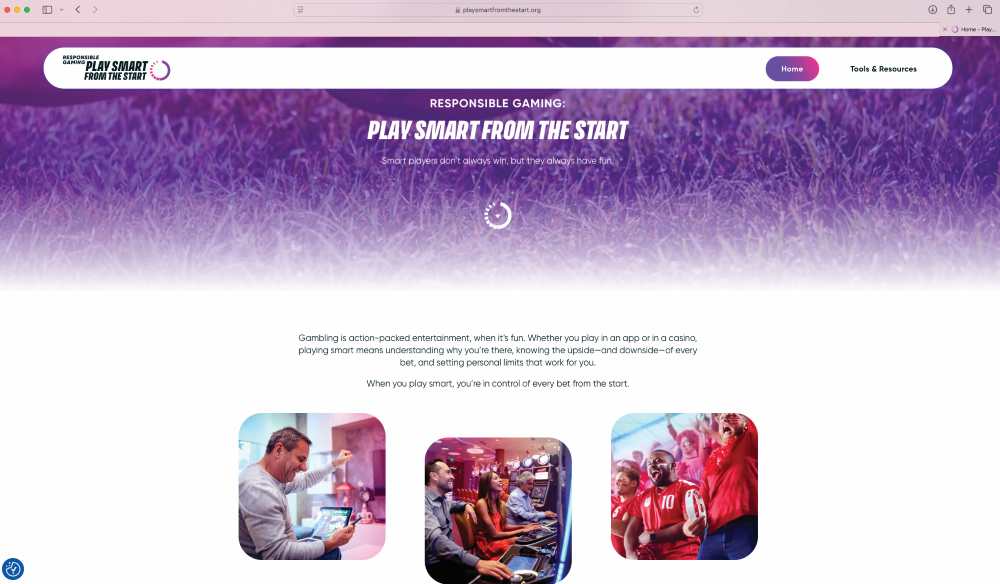
In June 2025, the American Gaming Association launched its Play Smart consumer hub to promote responsible gaming. It includes tips on safe play and easy access to support tools including the National Problem Gambling Helpline (1-800-GAMBLER) and state self-exclusion options. Since the launch, the AGA reports more than 59,000 views and more than 2,200 interactions with the site’s tools.
The National Voluntary Self-Exclusion Program, whose mission is “to provide a unified, accessible and effective self-exclusion solution that empowers individuals to make responsible choices about their gambling activities across multiple jurisdictions,” is a collaborative developed by state gaming regulators, problem gambling advocates and industry stakeholders. It was developed and is operated by Aiwazian’s idPair. He doesn’t see it as a way to shut down gamblers no matter where they are. Rather, it gives them control over their play and their data.
“If you sign up for self-exclusion, you should have control over where your data goes,” Aiwazian says. “It shouldn’t be something where you sign up for self-exclusion in New Jersey, then go to Nevada, walk into Caesars and find out you’re self-excluded. It should be something where you actually decide where your information goes, instead of having it go to this national database, so you suddenly can’t do anything you want to do, even if you didn’t have an issue (gambling) with casinos.”
The key is to assist people looking to self-exclude, he says. “If people can choose how the exclusion works for them and what’s relevant to their needs, I think that will increase participation.” In this way, self-exclusion and the tools supporting it are less of a scold than the old “Just say no” program, and more of a first step in support for those who need it.