
Japan: Still the Promised Land?

Ten years ago, Japan was considered gaming’s next mega-market and a likely challenger to Macau. A lot has happened since then, including Covid-19. What’s next?
It’s one of the most recognizable silhouettes in the world: Singapore’s Marina Bay Sands. The tri-towered monolith, which opened in 2010, is also one of the industry’s biggest moneymakers. Last year, it helped propel the Las Vegas Sands Corp. (LVS) to the top of the heap for global gaming revenue (US$13.7 billion).
Hard to believe, then, that LVS boss Sheldon Adelson once described MBS as “a warm-up” to his ultimate prize: an integrated resort (IR) in Japan.
Following the 2018 passage of IR legislation in Japan, brokerage CSLA projected annual revenues in the $40 billion range. That was the starting gun—soon gaming’s biggest operators hit their marks, angling for a piece of the new market.
Like LVS, Wynn, Melco, Galaxy and Genting were prepared to spend billions on a Japan IR. But ultimately, they all bowed out, citing factors that seriously inhibited the return potential. Like a cap on gaming floor space (just 3 percent of total resort footage). A relatively high tax rate (30 percent, 15 percent of GGR to the central government, and 15 percent to the host prefecture). Daily entry fees for Japanese gamblers (6,000 yen, about US$38). And regulation limiting locals to 10 casino visits per month.
In addition, IR proponents failed to persuade their constituents that casino gambling could be a good thing—an “axis of future growth,” as late Prime Minister Shinzo Abe once said. Despite the promise of billions in investment and tourism, opposition to the industry was widespread and entrenched. As Japanese engineer Koishi Toda observed, the IR plan “failed to resonate with the public because it placed profit before purpose.”
The plodding pace of government deliberation didn’t help, and only frustrated would-be investors. “Sands and Wynn build nice big things that cost a lot of money—they’re quick to back out when the government gets in their way,” says Scott Fisher, Ph.D., co-founding partner of Convergence Strategy Group. “If the return on investment isn’t great, they’ll go elsewhere.” And that’s just what they did.
Covid-19 dealt the decisive blow, striking a year after the legislation was enacted. The global crisis caused a surge in online gambling that had a chilling effect on land-based investment, at least in the short term.
“At some point the scales were tipped to say, ‘You know what, this is not looking like a great opportunity.’ Every major gaming developer walked away.”
—Andrew Klebanow, Klebanow Consulting
Even so, Adelson sounded almost wistful when he bid sayonara to Japan, about a year before his death in 2022. “While my positive feelings for Japan are undiminished,” he said, “the framework around the development of an IR has made our goals there unreachable.”
The Not-So-Great Race
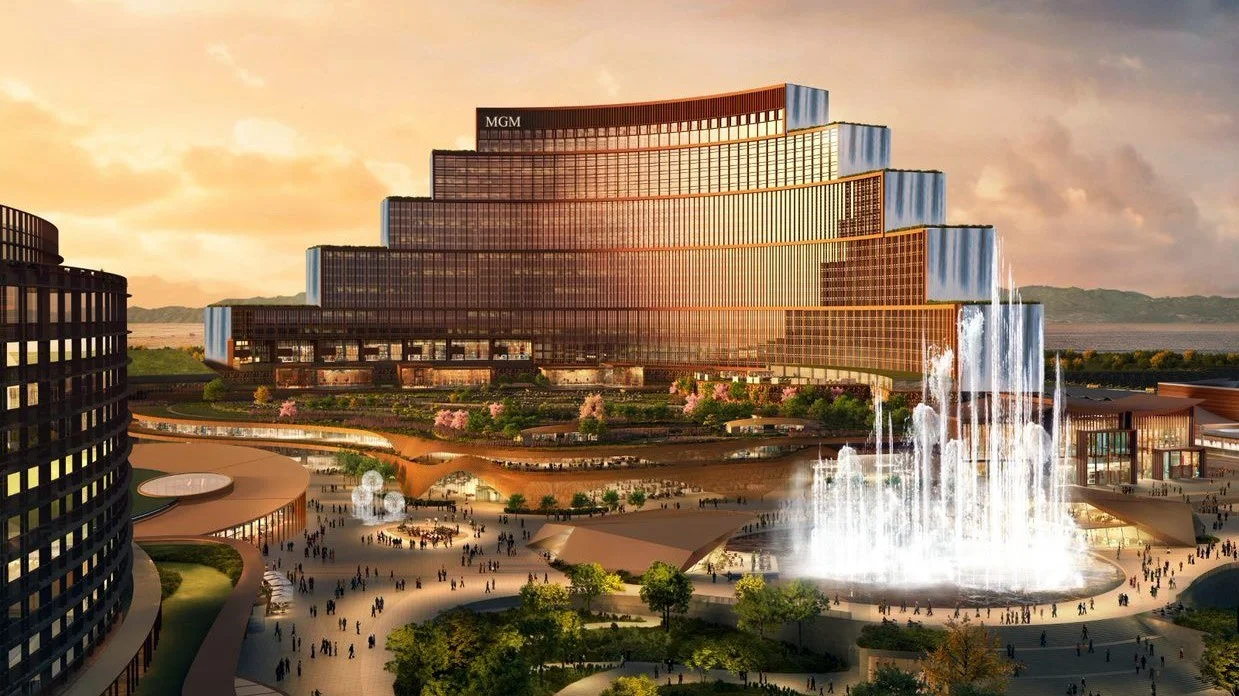
As a result, just two applicants drew the first straws: Osaka, working with MGM Resorts International and Orix Corp.; and Nagasaki, collaborating with Kyushu Resorts, led by a lesser player, Casinos Austria. Of those, just one made the cut: MGM Osaka. The $10 billion complex is now under construction on Yumeshima Island in Osaka Bay.
For several years after the first bidding round, the conversation around IRs hit a lull, sparking concerns that the industry might be one and done. But under pro-IR Prime Minister Sanae Takaichi, elected last October, operators will soon get a second bite at the apple. In 2027, for six months between May to November, the two remaining licenses will go up for grabs. Can the country regain its momentum, win back the big players and live up to its presumed potential?
It starts with location. “There’s a totally different roster of possible bidders if Tokyo and Yokohama are on the table, versus one of the more regional locations,” says Fisher. “But $40 billion (in GGR) was never realistic.” He reckons on gross revenues in the mid-teens for a resort in a major population center, like Tokyo or Yokohama. For regional casinos in smaller prefectures, “the revenue potential is comparatively small. It would still be a lovely number; I’d love to own a casino there if I didn’t have to pay for it.”
So far, Tokyo has been a nonstarter; an early poll found that 40 percent of residents opposed an IR in the capital. Yokohama once was considered a prime host city, but in 2022, upstart mayoral candidate Takeharu Yamanaka swept to victory primarily due to his anti-casino stance, trouncing incumbent Fumiko Hayashi, who supported a development.
Yokohama “had a great location, but horrible local support,” says Fisher of Japan’s second largest city. “Politics can always change, and suddenly it could be a great location again.”
In addition to location, there is a bigger question: will the Japanese embrace casino gambling as a pastime? Tsuyoshi Tanaka, editor-in-chief of Tokyo-based Amusement Business Answers, says yes. “Currently, Japanese customers represent a central demographic of casino patrons at Paradise City in Incheon, South Korea. If an IR is established in a location with better accessibility than Incheon, Japanese casino enthusiasts will undoubtedly patronize it. The rationale is simple: accessibility is the most critical factor.
“Once legal casinos open in Japan, those who wish to gamble will no longer need to take the risk of visiting illegal establishments.”
Pros, Cons & Cultural Dissonance
Statistically, Japan has a lot going for it, including 20 times the population of Singapore (124 million people versus 6 million) and the world’s fourth largest economy. Despite regulations designed to limit locals’ play, notes Fisher, “You don’t have to capture a whole lot of them to have a pretty full casino of Japanese people.”
Meanwhile, international tourism has rebounded in the years since Covid, and geographically, Japan is just four hours by air from the world’s biggest outbound travel market: China. Despite Beijing’s edict forbidding citizens from gambling abroad, the People’s Republic remains the chief source of VIP players around the world.
But China can and will pull the plug when provoked. Last fall, Chinese arrivals in Japan dropped 45 percent after a tiff between Prime Minister Takaichi and the Xi administration.
“There’s a totally different roster of possible bidders if Tokyo and Yokohama are on the table, versus one of the more regional locations.”
—Scott Fisher, PhD, co-founding partner, Convergence Strategy Group
Those who did visit spent freely—a record-breaking 9.5 trillion yen (around $60.26 billion), surpassing the 8.13 trillion yen achieved in 2024. All told, Japan welcomed 42.7 million international visitors for the year.
But “welcome” may be the wrong word. In a recent interview with iGaming Business, Japan-based essayist Pico Iyer said the culture is “deeply rooted in its ancient habits and customs and values, and therefore slow to change. It might take a long time for the society as a whole—which often thinks as a whole—to change its views about casinos and gambling and to get over whatever reservations it may have.”
For those reasons, Japan’s goal to attract more than 60 million tourists a year by 2030 may not be good news for many residents. “Japan is based not only on the notion of everybody sharing the same assumptions, but on the notion of everybody being silent, orderly and obedient,” says Iyer. “Foreigners tend to be unquiet, disorderly and disobedient. So it’s a real problem.”
“It is impossible to deny the presence of such sentiments,” agrees Tanaka. “In cities like Kyoto, where the transportation infrastructure is relatively fragile, the influx of massive numbers of tourists leads residents to feel the effects of ‘overtourism.’”
Tourism Minister Yasushi Kaneko, too, has expressed concerns about overtourism, also known as “sightseeing pollution.” Channel News Asia relayed the case of a Kyoto restaurant that posted two signs at the door: one saying, “No vacancy” in English, and the other saying, “Please come in” in Japanese.
Tanaka adds, “The root cause of this sentiment is the feeling that ‘our lives are becoming more difficult due to the crowds, yet we are receiving no benefits.’ If a region sees a high volume of tourists but generates low revenue—or if that revenue is not redistributed to the residents—local resentment is inevitable.” So the value of these multibillion-dollar investments must trickle down to the people of the community.
Appetite for Gambling?
Officially, casino-style gambling is illegal in Japan. But walk into any pachinko parlor, and you may as well be in a slot hall. Players are packed wall to wall inside the noisy arcades, perched at narrow cabinets that look and sound like pinball games, complete with buttons, flippers and tumbling silver balls.
“Make no mistake about it,” says Andrew Klebanow of Klebanow Consulting. “Pachislots are electronic gaming devices. They look like slot machines. They play like slot machines.” The stakes are low, and payouts cannot take place in the arcades themselves, but pachinko slots are routinely referred to as “gambling-style” or “hybrid gambling” games.
According to Poi Data, some 8,250 pachinko parlors now operate in Japan, including more than 550 in Tokyo and 400 in Osaka, generating an estimated $8.4 billion in revenue per year. Despite a decline in patronage—younger players prefer digital entertainment—some 11 million Japanese adults still play the games, indicating a robust audience for the casino version.
Maybe.
As Tanaka points out, “the enjoyment derived from pachinko/pachislot is quite different from that of casino slot machines. Pachinko/pachislot players visit parlors on specific days when they believe the ‘probability of winning’ is higher. Their true pleasure lies in identifying and confirming the accuracy of their own predictions and strategies.”
The money they spend is “negligible” compared to casino players, he adds. “To provide a specific example of the economic scale: for a standard-rate pachinko machine, the parlor lends a single ball to the player for 4 yen. On average, a player loses about only 1,500 yen (roughly $10) per hour. The average playing time is approximately two hours and 12 minutes.”
Pachinko play aside, to calculate GGR potential, it may be helpful to consider MGM Osaka. The IR footprint is so vast—more than 50 acres—that the 3 percent allotted for gaming may accommodate 2,000 slots and 200 table games (compared to 2,500 slots and 600 tables at Marina Bay Sands).
For non-gamblers, there will be lots to see and do: in addition to three hotels, the sprawling resort complex will offer a 3,500-seat theater, 400,000 square feet of meeting and exhibition space, dozens of restaurants and bars, a shopping district, a public park and other attractions “showcasing the best of Osaka and Japan.” MGM predicts the IR will attract about 20 million visitors a year and bring $7.9 billion in annual economic benefits to the region.
Overall, IRs should serve as economic drivers for their host communities, says Tanaka, “provided they can attract visitors as planned.
“While there will be some negative impacts from the opening of an IR, the positive effects should outweigh them. IRs will generate significant employment and provide local governments with substantial tax revenue.”
He is concerned about access to Yumeshima, home of MGM Osaka, a manmade former landfill in Osaka Bay, though it drew 29 million visitors for the six-month World Expo in 2025. “I sincerely hope that transportation capacity will be significantly strengthened by the time the IR opens.”
The Long Game
In the next go-round, U.S. operator Hard Rock International is expected to apply for an IR license, with Hokkaido as its partner. Kanagawa Prefecture could also be in the running, along with regions that failed to secure approval in the first round, like Nagasaki. Tokyo and Yokohama are still wild cards.
Consultant Andrew Klebanow touts an enviable location that he believes checks all the boxes: Chubu Centrair International Airport, near Nagoya in Aichi Prefecture. “It’s literally near ideal,” he says. “You have an international airport serving about 20 regional international destinations: Hong Kong, Singapore, Philippines. It’s an eight-minute walk from baggage claim to the casino site. There’s a ferry terminal behind the casino development site, next to an underutilized convention center. Oh, and there’s also a couple of thousand hotel rooms that are underutilized.”
“While there will be some negative impacts from the opening of an IR, the positive effects should outweigh them. IRs will generate significant employment and provide local governments with substantial tax revenue.”
—Tsuyoshi Tanaka, editor-in-chief, Tokyo-based Amusement Business Answers
Its location at the airport, on a manmade island in Ise Bay, means community opposition should be minimal or nonexistent. And the prefectural government is all in: in February, Governor Hideaki Omura envisioned Aichi as “an international tourist city with MICE at its core.”
So far, aside from Hard Rock, the sole major operator to express interest in Japan is U.S.-based Bally’s Corp. Bally’s Chairman Soo Kim has called Japan “an extremely attractive market,” adding, “If the opportunity arises, we’ll definitely raise our hand.” Macau concessionaire Galaxy Entertainment Group is also reportedly ready to come back in, given more favorable conditions.
Initially, Japan hoped to introduce the first IRs by 2020, to coincide with the Tokyo Olympics. Covid made quick work of that plan (the Olympics were canceled, too). Then the timeline was pushed back; MGM planned to open in Osaka in time for the 2025 World Expo. It didn’t happen. Now, the industry will not debut until 2030 at the earliest, when Japan’s first IR finally opens its doors. MGM will enjoy first-mover advantage for at least five years, and will serve as a barometer of the industry’s future success. Will the big operators be back? Klebanow isn’t sure.
“They continued ratcheting up the regulations. At some point the scales were tipped to say, ‘You know what? This is not looking like a great opportunity.’ Every major gaming developer walked away.” In 2027, when the bidding window reopens, will they walk back in?
In a 2024 market analysis, Savills Research predicted that major resort operators will take a wait-and-see approach to Japan “due to uncertainties regarding the complicated regulatory environment.” But if Osaka succeeds, it’ll be another story. “Many of these doubts will likely change to optimism,” the report continues, as other projects “learn from and build on the successes of Japan’s first IR.”
Rise of the Machines
An ingrained love of machine games could make Japan the world’s best-performing slot market.
By Andrew Klebanow
In 2027, Japan will evaluate applications for IR developments. While revised regulations have yet to be promulgated, they are expected to be less onerous than those issued in the previous application process, which discouraged most of the world’s largest IR operators.
One question operators must answer: What will be the revenue contribution from slot machines? Will it mimic Macau and Singapore, where table game revenues far exceed slot revenues? Or will it be more balanced, as in the Philippines?
With casino size expected to be limited to 3 percent of total square footage, operators need to determine how much of that precious square footage should be devoted to slots and tables. Since the latter consumes far more floor space, getting the allocation wrong will have consequences.
The general belief is that Japan, like Macau and Singapore, will be table game-centric. Observations of Japanese players who visit South Korea, a popular place for Japanese punters, have in part fueled that assumption. But that sample is small, and doesn’t take into account the pent-up demand for machine gaming that’s been building in Japan for the past few decades. Japan’s casinos, in fact, have the potential to generate the highest win-per-slot unit per day (WPUPD) averages of any market on the planet.
To appreciate the reasons, just examine Japanese culture and consumer behavior. First, residents of Japan derive much of their entertainment from electronic devices. Just walk through of a cineplex entertainment complex. Considerable square footage is devoted to various kinds of entertainment devices targeting different age cohorts, like claw machines for children and state-of–the-art arcades for teens and young adults. Then there are the pachinko and pachislot parlors. The latter devices offer gameplay nearly identical to slot machines. They hold particular appeal to male adults. Women for the most part shun them because of the crowds and the din of the machines.
Another indicator is the country’s collective use of vending machines for daily purchases. Japan boasts the greatest number of vending machines in the world, estimated at more than 5 million, a ratio of one machine for every 23 people. Putting money into a machine and receiving something in return is part of daily culture.
Perhaps the most important indicator of future gaming behavior is the portion of the population that is not served by various forms of electronic entertainment today, specifically women aged 40 and older. They don’t find pachislot parlors comfortable or particularly appealing. What they will find appealing, as demonstrated in markets throughout the world, are comfortable environments where they can spend a few hours wagering on slot machines.
Given these facts, basic assumptions and limits on casino capacity, Japan’s casinos will simply not have enough space for EGDs to meet anticipated demand. Depending on the market, it’s reasonable to assume that operators can expect their EGDs to generate WPUPD in excess of US$1,000 across their entire gaming floors, far higher than any casino in North America or any other market in the world.
Andrew Klebanow has worked in the casino industry since 1977 and as a gaming consultant since 2001. During his career, he has evaluated 1,100 casino properties in more than 30 countries. He can be reached at [email protected].