
Follow the Leaders


Some call it copying, or even larceny. Most slot suppliers call it giving the players what they want.
If there seems to be a sameness in the game mechanics being employed by slot suppliers these days, it’s because slot manufacturers have always latched on to the game features that have proven themselves popular with the players. This goes all the way back to the most enduring characteristics of slot machines since they first ventured beyond the mind-numbing repetition of spinning reels.
Consider the multiplying wild symbol—a wild symbol that not only completes a winning combination, but multiplies the payoff for that win. The feature virtually catapulted IGT to the top of the stepper-game trade when it first appeared in the 1990s in games like Double Diamond and Triple Diamond.
Not surprisingly, those classic games are still out in casinos, but the multiplying wild symbol has been used in a multitude of ways by all the manufacturers over the years, even as part of the most recent innovations in slot game play.
The same can be said of the free-spin bonus, multiple “7” combinations, and perhaps the most famous of the slot special features, the bonus wheel.
These days, it’s all about the hold-and-spin feature. Along with the pot-collection feature and the “what-you-see-is-what-you-get” method of paying awards based on the numbers on adjacent reel spots, these dominate the play features of the modern slot floor. Players love them, and thus, slot-makers keep serving them up.
Of course, it hasn’t always been an easy road for slot manufacturers with respect to intellectual property. In the 1990s, WMS Gaming famously had to stop producing reel-spinning steppers after IGT enforced its ownership of the Telnaes “virtual reel” patent it had acquired more than a decade earlier.
IGT also owned the patent on the original bonus wheel, which it inherited when it acquired supplier Anchor Gaming. The use of a roulette-style wheel on a slot machine was originally patented by Anchor executive Randy Adams, who licensed the feature to Bally for a game called Wheel of Gold. A year later, IGT proceeded to make history with its Wheel of Fortune game. Some suppliers paid a fee to IGT to offer their own wheel games until the patent expired, opening up the floodgates on the wheel bonus.
Although it stopped producing stepper slots, WMS notably went on to make history in the video slot genre with its pioneering game Reel ’Em In and its second-screen fishing bonus.
These days, suppliers are able to offer the most popular game mechanics thanks to what is known as a “patent pool.” Just as suppliers were able to offer ticket-in/ticket-out payment technology when the TITO patent was owned by a single company, most make periodic payments into a pool that compensates the few companies that own game-mechanic patents. Suppliers are thus free to offer the most popular slot game features, each with their own distinctive variations on must-have bonuses expected by players on the slot floor.

And use them they do. “Our philosophy is that you have to embrace the popular,” comments Mike Brennan, chief product officer for slot supplier Bluberi. “If you ignore that, good luck. We believe in combining the popular with the less used, reinterpreting things that have been done before. We think that’s a good recipe for a successful game.”
“The industry innovates by taking what’s popular in the market today and introducing a twist,” says Ben Kongpipattanakarn, product manager for AGS. “You pair it up with new mechanics or mash up mechanics together to create new experiences for players, diversity being key for healthy innovation.”
Reinventing the Wheel
Of all the game mechanics launched by slot suppliers over the years, the bonus wheel arguably has had the longest-running influence. When IGT combined it with a theme based on the Wheel-of-
Fortune game show in 1996, it launched the era of the themed slot that continues to this day.
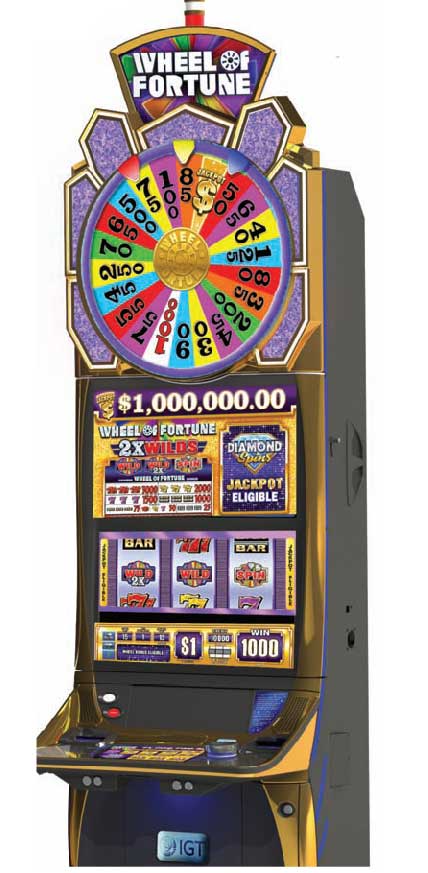 IGT has released more than 250 versions of the Wheel of Fortune slot machine, but other slot manufacturers have taken the bonus wheel and used it to boost many distinctive games over the past three decades.
“Wheel-type bonuses will always be a cornerstone of IGT’s portfolio, especially given the popularity of IGT’s Wheel of Fortune slots franchise,” says Dubravka Burda, IGT’s senior vice president of global studios. “We are still innovating the wheel mechanic, and there is no better example of this than our recently released Wheel of Fortune Trio cabinet and the Wheel of Fortune Cash Link Big Money game, which debuted in the No. 1 position in the Eilers & Krejcik ‘New Games Premium Leased & WAP’ report. This social-style game combines the cash-on-reels mechanic with the popular wheel spin.
“Players and operators love wheel-style bonuses. They are easy to understand and, when triggered, draw the attention of players from across the gaming floor.”
“The wheel is definitely a classic mechanic,” says Kongpipattanakarn at AGS. “It resonates with a wide range of players, and that that goes from low-denomination to mid and high in the market today.
“What we aim to do with that is to enhance the number of pointers that you can land. That’s just one of the ways that we’re looking to use high-performing mechanics paired with older mechanics to give players new experiences. The way we’re leveraging this mechanic is in certain products like Rakin’ Bacon Jackpots, which is one of our latest releases.”
“Wheels are an incredible part of the history of slots, predominantly here in North America,” says Matthew Primmer, chief product officer of Aristocrat Gaming. “We use it when we feel it matches the game and the theme, but it isn’t a mechanic we have used extensively recently. One of the best examples of our innovation with wheels has been the Whisker Wheels franchise, which has taken North America by storm.”
The other game mechanic that has had major legs over the years is the free-game feature. According to Caitlin Harte, vice president of product management for Everi, the way it is used has changed over the years.
“Free games have evolved from being a simple break in the base game to becoming showcases for a game’s most exciting mechanics,” she says. “We’re seeing more variability—random events, feature stacking, symbol upgrades—and more interaction. At Everi, we often use free games as a chance to introduce temporary rule changes that shake up the core game play and make the bonus feel like a true event.”
“When free games first started, the main factor was how many free games you got,” says Bluberi’s Brennan. “It was multipliers. It was wilds. Now, you’ve got a pot that leads into it with more modern mechanics, or things like the Snowball Effect, one of our game archetypes, where the longer the free spin goes, the more you win.
“It reinforces the base game a lot. We’ll have a little feature in the base game, and then it’s on steroids in the free spins. That’s pretty common, where you have a cash-on-reels effect as a catalyst in the base game, and then in the free spins, you get that almost every spin. That’s almost like a sign of the times. Whatever mechanics are in vogue, they’ll show up in the free spins.”
Holding, Spinning, Collecting
Perhaps the most important new mechanic of the past decade has been the hold-and-spin bonus, which first appeared in 2014 in the Aristocrat game Lightning Link, branded as “Hold & Spin.”
“The creation of the Hold & Spin feature should be attributed to Scott Olive, the leader of High Roller Gaming Studio in Australia,” says Aristocrat’s Primmer. “Scott, an EKG Hall of Fame game designer, had worked on iterations of the mechanic in earlier games. It all came together, however, with the creation of Lightning Link and forever changed the industry.
“We believe players respond so well to it because of its simplicity. Players naturally understand the potential values in the bonus feature and build anticipation as the re-spins continue and re-trigger.”
By now, everyone knows the basics of the hold-and-spin bonus. It works with cash-on-reels symbols that lock in place for three spins, and every time another cash symbol lands, the number of spins returns to three. The feature continues until three spins occur without a cash symbol or the entire screen fills with them, usually triggering a top “Grand” progressive.
“At Everi, we’ve approached hold-and-spin not just as a mechanic, but as a storytelling tool,” Harte explains. “Our versions often include unique upgrade behavior and thematic overlays that tie directly into the math model and visual style. We’ve built variations that introduce anticipation dynamically as the player progresses through a session. The goal is to make our hold-and-spin executions feel not only familiar, but also fresh and forward-thinking.”
 These days, the hold-and-spin mechanic is often paired with the other hot new game mechanic of the day: the pot collection or metamorphic bonus. One of the first iterations of this bonus was on the Light & Wonder game 88 Fortunes, which displayed a single pot of coins that was fed by coin symbols flying from the reels. These days, slot-makers will use two, three, four or even five pots displayed above the reels. Coin symbols or other icons appearing on the reels fly to the pots, making them appear to bulge.
In a perceived-persistence sequence, the pots—or piggy banks, pandas or other characters—grow fatter until one or more of them burst to trigger a hold-and-spin or free-spin feature enhanced by the pot or pots, with multipliers, two or more reel arrays, extra spins or other perks identified on the pots.
“Everybody’s got their own term for this—we call this a pot filler,” says Bluberi’s Brennan. “They’re so ubiquitous that if you create a game nowadays without one, two, three, or four, or even five of these, it actually adds risk to the game. It’s almost becoming the free spins of 2025. You could argue it’s not a mechanic, it’s a presentation. You just about have to have them.”
“For myself as a player, for pot features, it’s the thrill and excitement of seeing a pot grow,” says Kongpipattanakarn at AGS. “I even love walking on the floors and looking for those games with the pot—‘How big are they now?’ It keeps anticipation for the feature or the features that they may receive once the pot triggers.”
The use of the pot collection feature is becoming linked more and more with the hold-and-spin feature, as are other emerging game mechanics.
“The combination of Hold & Spin and other popular mechanics together in a ‘mash-up’ of mechanics has been an emerging and growing trend,” Aristocrat’s Primmer notes. “Hold & Spin is such a dominant mechanic, and the High Roller Gaming implementation is incredible, so to try and compete, others need to add other mechanics to their version of Hold & Spin. But as independent research lists show, we continue to see Dragon Link, Phoenix Link and many others rising to the top of charts.”
New Innovations
Slot manufacturers are still coming up with new game mechanics regularly, and we’re seeing the “mash-ups” continue with new games and new iterations of these mechanics. One of the trending game mechanics is the “what-you-see-is-what-you-get” (WYSIWYG) feature, pioneered by the Everi game Cash Machine.
Cash Machine popularized the simple formula where numbers on the screen—in this case, a traditional stepper game—combine to form the award. (The top award in this game is for 10-5-00 on the reels, for $10,500.)
“Games like Cash Machine flipped the script by making the numbers on the reels the actual prize, turning a traditional mechanical product into something bold and impactful,” Harte says.
Lately, this mechanic has begun to appear in concert with other game mechanics—most recently with IGT’s Tiger and Dragon Cash on Reels. This game includes collection pots and a hold-and-spin feature, but at its heart is a “nudge” feature that increases the first digit in the WYSIWYG award a random number of times, potentially reaching into double digits for a huge award.
“Players love this mechanic, as it takes the hold-and-spin feature that they already understand and applies an additional layer of engagement by clearly displaying the related cash awards,” says IGT’s Burda. “In introducing new twists to proven mechanics, we found similar success with games such as Prosperity Link and Mystery of the Lamp.
“The real secret to success, however, is pairing these attributes with quality math and developing a gaming experience that keeps players entertained over time.”
Another new mechanic that is beginning to see legs is a feature pioneered by Bluberi in its Devil’s Lock game, in which the main devil character appears in the middle reel spot on the array to instantly award all cash-on-reels symbols on the screen. In the free-spin round, the devil is anchored in that middle spot, causing all cash-on-reels symbols to instantly pay off with every spin.
Several new games from other slot-makers at the last few trade shows have features similar to the Devil’s Lock game. “It’s interesting for us, being a smaller vendor, to see our games emulated,” Brennan says. “We went to ICE (trade show in Barcelona) and we saw Eastern European vendors with two versions of Devil’s Lock. Never in my wildest dreams would I have thought that would have ever happened three years ago.
“But it’s where we are. It’s better that there’s less litigation. And if you created this game and it’s inspiring others, I don’t think they can do it as good as the original, and our philosophy is, if someone wants to try to copy us, that’s how it is. Hopefully, we’ve moved on to the new thing, and no one can copy us better than ourselves.”
The bottom line in slot game mechanics is that the manufacturers will continue to put their own unique stamps on the features that players have shown they love and continue to play.
“The race never ends, and there’s always going to be room for new mechanics on the floor, because players are honestly looking for diversity and new experiences,” says Kongpipattanakarn at AGS. “As a player myself, I’m still searching the floor for something new that I’ve never seen before, or that is something familiar but does it in a new way.”
“IGT game studios around the world are constantly testing out new mechanics,” says Burda. “Our customers rely on IGT to continue innovating and advancing the player experience via innovative content that resonates with player preferences of the moment. Not all innovation has to be disruptive. Sometimes, seemingly minor innovation has a huge impact.”
And all the copying?
“Imitation is part of any creative industry,” says Everi’s Harte, “but there’s a difference between being inspired by a trend and directly cloning it. IP protection has a role, especially when there’s clear innovation in how a feature is executed or tied to a brand. That said, competition also fuels improvement. At Everi, we believe in innovating forward—looking at what’s been done and asking, ‘What’s the next evolution?’ rather than, ‘How do we replicate this?’
“That mindset keeps the industry fresh and the players engaged.”