Caesars, MGM Host First Public Hearings for NY Casinos

The New York casino chase is rolling along, and now that the public hearings have begun, residents are getting their chance to make their voices heard.
On August 11 the downstate New York casino race entered a new phase as local residents and representatives gathered in the Grinton I Will Public Library in Yonkers for the first public hearing on the MGM Empire City proposal.
This was the first of a minimum of two mandated hearings before the project’s community advisory committee (CAC) can hold a binding vote on whether the bid can advance for further consideration. The next hearing is set for Sept. 16 at Yonkers Montessori Academy. Four of the five committee members must vote in favor of Empire City for it to advance.
The company is proposing a sweeping $2.3 billion renovation and expansion of its existing facility, the former Yonkers Raceway. The property is known as a “racino,” meaning it features both a racetrack and gambling offerings, in this case video lottery terminals (VLT). If approved for a license, Empire City would eschew its VLTs and become a full Las Vegas-style Class III casino.
Several dozen speakers gave opinions about the project, and the dominant theme is one that has been applied to many major casino expansions across the U.S. in recent years: labor and business leaders want the project while local residents largely do not.
As is typical for such meetings, legislators and elected officials were given first priority to speak. The only one to do so was David Tubiolo, Westchester County legislator for District 14, which includes Yonkers.
Tubiolo voiced caution for the project and did not endorse it.
“This project will no doubt bring with it an increase in traffic, an increase in noise and an increased need for emergency and first responder services,” Tubiolo said.
Tubiolo pointed to concerns about the area’s “flood-prone streets,” which were mentioned by others as well. He asserted that his community needs commitments from the company that “the strains on our emergency services and infrastructure” will not become too burdensome.
A good chunk of the public support for all of the eight bids has come from union and labor officials. All bidders have pledged thousands of union construction jobs, meaning workers will benefit irrespective of which projects are chosen.
“Let’s not get stuck debating hypothetical problems,” said Armando Moreno, a rep for the United Brotherhood of Carpenters and Joiners of America. “Let’s focus on real tangible benefits this project brings.”
Local and small business leaders have also been staunch supporters of most bids, with MGM Empire City being no exception. Lenny Caro, president of the Yonkers Chamber of Commerce, spoke briefly, but with a clear message: “We support this 100 percent.”
With few exceptions, the speakers who identified as local residents were staunchly opposed. One woman in particular, a retired city employee named Margaret, was not shy in addressing what she saw as an elephant in the room.
“Some people may not like what I’m going to say: We all know this is gonna happen,” she said. “The fact that we are here begging MGM, a multimillion-dollar international corporation, for a few lousy concessions is a disgrace. They should have been begging us with concessions to come here.”
Her comments touch on a common theme among speakers: MGM Empire City and Resorts World NYC seem likely to be licensed because of their speed-to-market advantage and existing relationship with the state.
MGM has, in its own economic projections, said that Empire City will be forced into closure if it is not chosen for a license. It cannot survive, MGM said, if there are three additional commercial licensees nearby. Residents were not pleased with framing that implies a threat seeking approval.
Kisha Skipper, president of the Yonkers NAACP branch, said that Assemblyman Gary Pretlow told her directly years ago that he was opposed to a full-scale Yonkers casino. That sentiment apparently changed somewhere along the line, she said.
Another local woman was especially descriptive in her assessment of the situation:
“This is either the renaissance of Yonkers or the rape of Yonkers. I want to see the renaissance and we need the leadership of everybody in Yonkers to bring everybody up so we can be an example for the nation of what could be done.”
*******
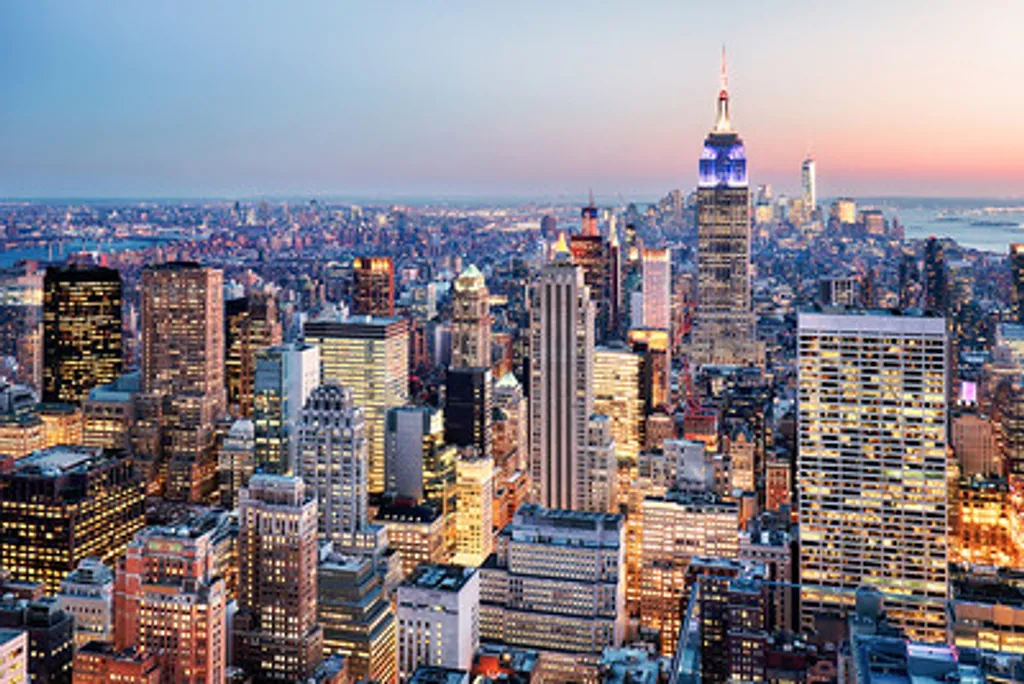
For many, the phrase “New York City casino” conjures immediate images of the city’s bustling urban landscape, most notably Times Square. At least, that is what Caesars Entertainment, SL Green and Roc Nation are hoping for.
The three companies are partnering on Caesars Palace Times Square, a proposed $5.4 billion renovation of an existing building at 1515 Broadway. It is one of eight bids vying for up to three available downstate New York casino licenses.
Hundreds of people were packed into the Borge Hall at Scandinavia House August 13 for the project’s first public hearing by a local Community Advisory Committee. The appointed CAC must host at least one more hearing before casting a binding vote by Sept. 30. Four of six CAC members must approve the project for it to continue and potentially receive a license. The next hearing has not yet been scheduled.
Project backers gave a presentation that was a truncated version of one they gave last month. SL Green CEO Marc Holliday again touted his company’s ties to the city, as its largest commercial landlord.
“You have my personal commitment and my team’s commitment that not only will we mitigate any potential impact from our project, but we’re going to implement a plan that will improve traffic flow and decrease congestion throughout [Times Square],” Holliday said.
Holliday reiterated several of the proposal’s key points: the casino floor would not be accessible on ground level; its utilization of an existing building brings the lowest construction impact; it does not have the capacity to fulfill its demand, meaning nearby businesses would benefit from spillover visitors; and so on.
Making an appearance for Caesars was CEO Tom Reeg, who was not present for the previous presentation. He championed the project’s power to draw international tourism, which is notable given the recent visitation declines in Las Vegas, Caesars’ biggest market.
“This is a unique partnership in the entertainment capital of the world, and we can really create something special that’ll attract international tourists and their spending power that’ll benefit New York’s economy for decades to come,” Reeg said.
He expanded on the company’s pitch to extend its Caesars Rewards program to local businesses, a perk that is becoming popular among applicants. The program, he explained, would act in a “hub-and-spoke” model that connects its various properties. As of now, Caesars has no New York ties to offer customers, with its closest property being in Atlantic City.
An extensive and sometimes rowdy public comment period highlighted a conflict that has followed the project since its introduction: the support of trade unions versus backlash from the theater community.
As was the case at a public zoning hearing in the spring, many of the first tranche of speakers were trade reps, with a large contingency representing the Construction & General Building Laborers’ Local 79 branch.
“The simple fact is that there will be a gaming license awarded to New York City, and this is the proposal that makes the most sense,” asserted Billy King, Local 79’s recording secretary.
Conversely, representatives from actors’ unions and theater groups were fiery in their opposition.
“We’ve become aware that security is not letting opponents of the casino into the hearing today,” asserted Jason Laks, president of the Broadway League. “SL Green says they want to be good partners and good neighbors, but they can’t even let this hearing happen without trying to rig the process. It’s shameful!”
CAC Chair Carl Wilson said the state gaming commission has been asked to look into the access allegations. Such accusations were made by several speakers throughout the hearing.
“Last year, Broadway added $15 billion to the New York City economy,” said Danny Whitman, executive director of the nonprofit Broadway Cares. “Do you want to be responsible for messing that up?” he asked, pointing at the committee members.