Fanatics Loyalty

When Fanatics made a highly anticipated splash entering the online sports betting world two years ago, the multibillion-dollar e-commerce giant had an arrow in its quiver for rewarding customer loyalty.
Utilizing exclusive partnerships with a number of the world’s most prestigious sports leagues, Fanatics expanded its FanCash rewards program into its gambling vertical.
Through FanCash, customers can receive up to 10 percent from each wager to use for spending on jerseys, hats, bonus bets and other perks. Unlike Fanatics, leading sportsbooks like FanDuel and DraftKings cannot offer carrots such as a Patrick Mahomes jersey or an Indiana Pacers hat to loyal customers. Now, as Fanatics dives into the online casino space, the popular merchandiser has a major tool at its disposal with the expansion of FanCash.
After a lengthy soft launch, Fanatics officially made its online casino debut at the start of May. As with sports betting, Fanatics has lofty ambitions for its online casino platform. Eventually, the company hopes to surge to the top of the marketplace.
If Fanatics can displace the current leaders, the FanCash apparatus will likely play a major role. With the launch, Fanatics made history as the first mainstream company outside the casino ecosystem to go to market with an iGaming division. While it is too early to predict whether the company will supplant the incumbents, some Wall Street analysts believe Fanatics can achieve double-digit market share down the road.
That is certainly the company’s intent with the help of FanCash.
“Fundamentally, Fanatics is a sports and leisure business, an entertainment business,” says Conor Grant, president of gaming at Fanatics Betting & Gaming. “We’ve seen a huge overlap between customers who play sports and also play in casino. It’s a natural step for us.”
Jay-Z Goes Deep
Described by the company as the “currency of sport,” the FanCash loyalty currency can also be used for other products such as collectibles and trading cards.
 On the sports betting side, the redeemable rate is tied to the risk proposition associated with the bet. For most bets, the standard rate hovers around 1 percent. As the odds climb, the rate steps up to a range of 1-3 percent for wagers between -105 and +600. Bets at +6000 or above will usually carry the maximum 10 percent rate on FanCash.
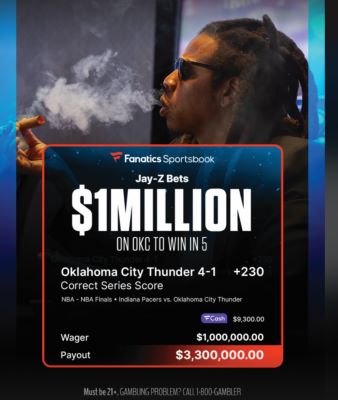
Prior to the NBA Finals, entertainment mogul Jay-Z placed a seven-figure bet on the series, wagering $1 million on the Oklahoma City Thunder to defeat the Indiana Pacers in five games. The wager (+230) provided the rapper with $9,300 in FanCash, one of the largest amounts in the history of the site.
Last year around the holidays, a customer informed Fanatics that he used his credits to buy his sons several Christmas presents, exchanging them for three jerseys. A customer can redeem FanCash for purchases on Fanatics.com, the Fanatics app and other Fanatics partner sites. The merchandising credits can also be used on FBG for casino rewards, such as profit boosts, and on fixed-cost items on Fanatics Live (excluding auctions).
“When we bring FanCash as a proposition and explain it to our customers, they’re finding it to be a really, really engaging tool,” Grant says.
A Differentiated Product
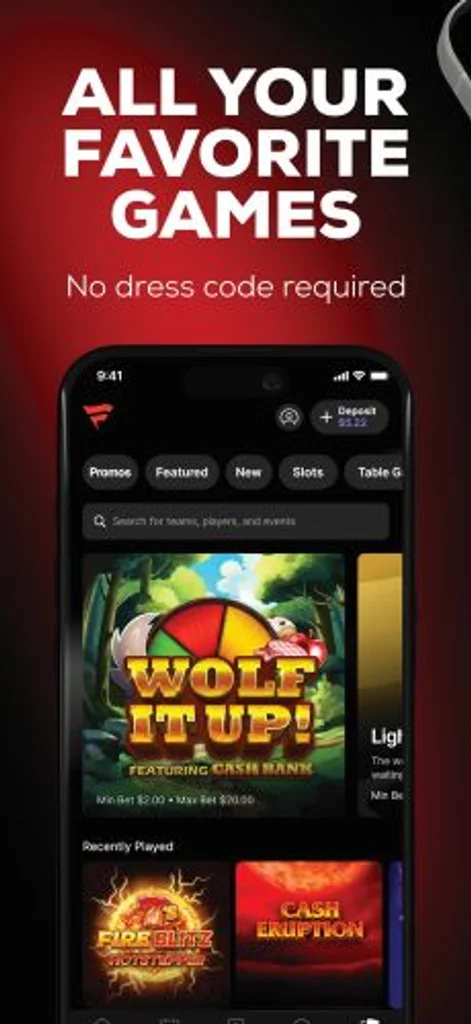
Fanatics offers plenty of casino options for customers to whet their gaming appetite. The app contains nearly 200 slot titles, including Cash Eruption, Bonanza, Cleopatra, Starburst and Zeus: God of Thunder. Cash Eruption is the nation’s most popular online slot title.
Beyond slots, the app contains offerings for roulette, blackjack, video poker, progressive jackpots and live dealer games. The calculus for FanCash redemptions on the casino side differs somewhat from the sportsbook due to the volume of play. For slot games, a customer will receive about 0.2 percent of their stake in FanCash. The slot rate is much higher than the one for table and live dealer games, where customers will earn approximately 0.05 percent of their stake back in the credits.
Even before Fanatics revamped the FanCash apparatus, financial analysts gave the loyalty program high marks for its unique appeal to customers. According to Lloyd Danzig, managing partner of Sharp Alpha Advisors, Fanatics’ competitive edge stems from its vertically integrated commerce and loyalty flywheel. FanCash is a natural extension, says Danzig, whose company is a venture capital fund for early-stage sports betting tech companies.
When Fanatics launched sports betting in 2023, investors focused intensely on the conversion rate from Fanatics’ legacy business, as well as the utilization rate of FanCash promotions. At the time, Danzig predicted that Fanatics would become successful if the company acquired customers more efficiently than its top competitors and monetized them more effectively.
The positive results so far may be evidenced in Fanatics’ increase in market share. In 2024, Fanatics’ share of the national sports betting market shot up to 5 percent, roughly five times higher than its inaugural year.
In an interview last fall, Fanatics Betting and Gaming CEO Matt King described FanCash as the aspect of its gaming business that resonated most with customers. The loyalty program, he gushed, serves as a “unique microcosm” of the brand. A customer’s devotion to the brand will eventually “pay off,” he said, adding that “no one else can really deliver that.”
Last valued at $31 billion in 2022, Fanatics may still have serious cash to burn. A former partner in the NBA’s Philadelphia 76ers and the NHL’s New Jersey Devils, Fanatics CEO Michael Rubin had a net worth of $10.6 billion in early June, according to Forbes. While Fanatics is live with sports betting in more than 20 states, it offered online casino in just four—Michigan, Pennsylvania, New Jersey and West Virginia—as of June 10.
Fanatics plans to scale up, with intentions of reaching 94 percent market coverage by this month. By comparison, market penetration remained closer to 40 percent at the back end of last year.
A New Customer Mix
Despite the enthusiasm for FanCash, there are lingering questions regarding whether online casino customers will be tempted by the incentives. For now, Grant acknowledges that customers on the sports betting side are a little more engaged—primarily because the sportsbook has been around much longer.
Nevertheless, he is enthused by the utility imbued in the loyalty program, which basically creates a variety of different ways a customer can spend FanCash.
As Danzig notes, the average slot or blackjack player isn’t necessarily a sports fan or a merchandise buyer. They skew older, are more habit-driven and tend to be less motivated by experiential perks. FanCash should also have an outsized appeal to female gamblers, who skew more toward iCasino than online sports betting, according to Ryan Sigdahl, an analyst with Craig-Hallum Capital Group. A 2023 report by H2 Gambling Capital found increased female participation in online casino nationwide, as female bettors made up 41 percent of all customers.
There are other factors at play. According to Sigdahl, online sports betting customers tend to exhibit higher brand loyalty than those who frequent casino games on their phones. At the same time, OSB products are usually more differentiated, illustrating why the higher-quality products are noticeably better than the rest of the pack. In addition, iCasino players tend to be more superstitious, he explains. The dynamic could test the stickiness of certain players when it comes to loyalty rewards.
“If they lose, they blame the iCasino brand and try their luck on a different app,” Sigdahl says. “If an online sports bettor loses, they blame the team or player. It is one of the many reasons iGaming share is less concentrated.”
However, Fanatics could revert back to its playbook for cross-channelization in terms of retaining customers. Grant points to the ability to provide customers with differentiated experiences that others cannot offer. Perusing the app, an ardent football fan might find free draws for NFL season tickets or a trip to the Super Bowl with VIP access at the Fanatics party.
“That’s the world we’re trying to unlock,” Grant says. “The opportunities and the potential are enormous.”
FanCash becomes even more interesting if it evolves beyond loyalty credits, Danzig notes. Once FanCash starts to be redeemed for a range of high-utility rewards such as VIP experiences and real-world comps, it will start to resemble a hybrid between Caesars Rewards and Amazon Prime, he adds. At that point, he says, Fanatics may start to see “more movement on the needle.”
Although Fanatics’ targets for double-digit market share by 2030 may be ambitious, the goals are not implausible, Danzig suggests.
An Empirical Approach
In 2011, a UNLV student pursuing double master’s degrees in business administration and hotel administration wrote a 40-page dissertation on the forces dictating loyalty among gamblers. Titled “An Exploratory Study of Casino Customer Loyalty Programs,” graduate student Cristina R. Crofts explored a bevy of academic theories related to loyalty initiatives, drawing on conditions such as reciprocity, attitudinal loyalty and reward types.
 One could infer that Fanatics may glean from the precepts of reciprocity when rewarding customers with FanCash. Under the theory, when customers “perceive that they have been helped, they tend to feel indebted and may feel compelled to provide retribution in the form of praise, devotion and repeat purchases.”
Fanatics customers may also exhibit “attitudinal loyalty” in returning to the site. Truly loyal customers demonstrate more trust and commitment to a casino, average more hours per visit and are less likely to search for an alternative, the study found. On the other hand, “spurious loyalty” is characterized by frequent purchases but no emotional connection to the brand.
Fanatics enters the space as customer acquisition costs have dipped, as well as bonuses overall, says Chad Beynon, an equities analyst at Macquarie.
Beynon believes there’s less bonus abuse or bonus loyalty in comparison with the early days of the online casino industry. Due to the novelty of FanCash, he expects customers to trial the product. Macquarie Group Limited, together with its affiliates, owns a net long of 0.5 percent or more of the equity securities of DraftKings Inc. DraftKings is among the leaders in the online casino space, along with FanDuel, BetMGM and Caesars.
Promotional Intensity
Eilers & Krejcik Gaming, LLC, a California-based boutique research firm, is one of the most respected consultants and advisers in the U.S. gambling industry. When the firm conducted extensive testing of Fanatics’ online casino app in the first half of 2024, the app scored well in user experience. Still, in evaluating the app, the testers identified game content and features as two of the areas that needed improvement.
More recently, the firm’s EKG Line published data on promotional intensity across the gaming industry. In its April note, the firm reported that Fanatics’ promotional spending to gross gaming revenue ratio surged to a staggering 76.7 percent. On a trailing three-month basis, through February 2025, its promo-to-net gaming revenue ratio came in nearly five-fold higher at 334 percent.
The metrics prompted Discerning Capital’s Davis Catlin to muse that Fanatics is likely “burning capital,” with 24-month paybacks to get to scale. The promos, though, may pay dividends. One competitor, Penn Interactive’s Hollywood Casino, provides customers with a bonus offer of $50 in credits and 50 free spins. According to EKG, the offer pales in comparison to one from Fanatics that awards customers with 500 free spins or $1,000 in rebates.
In a 2018 Harvard Business School study on Fanatics, Paulette Rubin described her son as being cut from a different cloth. At the ripe age of 9, Rubin demanded a fee when selling his baseball cards to a neighbor. “Nine-year-olds just don’t talk like that,” she exclaimed.
Rubin has outsized ambitions for the sportsbook, with his eye on eventually leading the market. Taking a page from Rubin, Grant has adopted a similarly aggressive mindset for the casino.
“I’ve set my team with the ambition that we will be right on the coattails of the top three by the end of 2026—that’s where I want to be,” Grant says. By 2030, Grant believes Fanatics can reach the pole position.
“Fundamentally, we believe we can get to No. 1,” he asserts. “It’s not going to be easy, I don’t expect it to be easy. But we’ve got huge ambition, and that’s where we want to be.”