Bring in the ‘A’ Team


Not all brands are created equal. Some carry a certain cache, a sense of expertise and timelessness, a one-word recognizability that requires no further introduction. Often, this comes in the form of a name. Think of Tiffany, Gucci, Bentley and others.
In gaming, one such brand is Ainsworth Game Technology, the lovechild of industry pioneer and centenarian Len Ainsworth. Founded in 1995, the company has historically been known for its high-denomination games. But since the start of the 2020s, the company has undergone several changes, both in personnel and in focus.
In its quest to revitalize the influence of the Ainsworth brand, the company has opted to diversify and invest in new offerings while implementing a development strategy centered around hard data and regional specificities. The highly expansionary environment of recent years has grown the North American game database hand over fist, which has allowed Ainsworth to carve market share and develop a distinct identity apart from the Big Three of Aristocrat, IGT and Light & Wonder.
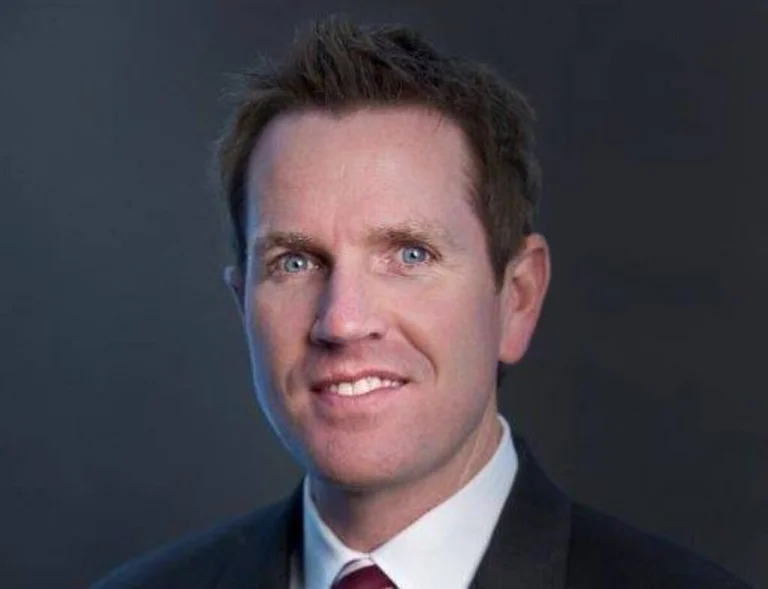
As North American President Deron Hunsberger notes, that momentum of steady growth has caused the industry to take notice, which in turn has attracted a new wave of talent eager to take part in that growth.
“People want to be part of a winning situation and success in an organization, so I think as we’ve had some success, people open their eyes to the opportunity of coming to work for Ainsworth. Being a smaller manufacturer gives you an opportunity to influence and direct the product that’s going to the market, and be an integral part of the success,” he says.
The introduction of industry veteran Harald Neumann as CEO in October 2021 was a turning point in the new direction, Hunsberger posits, as he “recognized early on the need to invest our capital in development. And that’s not just dollars, but also human capital.”
Right Place, Right Time
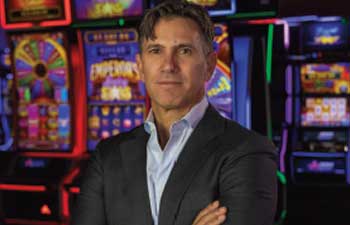
Two pieces of that human capital investment who have already played big roles in the company’s repositioning are Sean Evans, vice president of product strategy, marketing and sales, and Keith Kruczynski, vice president of North American studios. Both accumulated decades of experience at other big names around the industry, and both have found a new home at Ainsworth at a pivotal time in its trajectory.
For Evans, the decision to join the company was one fueled primarily by the opportunity to put that prior experience to work and build something new.
“I’m in my 33rd year in the industry now, and I’ve gotten to the stage where I actually like to build businesses,” Evans says. “Once companies grow to the point where they’re just trying to get minor incremental improvements, it becomes a bit of a mind-numbingly boring experience.”
Having observed the company for years from afar, he knew upon arrival that Ainsworth “has always been known to produce very high-performing high-denomination games.” But continued research and development is crucial to keep pace with an ever-expanding list of competitors. From a strategy and marketing perspective, Evans knew that the high-denom sector only represents about 8-10 percent of the overall market, and the key to future growth will be to unlock new opportunities in other verticals.
“Too often with companies our size, you can have a one-hit wonder and then you try and clone it and clone it. Then it becomes more and more difficult,” he says. “I’m thinking we have to work more towards diversifying across the floor to hit multiple play mechanics that we believe customers are really looking for.”
That’s where Kruczynski comes in.
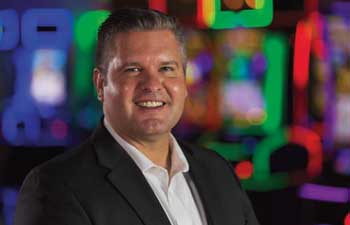
A veteran game designer and studio manager, Kruczynski knew immediately that the company’s problem wasn’t a lack of talent, but rather a lack of cohesiveness, collaboration and overall company pride.
“Ainsworth has some of the best talent in the industry that I’ve ever gotten the opportunity to work with across the board—designers, engineers, artists, testers,” he explains. “It was a team of really brilliant, dedicated people who knew what they were doing, knew what they were talking about. It was just that everyone was going in different directions.”
An increased emphasis on communication has allowed previous information silos to come down, and that in turn has sparked a renewed buy-in from all levels of the company. Kruczynski says this past G2E was an example of this progress, as employees “from the manufacturing floor all the way through the C-suite” got to participate and take in the experience.
And on the game side, he echoes Evans’ point that innovation will ultimately be the biggest growth driver.
“The question is, who do we want to be moving forward? QuickSpin is a great brand for us, but we can’t be successful making all QuickSpin games. There were times when we thought, ‘Let’s try this, let’s try that.’ Nothing
really stuck. But now the Raptor cabinet and the successes that we’re seeing early on are really giving us that new identity. It’s not a rebranding. It’s a repositioning, and building upon the strong foundation that was already here.”
The Local Touch
Perhaps the biggest overall change in Ainsworth’s philosophy has been to rethink the development pipeline. To do so, the company has leaned into a new directive for its studios, to try and craft games specifically for their local markets.
With locations in Las Vegas, Reno, Austin, South Carolina, Sydney, Australia and Monterrey, Mexico, those teams will now double down on those demographics and fine-tune mechanics rather than develop base games that are launched universally.
“We’re regionalizing, where we’re focusing and we look at our development teams now for a particular region,” Hunsberger explains. “So, the development teams here in North America are focused on being experts on what’s resonating in that market, and Australia has their development teams focused on games for their market, and so on.
“Each market is a bit different, and for a company of our size, it’s difficult to make it a one-size-fits-all. We’re very focused on studying the market, doing our research, ensuring that what we’re developing fits into what players are playing today and what they understand.”
Upon hearing the new directive, Kruczynski says this type of ideology was “a shock” in the sense that he’d never seen anything like it in his career to that point. But for where the company sits now, he says, it makes sense to try and make the most of each game without unlimited resources, and regional tweaks are a big part of that. Using baseball as an analogy, he says Ainsworth’s average has to be closer to .400 than .250.
And while it would seem that having the teams focus more on their own markets would negatively impact collaboration, Kruczynski says it’s actually the opposite, in the sense that the studios need to be able to take cues from each other and work out ways to make small changes that could better serve various environments, again tying back to the idea of maximizing the available resources.
“We can’t be carpet-bombing our games all over the place and hope they stick,” he explains. “We have to be more focused, more strategic, and make smarter decisions. Now, if a game does well from the studio in Monterrey, the North American team will look at that and say, ‘Okay, what can we take from here?’ It really puts the onus on studio heads to communicate with each other. We have to work together and also cheer each other on. That’s going to be the challenge, but I think it’s the right move for us.”
On the technical side, the company’s new Unity platform also allows for cross-porting at a much faster rate than ever before, shortening the development timeline and allowing the company to capitalize on games that perform well in one vertical and transfer them to others in a timely manner.
“Any game we develop, whether it’s in Australia, Reno, South Carolina, Mexico, when it’s on that Unity platform, it can go right over to HHR and Class II,” Kruczynski explains. “There is no porting; as soon as we put that out in Class III, Class II and HHR will have it a month or two later. I think that’s one of our biggest developments as a company for this year.”
Tell Me How You Really Feel
Aside from the minutiae of various locales, the company has also had an overall renewed emphasis in hearing directly from players. As Evans says, “It’s amazing how much players know,” and their input has taken on a bigger influence in recent years.
“We partnered up with Cache Creek Casino in northern California,” Evans says. “We invited some of the best players in their database to a focus group. We hold a customer advisory board in our HHR space, where we’re basically showing them our next 12-18 months of product, and we ask them to rank it.”
Krucyznski also lauds the focus group as an “absolutely tremendous” way to “watch players play and listen to them give feedback on all our new games.” Moving forward, the company is planning on holding another focus group soon in the Midwest, which is a hotbed for Class II and HHR markets.
In addition to players, there has also been an effort to facilitate better communication with customers, and in some cases help mend relationships and build more trust that will ultimately lead to more placements. That trust, however, is built primarily on the success of the products.
“For us to earn back the confidence of our customers, we have to develop games that perform and have sustained performance across all jurisdictions,” Hunsberger says. “That’s going to take time, and we need to be able to build a pipeline of sustainable, performing games. We’re fortunate in that Ainsworth has been around for a while. We’re licensed in every market in North America. The distribution channels are open; a lot of it now is having the product to fill those distribution channels.”
With regard to product emphasis, Hunsberger maintains that it begins and ends with Class III. HHR and digital represent recurring revenue streams and new growth opportunities, respectively, but the company “looks at Class III as being the primary market where we can develop games that resonate, and then utilize that content” elsewhere in the business.
For Krucyznski and the development team, the 80-20 rule—or the idea of allocating 80 percent of resources to core offerings and saving 20 percent for “swings for the fences,” as he says—reigns supreme. December 4 will be Ainsworth’s annual game developer summit, which has spawned a number of the company’s best-performing titles in recent years.
“The ideas that we see in December are going to be the things that we show at G2E in 2026,” he predicts.
Onward and Upward
2025 will be another critical step in Ainsworth’s journey in reintroducing itself as a powerhouse among suppliers. But aside from the bottom line, each stakeholder has their own wish list of items they’d like to see in the course of those efforts.
In Evans’ mind, next year is another step toward a desire “to be top five in three years.”
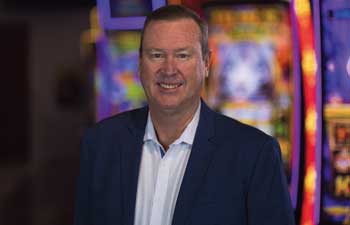
“The first goal is to re-establish ourselves in multiple areas, so I consider that a tick,” he says. “Now for next year, we need to look at increasing our install base in our venues. Then the third year is figuring out what ship share we need to get into the top five. And it’s always nice to get some industry recognition along the way. So, if we could pick up a couple more nominations and maybe an award, I’d be very, very happy.”
Conversely, maintaining a positive internal culture and camaraderie is key for Krucyznski. He contends that “without great people, you won’t see great products,” and adds that “having people here who are happy to be here and have that pride, ultimately that’s what it’s all about.”
He also naturally hopes for one of the so-called “20 percent games” to take off—the one he highlights for next year is Rocket Frenzy, which debuted at G2E with great feedback. “I really wouldn’t mind making Rocket Frenzy games for the next three years,” he admits.
Up top, Hunsberger hopes for a combination of both internal and external progress.
“When we look at milestones, we want to make sure that we’re operating efficiently internally to ensure that we can provide the product for our sales team to execute in the field,” he says.
“That’s the No. 1 thing. Then when we look at external goals as it relates to ship share or sales volume, that’s No. 2. We certainly want to get back to the ship share we enjoyed four or five years ago, and we have the library to do that. I think it’s important for the market to give us an opportunity to continue to show the strength of Ainsworth as a place that you can go to win.”