Alleviating the Problem

Kindbridge is at the forefront of the responsible gambling movement, providing pathways to treatment for problem gamblers or at-risk players through partnerships with operators.
The next step? A collaboration with Mindway AI, a company aimed at identifying risk factors earlier and in more granular detail than typical RG avenues.
The partnership between these two companies will elevate RG practices at every point in the process, from identifying at-risk players to giving them streamlined access to treatment.
“We’ve been working on this in the background for a while,” says Kindbridge CEO and founder Daniel Umfleet. “It’s probably been going on for about 18 months.” Umfleet adds that timing is “perfect” with Kindbridge “building out its capacity” and with risk scoring “becoming more of a front-and-center regulatory issue.”
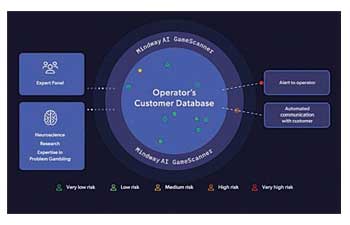
It all starts with arguably the hardest step: identifying players who display risky betting behavior or who outright present with gambling issues. Mindway AI’s GameScanner software combines artificial intelligence algorithms and human expert assessments to overcome hurdles inherent in the challenge of identifying players in need of help. Mindway is already live in 37 countries across four continents. The partnership is U.S.- and Canada-focused for now, but that could change down the road.
“There’s a global objective in a longer sense together, but that has to come in steps,” Mindway CEO Rasmus Kjaergaard says. “Obviously, it makes sense to start where we are already operating either side and combine our forces there and see how it can grow.” The companies are beginning to ramp up U.K. services as well.
 “Our biggest customer has 2 million active players a day in one jurisdiction here in Europe,” Kjaergaard says. “Multiplied by (standard problem gambling prevalence of 1-2 percent), that’s still quite a lot of cases to handle. So you need systems in place that are automated and optimized for the purpose of handling the worst cases first.”
Zooming in from the high-level global view, Kjaergaard believes RG solutions should account for unique behaviors.
“You and I are two different individuals,” Kjaergaard says. “Our gambling behavior is individual, and our risk factors would be individual, too. AI is strongest in finding patterns in big data sets, and you need to instruct it which patterns to look for. The challenge is that these patterns are individual; there’s no sole truth.”
“What we are looking to get out of this long-term is validating that the risk scoring has a correlation with mental health-related issues,” Umfleet says. “Therefore, there needs to be a continuous feedback loop with the risk scoring on the mental health side of the equation to ensure that there’s a direct bridge happening when somebody of a certain risk profile gets identified, they then get direct access to the right kind of resources.”
The Full Picture
Many solutions will focus on self-exclusion, self-assessments, or highly variable data points to identify problem gambling, according to Kjaergaard.
“We want to create a full picture, and that requires an approach combining real human experts—mainly psychologists working in RG—with AI.” The model has proved effective thus far. A test in July revealed that GameScanner detected problem gamblers like a human psychologist would 87 percent of the time.
With Mindway AI’s solutions honed and constantly improving, the natural next question is, what happens next?
After a player is identified and/or self-excludes, how can Mindway and Kindbridge leverage the data they have to give that player the best chance at help? The partnership is in its early stages, but both businesses have ideas on how they can streamline the process and drastically improve the next steps for players.
Michelle Hatfield is the chief clinical officer at Kindbridge Behavioral Health, a licensed marriage and family therapist, and a doctorate candidate in cyberpsychology. She already has a vision for how the two companies can come together and augment their treatment and outreach plans.
“Right now, we’re working with Mindway to establish a treatment pathway,” she says. “Ideally, people who demonstrate risky behaviors and are scored on Mindway’s continuum of concerns get referred to us for services, and that’s where we would step in to transition the player, identify their needs, and determine what kind of treatment is best.”
Currently, a player will be referred to Kindbridge via an operator if they self-exclude, express a need for services, or identify that they’re at risk for a potential problem with gambling.
“They access us through that operator,” says Hatfield. “They receive an email with details about Kindbridge and links to an intake and screening scheduler.”
That first meeting is essentially a pulse check and an informational session. Kindbridge’s providers will assess the player for the type of care they need, whether there are treatment providers in their area, and other baseline details.
From there, the player completes a self-assessment, which helps Kindbridge determine if they have a gambling problem and/or an underlying mental health condition that should be prioritized.
The glory of Kindbridge’s approach is that there are no bottlenecks to treatment. “We have staff available,” Hatfield says. “We have therapists certified in gambling counseling, and they have capacity. People can get services within two to three days of scheduling an appointment.”
Umfleet adds, “Whether it’s just light-level, light-touch mental health-related issues, or if it’s all the way up in the addiction category, they’re more likely to engage with the service because you’re communicating with them more frequently based off of how they’re sliding around on the risk scale.”
The GameScanner Tool
There’s always room for improvement, though, and Hatfield already sees the value of Mindway’s GameScanner. “What I would like to see is a component of research. We can explore how their findings correlate with our assessments.
“Mindway might come with their risk scoring assessment on an individual,” she continues, “so we can take that risk-scoring and compare it to the Problem Gambling Severity Index to find overlap. We can say, ‘Look, your risk scoring of 1 through 5 often correlates with our PGSI scoring.’”
Armed with that data, Kindbridge can, in turn, tweak its treatments to cater to players. There’s also value in hard data, which Hatfield says can help paint a picture for players of what their exact risk factors are.
Granular data plays a key role here, and Kjaergaard provides an example.
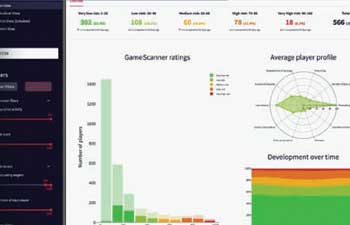 “One common risk factor is nightly play. Most systems might start and end with the question of whether there’s nightly play. We go deeper and find extra context. For example, if the nightly play is clustered around the weekend and accompanied by stable deposit patterns, that’s one risk level,” Kjaergaard says.
That type of nightly play is consistent with weekend viewing of NFL games, perhaps. On the flip side, there are much riskier ways to play nightly.
“Perhaps we see nightly play with erratic deposits and frequent bets on weeknights spinning into night hours. That’s a significantly higher risk level.”
Kindbridge can benefit from this data in many ways. The obvious path is comparing the information with a player’s self-assessment to see if the self-awareness lines up with the problem’s severity. It can also nudge the treatment process in subtle ways when a licensed treatment provider has a clearer picture of a player’s driving risk factors.
And while this hasn’t yet taken full shape, Mindway and Kindbridge may be able to improve their messaging strategies when a player presents with issues. Hatfield notes that repeat messages—whether via email, text, or other channels—are often most effective at getting players to seek help. Once they do seek help, it’s important to provide a safe and understanding space for them.
Hatfield says, “Usually in treatment, somebody’s coming to us because they’ve been nudged or they’ve noticed a problem on their own. We have to establish a no-stigma, no-judgment, supportive environment. As a treatment provider, it’s essential to approach it from a space of wanting to help the client meet their goals.”
Approaches to responsible gambling communication and treatment also hinge on regulatory requirements. As of now, the U.S. doesn’t have a blanket strategy for tackling such issues, but other countries are making big strides.
The U.K. has implemented online slot limits and affordability checks. Concern about player protection has cast doubt on the nascent Brazilian market. U.S. lawmakers have proposed federal sports betting legislation in response to a perceived lack of effective RG safeguards.
In yet another example, Kjaergaard cites new requirements for Dutch operators.
“In what could be perceived as somewhat extreme, from an American perspective, in the Netherlands they just put new enhanced checks in place where if you detect something wrong with particular risk factors, or harm with a player, you as an operator have to reach out to the customer within an hour,” he explains.
The increasingly bright spotlight surrounding problem gambling requires stakeholders to get creative in their solutions. In order to meet players where they are, collaborative approaches such as this might be the best answer.
“We track risk, and we do it quite well,” Kjaergaard says. “But we do not give diagnosis on addiction, and the beauty in partnering with a company like Kindbridge is that you take our risk scoring and turn it into helping real people with real problems.”