
Warrior, Statesman, Champion

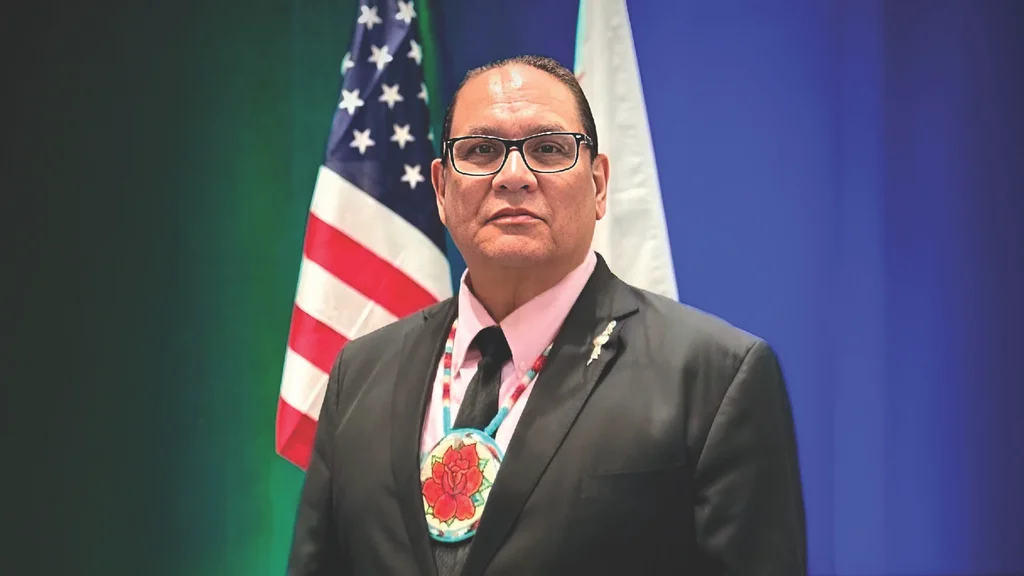
Tribal nations responded with shock and grief at news that Ernie Stevens Jr., longtime chairman of the Indian Gaming Association (IGA), had died unexpectedly in his home state of Wisconsin on September 26. Stevens was 66 years old.
A member of the Oneida Indian Nation, Stevens “dedicated his life to Indian Country,” according to a statement IGA issued after his death. “For more than two decades as chairman, he never wavered from the mission of advancing tribal government gaming and strengthening tribal sovereignty.”
“Trail-blazing leaders such as Ernie pave the way for uncontested legacies, and the Nation will be forever grateful for his unselfish contributions,” said Tehassi Hill, chairman of the Oneida Nation.
During Stevens’ leadership of IGA, tribal gaming revenues soared from $11 billion in 2000 to $43.9 billion in 2024, making tribal gaming the dominant segment of the U.S. gaming industry.
The Milwaukee native is survived by his wife of 45 years, Cheryl; five children, Brandon, Ernest III, Margaret, Maria and Lois; and 20 grandchildren.
Humble Beginnings, Great Heights
As a boy, Stevens witnessed tribal activism close to home. His mother, Marj Stevens, co-founded the Indian Community School, dedicated to preserving Oneida culture, customs and language. The school, originally based in the Stevens’ second-floor apartment, instructed Oneida children in the “longhouse way,” tribal traditions that by then were in danger of being lost to assimilation.
The Stevens family lived above the office of the American Indian Movement (AIM) Wisconsin chapter, established in part by Stevens’ uncle, Herb Powless. In 1971, AIM members led by Powless seized an abandoned Coast Guard Station on Lake Michigan. They asserted their rights to the land under the 1868 Treaty of Fort Laramie, which mandated that any abandoned federal property be returned to its Indigenous owners. They won that battle and relocated the school there. (It still operates today, in a different location.)
In a 2024 interview with the Milwaukee Journal Sentinel, Marj Stevens described her neighborhood, on the city’s north side, as a “ghetto” where her six children were subjected to ridicule. But local bullies soon had reason to think twice. At age 16, Ernie co-founded the Soaring Eagle Boxing Club in Oneida. He went on to become a four-time consecutive state heavyweight champion (1976-1979) and a two-time National Heavyweight Champion (1977-1978).
Stevens earned an associate’s degree from what was then Haskell Indian Junior College, a bachelor’s in criminal justice from Mount Senario College and a master’s degree in management from the University of Phoenix. The present-day Haskell Indian Nations University honors his legacy by hosting the annual Ernie Stevens Jr. Classic basketball tournament.
In the 1990s, Stevens was elected councilman of the Oneida Nation in Wisconsin. He also served as first vice president of the National Congress of American Indians.
In 2000, he became IGA chairman, and last April, he was reelected to his 13th term. During his tenure, IGA became an influential voice in Washington, D.C., consistently advocating for tribal rights and ensuring the protections granted by the Indian Gaming Regulatory Act (IGRA).
“Trail-blazing leaders such as Ernie pave the way for uncontested legacies, and the Nation will be forever grateful for his unselfish contributions.”
—Tehassi Hill, Chairman, Oneida Nation
That breakthrough legislation, enacted in 1988, established the gaming framework for Indian Country. IGRA paved the way for an industry that has enriched and empowered many tribal nations, who use gaming revenues to fund education, health care, infrastructure and economic development.
In 2015, Stevens was inducted into the American Gaming Association’s Gaming Hall of Fame, and in 2023, he received the ICE Landmark Award for his leadership during the Covid-19 pandemic.
Unmatched Legacy
At a ceremony in Milwaukee in July, Mark Powless, chairman of the Oneida Gaming Commission, saluted Stevens for his lifetime of service.
“Ernie Stevens Jr. has dedicated his life to Indian Country with unwavering commitment and passion,” Powless said. “From the boxing ring to the boardroom, in his career he has demonstrated strength, vision and resilience that uplift tribal communities nationwide.”
In one of his last official acts, on September 16, Stevens attended the annual Day of Remembrance at IGA’s conference center in Washington. The event acknowledges the plight of Native American children who were once compelled to attend U.S. federal Indian boarding schools, where they often faced abuse and neglect.
According to Native News Online, Stevens was in good spirits that day and spoke of his plan to write a book about his life. He died 10 days later.
Contacted by the Associated Press, Stevens’ aunt, Bobbi Webster, called news of his death “unfathomable. He was pretty young and vibrant, athletic and healthy. It just came as an unexpected shock to everyone who knew him.”
More Than a Chairman
Then the tributes poured in, from Indian Country, the gaming industry at large and the halls of power.
Phil Hogen, former chairman of the National Indian Gaming Commission, called Stevens “a dynamic and visionary leader.”
Bill Milller, president and CEO of the American Gaming Association, hailed him as “a tireless and passionate advocate for Indian Country and a unifying force in advancing tribal sovereignty through gaming.”
Marcellus Osceola Jr., chairman of the powerful Seminole Tribe of Florida, remembered “a friend who championed the sovereign rights of all tribes to advance the livelihoods of their members through successful gaming enterprises.”
Washington State House Speaker Pro Tem Chris Stearns called Stevens “a lion of a man” whose “faith in his fellow humans” could not be extinguished.
Former U.S. Secretary of the Interior Deb Haaland, the first Native American and first woman to hold that position, said Stevens was “tremendously optimistic about the abilities of Indigenous people” and “displayed sharp, decisive leadership. When I got news of his passing, I realized the difficulty in imagining this world without him.”
“We will miss his leadership and especially his commitment to education and youth,” wrote Menominee Nation Chairman Joey Awonohopay in a social media post. “His legacy of service, mentorship and unwavering advocacy will live on in the generation he inspired.”
A statement from the California Democratic Party Native American Caucus said, “Ernie was larger than life, both literally and figuratively. … Brother, your enormous heart and soul will be missed.”
Stuart Hunter, managing director of Clarion Gaming, said Stevens will be remembered “not only as one of the most powerful voices for tribal sovereignty, but also as a person of kindness, warmth, with an unshakable commitment to his people. … He will be greatly missed.”
IGA Executive Director Jason Giles said, “Ernie Stevens Jr. was more than a chairman. He was a warrior, a statesman and a champion for all of Indian Country… His legacy will be unmatched, and his voice will echo for generations to come.”
The Torch Passes
In 2023, addressing the United National Indian Tribal Youth National Conference, Stevens told young attendees to cherish and defend their hard-won freedoms.
“Indian Country continues to face many challenges negatively impacting tribal sovereignty, tribal jurisdiction, economic self-sufficiency and women’s health, all impacting your future,” he said. “It is important that we stand together to continue to hold this country to its commitment, to promises made by numerous presidents, enshrined in our treaties and the Constitution.”
A final, fitting tribute came from D.K. Sprague, chairman emeritus of the Match-E-Be-Nash-She-Wish Band of Pottawatomi, operator of the Gun Lake Casino Resort in Wayland, Michigan. Sprague thanked “Big Ern” for his advice, advocacy and support as the tribe pursued federal recognition in the 1990s. Gun Lake, which opened in 2011 and completed a $300 million expansion in March, employs about 1,500 people and generated a reported $45 million in revenue in 2024.
“Ernie’s guidance through our initial struggles helped pave the way to the success” of the casino resort, wrote Sprague in a Facebook post. “He was a big part of the Gun Lake Tribe achieving federal reaffirmation and our legal and legislative victories on our path to self-sufficiency.”
He concluded with “Chi miigwetch, Ernie,” Ojibwe for “thank you.”