
Views from the Mountaintop

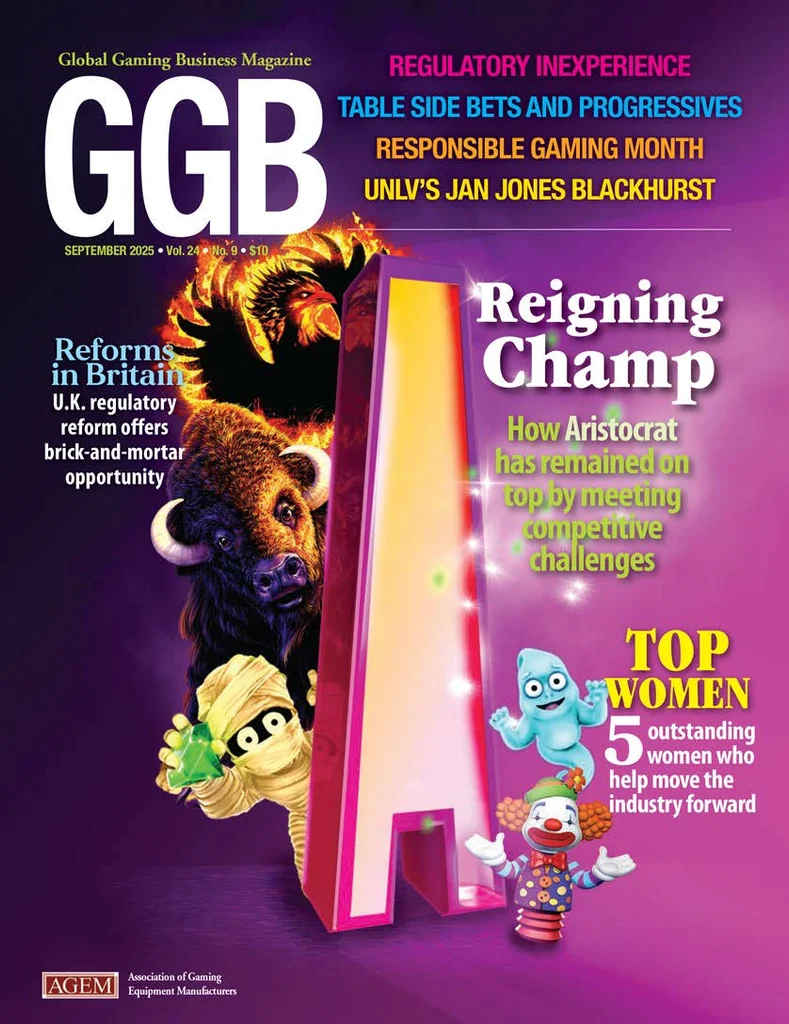
On February 27, Eilers & Krejcik Gaming held its seventh annual EKG Slot Awards show, where being recognized has become one of the supplier sector’s highest honors. Aristocrat Gaming widened its already expansive trophy case that night and took home another award for Best Overall Supplier—also its seventh, meaning no other company has yet won the judges’ top prize.
“The EKG Awards recognize top performance, and we are grateful to each of our customers who allow us the privilege of entertaining players with our leading game content, hardware, systems and more,” Aristocrat Gaming CEO Craig Toner, who was appointed to the role just a few months prior, said in a release the day after the ceremony.
But while Aristocrat maintained its pole position yet again, this year’s results also highlighted just how fierce the competition has become. In 2022, Aristocrat won nine individual awards in addition to the overall prize. It followed that with six in 2023, topping the field both times. Then in 2024, Light & Wonder grossed seven individual awards to Aristocrat’s five, and this year Aristocrat netted just one individual category, as opposed to seven for IGT and six for L&W.
Those competitors to Aristocrat have long been fighting for second and third place, but both have also become significantly stronger in recent years. L&W has seen multiple years of significant growth since divesting its lottery and sports betting divisions in 2022, and IGT was recently merged with Everi Holdings in a $6.3 billion deal under Apollo Global Management, one of the biggest shakeups the supplier sector has seen to date.

Toner’s predecessor at Aristocrat, Hector Fernandez, is currently waiting through a non-compete obligation before he takes the reins as CEO of the new IGT later this year.
Despite these trends, Aristocrat is more focused than ever on maintaining its lead and reestablishing its dominance in the sector. The data remains striking—according to the most recent figures from EKG’s July Game Performance Report, Aristocrat was easily the highest-grossing supplier overall, representing more than 30 percent of total units tracked compared to 23 percent and 20 percent for L&W and IGT. Its share of the total theoretical win was even higher at 40 percent, almost double L&W’s second-place figure of 22 percent.
And while its existing hit titles like Dragon Link and Buffalo still dominate game charts and casino floors everywhere, new releases for its Spooky Link, Mo Mo Mummy and House of the Dragon titles were also at or near the top of the new core video and premium IP charts.
“Our primary focus is scaling the business in a way that deepens our player engagement across every channel, including land-based, online and mobile. We’re investing in new platform capabilities and global content strategies that give players more ways to connect with our experiences, wherever they are. It’s not growth for growth’s sake; it’s about building longevity and resonance.” —Craig Toner, CEO, Aristocrat Gaming
The company’s ASX-listed stock has climbed some 32 percent in the past year and 146 percent over the past five. Its half-year results, published in May, showed a 9 percent increase in overall revenue to AU$3 billion (US$1.95 billion), but its profit after tax saw a 21 percent year-over-year decline to AU$511 million.
Toner, who is now approaching a year at the helm and about eight with Aristocrat overall, says he knew coming into the role “that both the opportunities and challenges would co-exist” for him. He expected to jump into the cockpit of a fast-moving jet while also keeping in mind “the need to double down on agility and bold innovation.” So far, nothing has been unexpected, but that doesn’t change the goals or the difficulty in achieving them.
“Competition is fiercer than ever, and we welcome it because it moves the industry forward to create new and engaging experiences for customers,” Toner says. “It pushes us to evolve, sharpen our edge and explore what’s possible. Awards are meaningful, yes, but the real measure is whether we continue to earn players’ and operators’ loyalty and trust. That’s what drives us every day.”
Player-Focused Growth
For a behemoth like Aristocrat, the right mix of consistency and innovation is a difficult cocktail to master. Today’s increasingly competitive landscape also makes the margin for error razor-thin and adds even more pressure to each decision. But when asked about the company’s biggest current priority, Toner points to the real engine that drives the growth for both Aristocrat and the industry overall: the players.
“Our primary focus is scaling the business in a way that deepens our player engagement across every channel, including land-based, online and mobile,” he explains. “We’re investing in new platform capabilities and global content strategies that give players more ways to connect with our experiences, wherever they are. It’s not growth for growth’s sake; it’s about building longevity and resonance.”
Leading the way for this everything-all-at-once product development is Chief Product Officer Matthew Primmer. Primmer has had a similar trajectory at Aristocrat as Toner, in the sense that he moved into the C-suite at around the same time after working his way up for several years.
Over that span, he says, the growth and transformation of the company have been “incredible,” going from “a strong regional player” to a “creative powerhouse” around the world.
“Leading the product team today means being part of that evolution, driving forward new ideas while honoring the DNA that got us here,” Primmer says. “That DNA consists of two key strains: obsessing about our games and entertaining the customers.”
In terms of product segments, Primmer has a tough job in deciding just how much of the resource pie to allocate to the company’s various content arms, which include Class III, Class II, digital content, social casino and iGaming. Each segment presents “countless opportunities,” and they are “equally critical parts of our strategy for our D&D investments” because of their connection to customers, he notes.
Given that regulated iGaming is still in its infancy in the U.S. and Canada as compared to the other segments, it makes sense that this would be an area earmarked for future growth. Aristocrat has solidified this objective by setting a hefty goal of earning at least US$1 billion in interactive revenue by fiscal year 2029. In the first half of 2025, the company posted AU$263 million (US$171 million) in interactive revenue, a modest sum in comparison to its future goal but a strong 141 percent gain from the prior-year period.
“iGaming is a growth engine for us, and we have stated our revenue target,” Primmer says. “We are moving thoughtfully to meet that target by investing in that business, with one of the benefits being that we are able to scale our content across more channels and in front of more customers.”
Anything related to scale becomes both simpler and more complex when considering various hubs around the world. No two players are alike, and the same is true for geographic regions of players. Aristocrat has studios around the globe from which to draw ideas, but they must collaborate and work with each other to produce the best content for the end user.
Primmer calls this dynamic “an ecosystem of creative exchange,” a system that “starts with shared vision and ends with trust.” Such a foundation is necessary for true creative exchange in a high-stakes environment.
“Whether it’s Sydney, Las Vegas, Macau or London, we’re synced on delivering standout content that reflects our global strength,” he says. “Delivering content across channels is a strategic advantage, and we are organizing our product teams and studios to do that more quickly and with the highest commitment to quality.”
Toner reiterates that perspective, adding that the company “applies a global lens” to all of its various workings. With regard to areas of future growth, nothing is off the table, but intentionality remains key.
“North America remains a core focus, but we see exceptional momentum in Europe and the Asia Pacific market as well,” Toner says. “We’re being intentional about how and where we grow, localizing content, fostering partnerships, and aligning with the needs of our customer base.”
In the future, that ecosystem will grow even more. Aristocrat last October became the first supplier to be issued a license by the General Commercial Gaming Regulatory Authority, the newly formed gaming regulator for the United Arab Emirates, which many believe could become the industry’s next growth hub.
Protecting the Empire
If there has been something of a change in the company’s approach recently, it has been its split between in-house and licensed content. While other suppliers have leaned heavily on branded IP games over the years and are now venturing into in-house titles, Aristocrat has essentially done the opposite.
In the last three years alone, the company has struck high-profile game licensing deals with the National Football League, Game of Thrones (House of the Dragon) and, most recently, Hasbro (Monopoly).
In January, the NFL slot series expanded outside of the U.S. for the first time since its debut in 2023 with a launch in Puerto Rico. The House of the Dragon series made its casino floor debut at Wynn Las Vegas in February, and the Monopoly series will begin production in early 2026.

Helping Aristocrat to secure these deals is Joe Kaminkow, the company’s chief innovation officer and a member of three different game-related Halls of Fame. Kaminkow’s mastery of licensing deals goes back several decades and includes much of the American zeitgeist, from NASA to The Simpsons, The Wizard of Oz and on through the company’s most recent forays. For all that he’s accomplished, he has chosen to stay with the company and has become one of its most potent resources.
“It can feel like a lot of the same in this industry, so for me, the more important thing is to continue Aristocrat’s culture of innovation and developing the next new thing,” Kaminkow told GGB last December.
While Kaminkow’s job is to identify and negotiate that next big thing, it’s then Primmer’s turn to take that IP and turn it into something great, which is no simple task with any well-known and well-loved brand. The advantage with IP branded games in particular, he says, is that they “offer instant recognition and draw.” But the designers must ultimately back up that first impression with solid game play to fully execute the vision.
“The creative passion from the studios for a brand is critical, and that passion comes through in their execution,” Primmer says. “It reverberates through the games and onto the casino floor.”
Moving forward, the company will continue to tinker with its licensed portfolio in addition to its proven stable of in-house titles, and the right balance is fluid and never set in stone. The overall goal, Primmer says, is “designing for impact, not just novelty.” When done right, the sides complement each other, but as Toner notes, everything is a balancing act.
“We preserve what works and what players love, but we’re not afraid to challenge our own playbook,” he explains. “We’ve created space for calculated risk-taking, whether in mechanics, formats or narratives, and we test relentlessly. Our culture prizes both excellence and reinvention.”
In addition to its content and leadership teams, Aristocrat has also recently had to rely heavily on its legal division. In the last year, the company has successfully defended its IP in court both in Australia and the U.S.
“Whether it’s Sydney, Las Vegas, Macau or London, we’re synced on delivering standout content that reflects our global strength. Delivering content across channels is a strategic advantage, and we are organizing our product teams and studios to do that more quickly and with the highest commitment to quality.” —Matthew Primmer, Chief Product Officer, Aristocrat
One case involved former employee Dinh Toan Tran, who allegedly copied “a substantial volume” of company information onto external USB drives before submitting his resignation in December 2023. Tran was poised to join a competitor before Aristocrat filed suit in Australia in January 2024. The matter was resolved “on favorable terms,” the company said afterward in a release.
The other case, which is still ongoing, involves L&W’s Dragon Train series. Aristocrat alleges that the series misappropriated IP from its popular Dragon Link family. A preliminary injunction was granted by a Nevada judge last September, and L&W has since pulled the games from the market. The case has evolved since then and has a trial scheduled for next year.
At the time of the preliminary injunction, Primmer said in a statement that the ruling “underscores the value” of its IP. He also noted that the company is only able to create such appealing games “knowing that the law protects” its products. Nearly a year later, his sentiment still applies.
“We build experiences that stick, mechanics that engage, narratives that resonate and visuals that innovate,” he asserts. “It’s no surprise they draw attention, but we take pride in doing things the right way. Our success is rooted in originality and player-first design. Our brands, our IP and innovations are our competitive advantage. We will continue to innovate and simultaneously defend our IP because they are central to who we are as a company.”