Trading Up

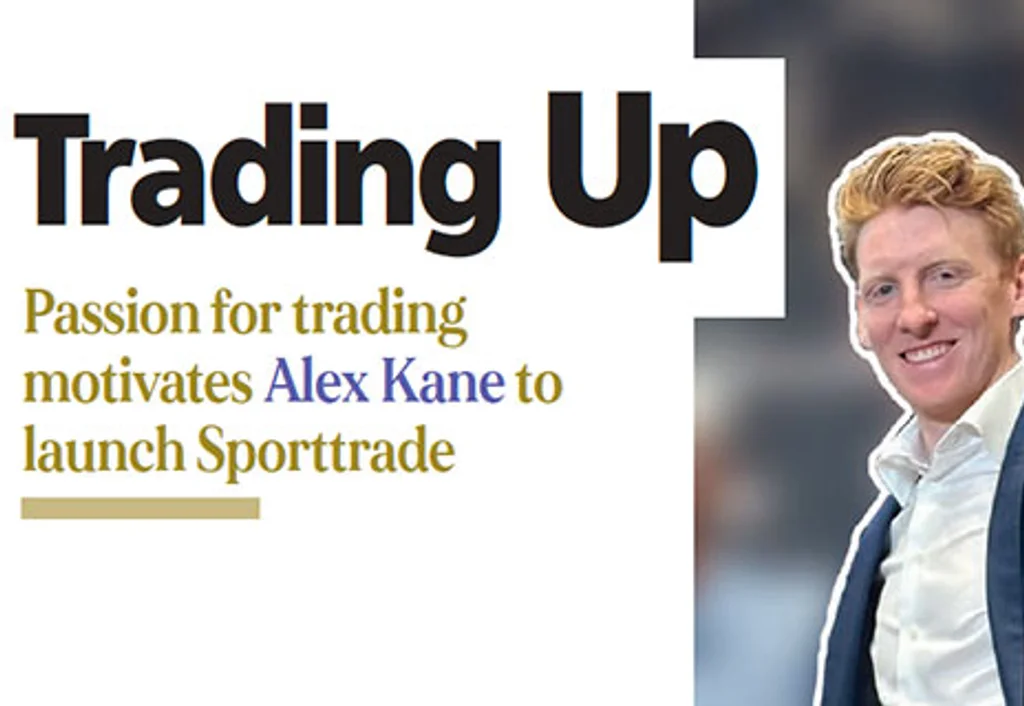
Alex Kane is excited.
Ask him about Sporttrade, the company he founded in 2019 that models sports betting on the commodity exchanges, and he can barely contain his joy in describing the platform.
“I am obsessed with marketplaces!” he says. “I was interested in this, and I wanted to build a marketplace because of that obsession. It’s that vibrant atmosphere of buyers and sellers. I just loved that!”
“I am still excited because I do still have this long-term vision of wanting to create something different,” Kane told iGamingBusiness when Sporttrade launched in Virginia. “I love listening to players and learning from them.”
A native Philadelphian, Kane counts the Phillies as his favorite team, but the success of his hometown Eagles—winners of the most recent Super Bowl—has also been exciting for him.
But ask him about trading, especially trading on sports bets, and get ready. Kane has a lot to say.
Like Day Trading, but with More Passion
When access to legal sports betting in the U.S.—particularly online betting—began broadening in 2018, newcomers to the activity could be stumped by the cryptic numbers that surrounded placing a bet. If the Patriots are your favorite team, seeing them listed at –150 or +3.5 can be confounding and might stop a novice from putting money down.
If the Patriots are listed at 45 percent, however, a bettor can readily understand that they’re given a 45 percent chance of winning. Decades of exposure to percent chances—think percentage chance of rain—has conditioned Americans to be able to judge success rates.
It works the same way with Sporttrade.
On any given day, Sporttrade can list thousands of outcomes on a game, like a marketplace. For instance, during the NFL season, bettors might choose the Denver Broncos to beat the Los Angeles Chargers. Customers on Sporttrade can place a bet and then track the percentages of potential success throughout the game and sell that bet—hoping to make a profit—at any time before the game ends.
Much like the stock market, Sporttrade taps into a market maker—a person or institution that keeps the market fluid by quoting buy and sell prices, essentially facilitating trades and earning a profit on the margin.
Sporttrade hosts what’s called an order book. “That order book is like a collection of all the bids and offers,” Kane says. “A bid is like an instruction to buy, and an offer is an instruction to sell. Market makers plug into our venue, and then they flood all the order books—in this case, Denver to beat the Chargers—with bids and offers.
“Without them, it would be kind of like, well, what’s the value of the U.S. stock market without market makers? If you took the NASDAQ and the NTSE and you unplugged all the wires from the market makers system to the exchange system, the entire financial market would collapse within seconds.”
Sporttrade works the same way. A bettor can see that Denver is maybe given a 32 percent chance to win before the game starts. So they buy in at 32, and when Denver scores a touchdown, the bettor can look at how the stated win probability has changed. In this instance, it would have gone up because of the score.
Like the market, bettors or investors want to buy low and sell high. Now, after Denver has scored and is up comfortably at halftime, the probability of victory has perhaps risen to 80 percent. Our model bettor might say she wants to sell at 80, which is the highest bid. She can set that as her sell price and make a profit.
Kane says the app’s transparency and pricing are key to success. This is because of the player’s ability to control the buy or sell option. “No other sportsbook would possibly allow that,” he adds.
Kane’s belief in the concept of a market-type app is based on his interest in market trades. “I really think it will be successful in the U.S. because Americans are traders, and we have this affinity towards markets.”
Slower Climb to Acceptance
While Americans may be used to the idea of market-based moves, Sporttrade has been slow rolling out.
“It’s taking longer than I probably would have hoped, but I know it’s going to work that way one day… the vast majority of customers are going to opt for that sort of model. Either because it’s more transparent, or they don’t get limited, or pricing is a lot better, or it allows them to do things they already can’t do in a sportsbook. Or it’s just that general belief of ‘When I use Sporttrade, it’s the only app that doesn’t try to screw me.’”
Sporttrade is available in five states, with the most recent launch in Arizona in November 2024.
“I think (the impact of Sporttrade to the betting market) will be more down the line as it progresses,” Steve Bittenbender, a writer and analyst for BetArizona.com, told Cronkite News in November. “I definitely think Sporttrade is going to help increase the overall handle.
“I don’t think they’re going to be taking away much from the existing sports betting operators right now. I think they’re going to be fitting a niche that hasn’t been available, through the exchange operation that Sporttrade runs.”
Finding That Niche
Kane found his own niche early on, while coming from a family of high achievers. His mother was head of women’s wear at designer Liz Claiborne in the ’90s, his father is an endocrinologist, his oldest sister is a doctor and his younger brother is in medical school.
His own interest was in finance and business law when, in a departure from the rest of the family, he got the bug to create a sports betting marketplace.
 “We have doctor, doctor, doctor, designer and a guy who’s trying to build a sports betting marketplace,” he says with a laugh. “That’s us. A lot of smart people, but not a lot of overlap. I think we would do well at Family Feud.”
When his mother landed a job at Drexel University, it was fortuitous for Kane. It enabled him to attend the school “for free to learn about finance and business law and catch this bug, this crazy bug, for wanting to build a sports marketplace,” he says.
His experience in Drexel’s Charles D. Close School of Entrepreneurship set him on his path. Taking a cue from the Robinhood trading app, Kane conceptualized what became Sporttrade. He was accepted into the Comcast and NBC Lift Labs incubator and received the monetary and mentorship support that helped him create the app.
His time at Drexel in Philadelphia also fueled his desire. “I was obsessed with marketplaces, obsessed that you could see a real-time ticker at the Drexel LeBeau College of Business. That’s so cool! It’s a live market, it’s a referenceable thing that you go back to the old movies and see the prices are born out of this incredibly vibrant atmosphere of buyers and sellers. I just loved that.
“But I had no experience in finance. I didn’t know anyone in finance. And obviously my family had no expertise in that side of the world—law, business, anything,” he says. Taking a leap of faith, Kane searched through LinkedIn and Twitter (now X) and cold-contacted people in the industry, trying to get his idea of a sports betting marketplace in front of someone.
One of those people he contacted was Jack Andrews, a professional gambler based in New Jersey.
“He pitched me this idea of a sports betting exchange, and at the time, he told me (he’d charge customers) only 1 percent commission on it,” Andrews says. “And I said, ‘Well, you know, you’ve got to pay the excise tax out of that.’ And he said, ‘What now?’
“He hadn’t even heard of the excise tax yet,” Andrews recalls. “So that’s how early on I got to talk to Alex Kane. I told him what a horrible idea it all was, and I’m glad I was kind of wrong, because I’ve used Sporttrade here in New Jersey since they went live and it’s been a very pleasant experience. It’s kind of a game changer.”
Kane’s persistence paid off. Kane heard from one contact who responded that he, along with another potential investor, were interested in going into the sports betting business. They told him, Kane says, “We understand marketplace and market microstructure and how to build these venues. And we’re also sports bettors, and we want to be market makers on your platform, and we want to invest in your business.”
Months of raising capital and code building turned into years before Sporttrade launched in New Jersey in 2022, followed by Colorado in 2023, then Iowa, Virginia and Arizona.
Kane is excited about the coming launch of a web platform that will remind users of stock trading platforms. “I think the biggest things ahead for us are this web platform, getting it out there, showing the market. I think through that, I think we’re going to have a big breakthrough on the adoption of the platform in a way that we haven’t experienced to date.
“It’s not a sportsbook, it’s a marketplace. It’s got all this transparency where you can track the flow of the game and you can place your own order.
“I’m here to build this very, very differentiated marketplace,” he says.
“He always has a super-intelligent take on whatever the situation is,” Andrews says of Kane. “Now, he and I disagree on plenty of things, but he has a way of being able to explain his side very eloquently, very distinctly, so that you understand his point without it feeling like he’s the opposition.”
Make It Easier
A simple thought drove Kane in the beginning: Build an environment that works for the customer.
“Honestly, it’s what I care most about,” Kane says. “I couldn’t care less about money or any of those things. I just want to build an environment that’s so dang good for customers that I could open up Sporttrade one Sunday afternoon and be like, ‘Wow, that market! It can’t even get tighter. That is unbelievable.’”
Andrews also sees an audience for Sporttrade: price-sensitive gamblers. “If you go to a stadium and you want to buy a Coke, you will pay $8 for a Coke,” Andrews says.
“If you went to the supermarket and one bottle of Coke was $8 and there was another that cost $1, which one are you going to buy? You’re going to buy the $1 one. But when people are at the stadium, they’ll say, ‘I’m in here for entertainment, and I’ll just take this $8 Coke.’ But people need to look at it more like a supermarket, because you wouldn’t go to a supermarket and buy the highest-priced identical item, would you?”
Kane sees his audience as the curious type, someone who might be drawn to crypto or prediction-market platforms. But he also sees people who might be drawn to the idea of thinking like stock or futures traders, someone who might already be a sports bettor or poker player ready to take that next step and bet on the flow of the game.
“Maybe they’re stock traders who say, ‘Well, Sporttrade is pitching itself as this place where I can bet the flow of the game. I can buy low and sell high, and the price is the probability, let me try that,’” he says. “And they try it once, and they buy Denver at 35 to start the game, and they sell them at 80 at halftime. And they’re like, ‘Whoa. Holy cow, I can start to buy things! I just have to buy things in every direction.’
“What I have to do is teach players about this marketplace version of Sporttrade, sports betting,” he says. Regular sports betting isn’t intuitive, Kane believes, but percentage chance of victory is. Getting people to understand the simplicity of Sporttrade—keeping the “training wheels on,” if you will—is key to keeping people engaged.
“That’s the incredibly fun part of my job,” he says. “It’s such a big vision. It’s such a tall task. It’s like such a mountain to climb. Because you’re trying to rewire the thinking. You don’t have to rewire everyone—boil the ocean, per se—but you do start rewiring folks one by one and show them this is better. Then we have step one right.”
It’s that passion and excitement about the potential of the platform and method that gets Kane up in the morning.
“If I wasn’t 100 percent convinced that this was inevitable, I would have given up long ago.”