
The Race for Third

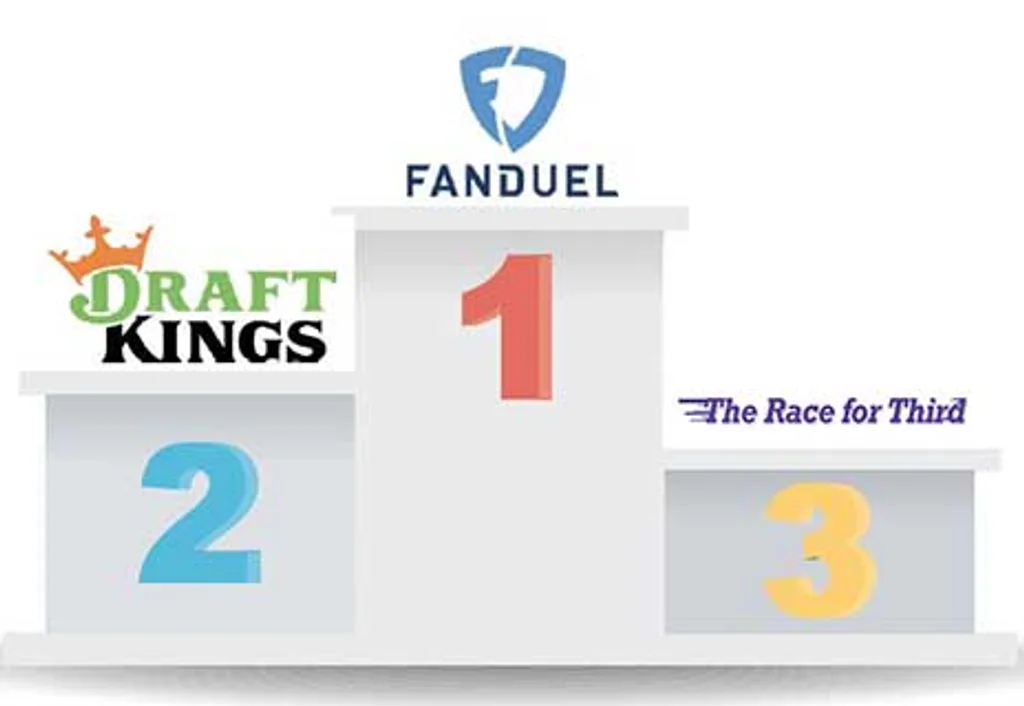
Almost since the first day digital sports betting went live in the U.S.—August 6, 2018—DraftKings and FanDuel have had a stranglehold on market share. That’s not really what anyone expected.
More than six years into legal online wagering across the U.S., stakeholders and industry watchers are increasingly obsessed with one question: Who will definitively be the third-largest operator by market share?
It’s not an easy question to answer. It’s also not one that operators necessarily want to entertain. There are multiple obvious candidates—BetMGM, Caesars Sportsbook, ESPN Bet and Fanatics Sportsbook. And there are a few other possibilities. What two of those big companies have in common is a thread that stakeholders, analysts and those in the industry say is critical: Technology-first companies have a leg up.
“I’m a user of most of these apps,” says Sporttrade founder Alex Kane. “I look toward management teams and/or the CEO and/or a board that is very digitally focused… To get to third, you have to have alignment within the team. MGM and Caesars are digital immigrants, but Hard Rock International is a digital native.”
Kane, who had a vision for stock market-style trading in sports betting, has seen his company evolve to a more traditional platform. At least for now. But he understands the pressure to deliver new, different, faster, unique products. And he also believes that for many of the biggest companies, being public and answering to stockholders can muddy the waters.
But there is still a hunger, at least among analysts and industry watchers, to determine which of the current players can close the gap to
DraftKings and FanDuel, which according to a Susquehanna Financial Group August industry report, own 77 percent of gross gaming revenue in wagering and online casino across the U.S.
“Maybe we are spending an outsized amount of time talking about someone trying to compete for the No. 3 spot in this market,” Adam Candee said during a September Legal Sports Report podcast. The podcast focused, in large part, on how time is running short for Penn Entertainment’s ESPN Bet to make its move.
Genesis of ESPN Bet and Fanatics Sportsbook
For operators, success does not necessarily equal market share. For many, success is about hitting a certain revenue target. For others, it is about driving traffic to their other businesses, whether those are online casinos, brick-and-mortar casinos or, in the case of Fanatics Betting & Gaming (FBG), merchandise platforms.
This fall marks the one-year anniversary for two major nationwide operators—Fanatics Sportsbook and ESPN Bet. More than five years after the four other biggest U.S.-based operators took their first bet, those two platforms are just getting started.
Fanatics confirmed in January 2023 that it had purchased Amelco source code on which it built an in-house technology stack. Six months later, it got the green light from PointsBet shareholders to buy the company’s U.S. division, which included market access in a dozen states. By the start of football season 2023, Fanatics Sportsbook was live in more than 10 states. It’s now available in 22, including New York.
ESPN Bet, the partnership between Penn Entertainment and the “Worldwide Leader,” went live two months later, in 17 U.S. states. The launch came months after Penn Entertainment announced it was cutting ties with Barstool Sports, and shutting down Barstool Sportsbook. While operating a digital betting site wasn’t new, the experience—partnering with Disney and ESPN—was. Live now in 18 states, Penn in early September was still awaiting the go-ahead to launch in New York.
Can BetMGM Secure Third?
 Neither Fanatics founder Michael Rubin nor Penn CEO Jay Snowden were shy ahead of launch about saying that their platforms would grab double-digit market share. Susquehanna in its August report wrote that ESPN Bet had 3.7 percent of market share and Fanatics Sportsbook had 2.8 percent. Bet365 had 3.5 percent.
Those numbers are well behind BetMGM, which sat at about 12 percent market share, and Caesars Sportsbook, which sat at about 4.3 percent.
BetMGM, then, seems the logical choice for securing the No. 3 spot. But as Kane pointed out, it’s a “digital immigrant.” And multiple analysts say it will have a difficult time keeping up with tech-first companies, due to the culture, debt burden and other factors that legacy casino companies must deal with.
But the company has made some recent changes that should further expand its reach, and in turn, market share.
BetMGM last month launched its traveling digital wallet in Nevada. Many see this as potential turning point for the company, which is a joint partnership between MGM Resorts International and Entain. The key will be how MGM can use Nevada—where neither DraftKings nor FanDuel has a presence—for customer acquisition.
BetMGM is the first digital sportsbook to offer such a product in Nevada. Susquehanna analysts wrote that BetMGM’s wallet could “provide an important opportunity to retain user growth as those customers return home and are able to use the same app.” The analysts project annual year-over-year growth for BetMGM’s online sports betting and casino businesses to be 8 percent for the year.
Fanatics Exec: We Still Have Work to Do
Executives at Fanatics and Penn Entertainment are unmoved by all the numbers and speculation. One year into their ventures, executives at both companies say, slow your roll, we’re just getting started.
When sports betting became a states’ rights issue in 2018, it wasn’t clear what would happen in terms of which companies would dominate the space. But since that summer in New Jersey when DraftKings went live in August and FanDuel followed a month later, the two have lapped the competition.
“The expectation was clearly not that by a lot of people in the space,” says FBG CEO Matt King. “I think you had an alchemy of factors. They have the best products. If you look at DraftKings and FanDuel, they were the more technologically endemic companies. Pair that with brands that people already know… But it was expected that the casino companies would be on top.”
Prior to taking his current position at FBG, King was FanDuel’s CEO.
King is quick to acknowledge that his platform is still a work in progress. But he is focused on “enhancing the fan experience” rather than targeting a specific number to define success. There are three parts to reach that goal, he says:
Creating a product that “frankly rivals that of other digital-first companies. Historically, if you look globally, sports betting apps have always been harder to use than the Ubers or DoorDashes of the world.” King says Fanatics approached its sportsbook as a “Silicon Valley app experience.”
Creating a “more rewarding experience. Literally more rewards.” He compares the industry to Capital One, where you earn rewards, versus American Express, where you can earn experiences. “Because of the brand we already have,” he says, “because of the access to 100 million sports fans, we can get customers cheaper than anyone else. So we take that customer acquisition savings, and put it into the experience.”
It’s all about the brand. “Fanatics is, first and foremost, a sports brand, not a gaming brand. We are never going to do a billion (dollars) in marketing in a year, like a ‘bet $5 to get $200 offer.’ If 95 percent of our brand sits at our Fanatics level and 5 percent know we have a sportsbook,” that’s OK.
Penn’s Promise
Over at Penn Entertainment, Snowden also acknowledges ESPN Bet is a relatively new player in a “nascent industry” where wagering is legal “in about 50 percent of the country.” Though 35-plus states currently offer legal betting, either in-person, digitally or both, it is not yet legal in California or Texas, which combined account for about 21 percent of the U.S. population.
ESPN Bet in early September was still aiming to go live in New York, the biggest state with a competitive market, within days or weeks.
While its entry into New York could give ESPN Bet a market-share bump, Snowden says he believes “there is an opportunity for significant innovation and disruption in the industry—and I believe we are uniquely positioned to play that role, given our differentiated fan-focused strategy with the strongest brand in sports.”
During the company’s second-quarter earnings call in early August, Snowden acknowledged that “we have ground to make up—particularly in key-feature categories such as parlays and player props. This is a consequence of the laser focus that was placed on our platform migration, rebranding and new state launches.”
To that end, ahead of the football season, ESPN Bet debuted improved parlay carousel functionality, a dedicated “parlay lounge,” and expanded same-game parlay options.
“Our goal is simple,” Snowden said during the call. “We want to create the best product for sports fans by elevating how they find, place and track their bets—both within ESPN Bet and across the entire ESPN ecosystem. By delivering here, we’ll drive our monetization through enhanced engagement, retention and reactivation.”
What About Caesars?
While most eyes have been on ESPN Bet and Fanatics, of the biggest legacy casino companies, Caesars has been lagging in terms of product or has “product deficiencies,” as Susquehanna analysts noted.
The company is rolling out many new features, from adding thousands of same-game-parlay options to improved functionality.
The BetMGM digital wallet rollout, though, could hurt Caesars, which does not have a similar product, and has not announced plans to add one. Susquehanna analysts say the company’s lack of customer-acquisition investment and sale of the World Series of Poker brand may indicate a lack of focus on digital brands.
Along with Caesars, BetMGM, Rush Street Interactive and Penn’s ESPN Bet, for that matter, are encumbered by a casino culture that can be slower to react and innovate. While some of those companies appeared positioned to be frontrunners as digital sports betting swept the nation, BetMGM is the closest to catching DraftKings or FanDuel, and its market share is still only about 30-35 percent of either.
“It’s a combination of management and resources focused on tech versus gaming,” Truist analyst Barry Jonas says. “The large differential is the database. You take the DFS databases, mostly the male target demographic, and you compare that to Caesars or BetMGM databases, which is maybe older, more female slot players.
“So out of the gate, DraftKings and FanDuel were willing to lose more money and manage loan-to-value. They had less debt burden, less head counts, they don’t have the shackles of the traditional casino companies, and have technology-focused operations.”
How About bet365?
So what of bet365, the U.K.-based tech gaming company that is live with its sportsbook in seven states? The company made its U.S. debut in 2019 in New Jersey, where in May it had 5.7 percent market share—more than double what it had at the start of the year.
A market leader in the U.K., bet365 lacks a familiar brand in the U.S., analysts say, though it does bring a high-quality product from odds to streaming services to breadth of markets. Across the U.S., bet365 has less than 4 percent of market share for digital sports betting and casino combined, though it is only live with online casino in New Jersey.
All of these companies continue to innovate, create niches for themselves and, with any luck, grow. One or two may be able to make a dent in the gap between the field and the big two, though DraftKings and FanDuel, with their tech-first mentality, will continue to innovate, create, and push the envelope.
And all the other companies may use a different metric than market share to define success.
“While FanDuel and DraftKings currently hold the top two spots in online sports betting and iCasino, it is not a forgone conclusion that the rest of the field will be forever playing for third place,” says Snowden.
Snowden’s point is well taken. After all, the U.S. market is not fully formed, and it could take a decade or more for the field to level. So the question remains—which company will definitively be the third biggest operator by market share?
“I think if you look at Europe and other markets, you don’t see such concentration there,” Jonas says. “But in the evolution here, once there is more parity in the product, then share will be spread more evenly.
“Once there is iGaming, omnichannel players will be able to take more advantage. But the question is, when do you see that parity coming? As everyone else is playing catch-up, it’s not like DraftKings and FanDuel are standing still. Is there a slowdown in innovation at some point that allows the field to become more level?”
Time will tell.