
Social Revolution

Advances in technology have turned social casinos into immersive worlds that rival the land-based experience
The social casino market could be worth $8.7 billion by 2026 and surpass $11.2 billion by 2028.
That’s a fraction of the $160 billion online gambling sector, but it’s up almost threefold from 2014, and poised to grow.
Though participation has dipped since the Covid-19 shutdowns, manufacturers are upping their game to expand this subset of the casino-verse. With eye-popping graphics, user-friendly interfaces, recurring rewards and a model that encourages interaction, they build virtual ecosystems where players enjoy casino-style games without having to spend a dime.
Free at the base level, social casinos generate revenue through ads and in-app purchases that unlock additional games and features. Because they don’t involve gambling, they’re legal in almost every state.
Mobile First
The ubiquity of slot-style games in the social realm is no coincidence. “People have a brand affinity for slots at the casino, and they come inside our apps to play those same games at home,” according to Danny Moy, chief strategy officer for SciPlay, Light & Wonder’s social gaming arm. “We partnered closely with land-based developers on the gaming side at Light & Wonder to create the same fun factor and enjoyment people get in an actual casino.”
Game developers and technology teams work to reproduce “the same look and feel, the same joy and adrenaline a player would experience in the real-world casino, from the speed of the animation to the feel of it when you hit the spin button to the sound of hitting a jackpot,” Moy says.
Among SciPlay’s most popular titles are Jackpot Party, Quick Hit Casino, Goldfish Casino and 88 Fortunes. Social casinos also offer variations of blackjack, roulette, bingo and other casino-style games.
 The majority of users, an estimated 85 percent, play on their phones. So games once configured for casino terminals must be reduced to roughly the size of a deck of cards. It’s a small world, but discerning players expect it to deliver a compelling entertainment experience, says Lisa Singer, vice president of brand and strategy for High 5 Casino.
Building a social casino “involves meticulous attention to detail,” she says. “Key to the process is designing with the mobile user in mind from the outset, creating user interfaces that are easy to navigate, even on smaller screens.”
Touchscreen interactions must be “smooth and precise, allowing players to engage with the game effortlessly.” Players want smooth game performance that doesn’t drain battery life or consume too much data. “This involves fine-tuning animations, minimizing load times and ensuring compatibility across a wide range of devices,” Singer says.
Features like tumbling reels and split symbols “not only enhance game play but also increase their chances of winning big. The rich themes, high-quality graphics and sound design provide an engaging escape that keeps them coming back.”
High 5 Casino’s 1,200-plus titles include favorites like DaVinci Diamonds, Green Machine and 88 Drums. In May, High 5 was named Social Gaming Operator of the Year at the 2024 EGR North America Awards—its second year in the top spot.
Creating Community
The social casino model originated in 2007, when Zynga Poker debuted on Facebook. The sector picked up steam in the 2010s, with the rise in smartphone use. Since then, social games have evolved from simple, sometimes clunky versions of cartoon slots to “full casual games, with a robust meta-progression,” says Moy.
Given their origins, social casinos have become intrinsically linked to social interaction; sharing and celebrating with online friends fosters a sense of community, stoked by real-time competition.
These games “have live-ops events and social and community interaction, all around the original core experience,” says Moy. “So you’re still playing slots, but you get to be social and chat or communicate with other players in the game. It’s like a full-on video game inside these apps.”
Players may be alone when they log on, but they are hardly isolated. There’s a whole community inside these apps, and interaction is enhanced through features “like daily challenges, quests and leaderboards,” as well as social-sharing capabilities, says Singer.
Built-in, recurring goals drive excitement, as does the pursuit of “gaming capital”—bragging rights in the form of trophies and collectibles, which can be shared in chat rooms and on social platforms.
SciPlay even creates charitable events inside these casinos, bonding users in support of a common cause. These elements “add traditional video game elements on top of that core slot experience,” Moy says.
As for who’s playing, data suggests that the audience skews female—on average about 60 percent female, 40 percent male, “but not completely lopsided,” he says. “You have people in their 20s, but generally it’s going to be 35-plus, and could reach as high as the 60s and 70s.”
‘Bite-Sized Entertainment’
Research published in 2022 showed that the majority of people play social games just for the fun of it. But the reasons are quite multifaceted. For example, 46 percent of those surveyed said they also tend to play when they’re bored. Twenty-nine percent said they come mainly for the social aspect.
Perhaps most importantly, the games also tap into the brain’s pleasure centers. Participating in a game and solving the problems it presents releases dopamine, a brain chemical that plays a major role in motivation, pleasure and habit creation. Those feelings are magnified by the likes, thumbs-ups, shout-outs and shares of fellow players.
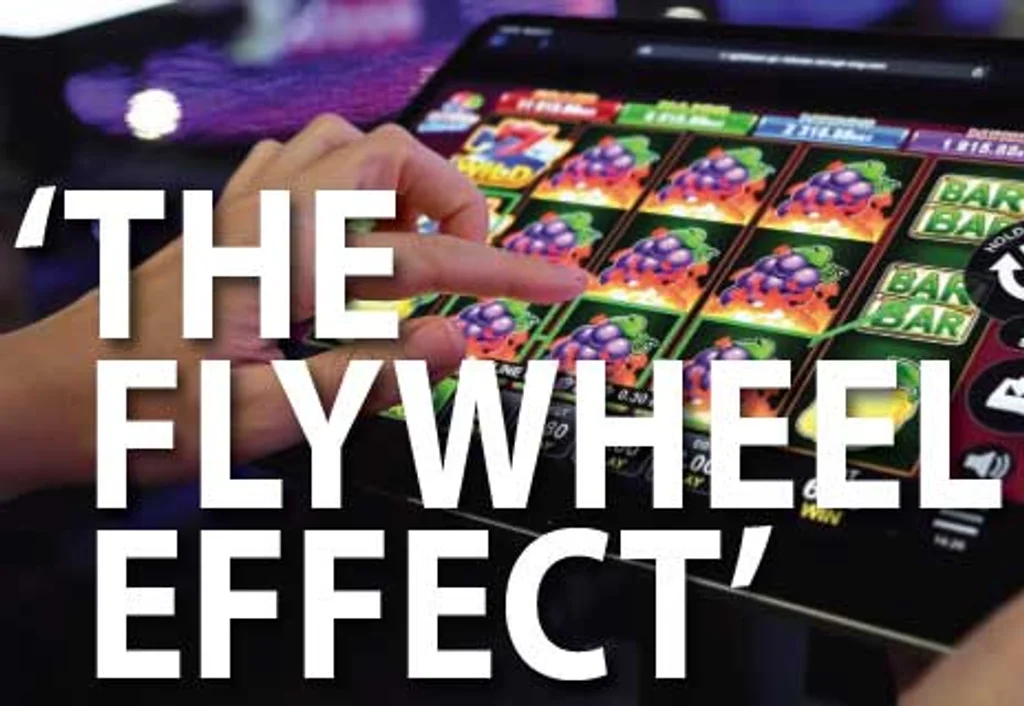
 SciPlay designers invite sustained play with game loops within the app, says Moy. “So one game element helps you earn and unlock another piece of the game element. If you complete that, it unlocks another piece of the game element. We try to create this ‘flywheel effect.’” That term, coined by researcher Jim Collins in his book Good to Great, is described as “a customer-centric cycle of attract, engage and delight.”
“Quick load times and engaging content hook players from the start,” adds Singer. “Regular content updates, special events and rewards for daily logins encourage frequent engagement and maintain player focus over time.”
Social games tend to be a secondary activity, with about 70 percent of users watching TV or streamed content while they play. Players can be easily distracted, so casinos specialize in what Moy calls “bite-sized entertainment, at the players’ discretion.” People can jump on for a quick, five-minute or 10-minute session (and get a mini-dopamine hit), or go deeper, become engrossed, and play 30 minutes or more.
No matter when or how long they play, or for what reason, game players are driven by similar goals, says Moy: “to complete a quest, to compete in a tournament, to find and earn different pieces of a (prize) collection.
“Social casinos tap into those different player motivations. And those player motivations are also what cause people to play games of any kind.”
Future Forward
Like every other technology, social casinos are likely to be elevated, if not transformed, by the use of artificial intelligence.
This brave new world could prove a great leap forward in experiential gaming with a personal touch. According to research by McKinsey, in 2024, consumers expect personal recognition and service when they interact with brands: 71 percent expect it every single time, and 76 percent are unhappy when they don’t get it.
AI-driven features of the future could include “adaptive game difficulty, predictive analytics for tailored rewards and virtual assistants that offer real-time game play tips,” says Singer. “We anticipate a future where technology continues to enrich social interactions and game-play dynamics.”
Moy adds, “Social casinos will continue to evolve as players tell us, on a daily basis, what they like to play and engage with. AI will definitely help us develop newer products and features faster than before, so we can get them into the player’s hands more quickly.”