Okada Manila Gaming Revenue Dip Tracks Inbound Travel Weakness

Okada Manila, the Philippines’ largest integrated resort, reported a sharp contraction in gaming revenue through 2025 that industry executives say underscores the fragility of VIP-driven models.
Key Takeaways:
- Okada Manila experiences a 34% quarterly decline in gaming revenue, driven by VIP market struggles.
- Chinese and Korean travel disruptions significantly impact inbound visitation.
- Shift towards domestic and mass-market segments becomes critical for recovery.
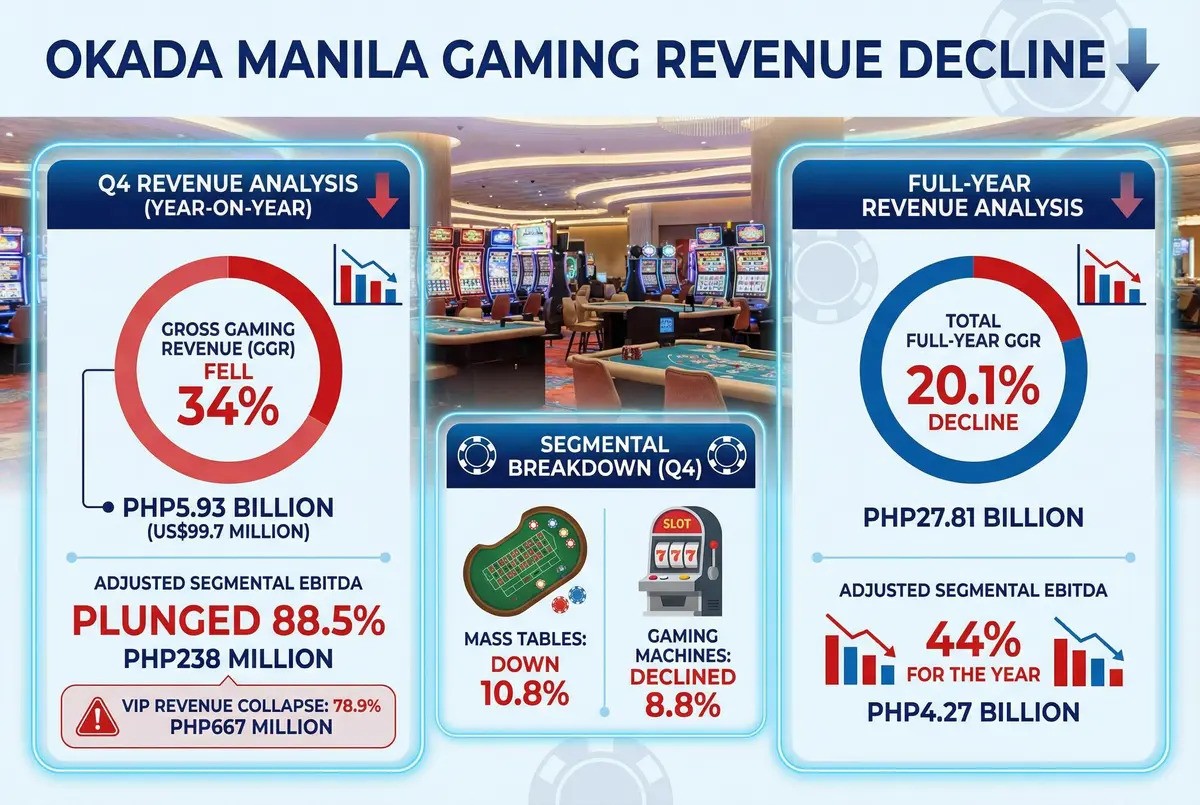
According to iGaming Business, fourth-quarter gross gaming revenue fell 34% year-on-year to PHP5.93 billion (US$99.7 million), leaving full-year GGR at PHP27.81 billion, a 20.1% decline. Adjusted segmental EBITDA plunged 88.5% in Q4 to PHP238 million and 44% for the year to PHP4.27 billion, driven chiefly by a 78.9% collapse in VIP revenue to PHP667 million.
Mass tables were down 10.8% while gaming machines also declined 8.8%, per Inside Asia Gaming.
Travel Disruption and Soft Demand Weigh on Gaming Revenue
The slump has been linked to disrupted inbound travel after the suspension and slow resumption of Chinese e-visas, which Tourism Secretary Christina Frasco warned would take time to recover: “As we can see in the results of any marketing campaign, it’s a work of at least six months before you can see actual conversion.”
Analysts such as Abacus Securities warned that “anemic” visitation from China and South Korea would continue to weigh on VIP volumes across integrated resorts in Entertainment City, which faces softer demand even as new supply timelines shift.
The pressures facing Okada Manila contrast with expansion strategies elsewhere in the Philippines with Hann Casino in Clark doubling its gaming capacity.
Quarterly trends through 2025 show sequential and year-on-year weakness across VIP and, increasingly, mass segments, highlighting pressure on margins and the need to rebalance mix toward domestic and mass customers.