
Just Incredible

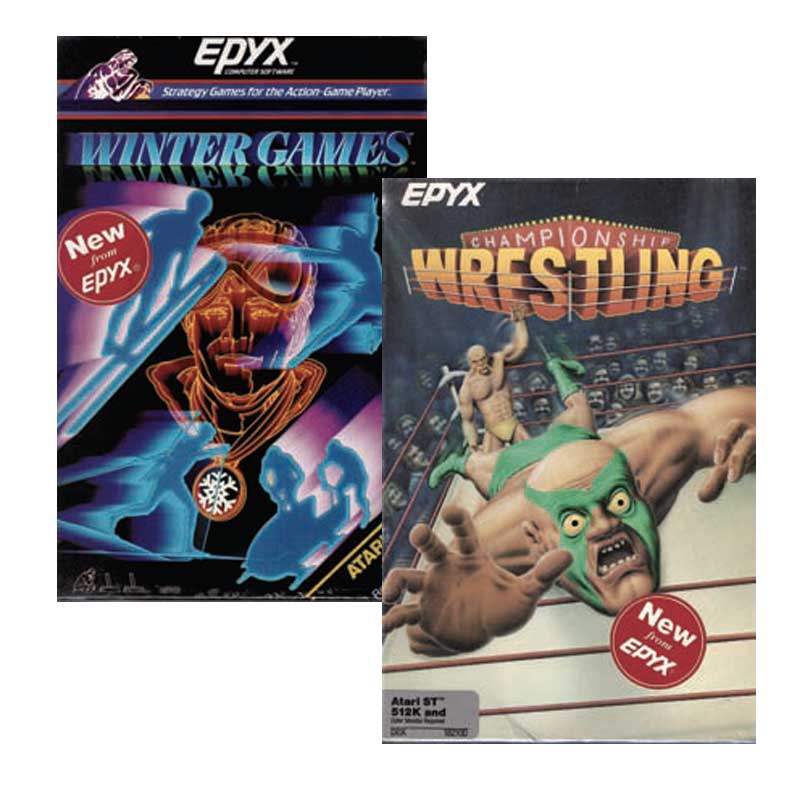
Nearly 40 years ago, Elaine Hodgson and Richard Ditton started a business by programming and designing a video game called Championship Wrestling for Epyx, for the old Commodore 64 home video console. Of course, it was obvious that business would eventually capture significant market share in the casino slot sector.
Well, not really. There was a lot of evolution, from video games to pinball games to hugely successful arcade and tavern games, in creating what is now Incredible Technologies, Inc. (IT).
Much about the company, still privately held by Hodgson and Ditton, is unique, especially in the casino slot market. It is a slot supplier owned and run by its founders, amid a sea of publicly traded and hedge-fund-owned competitors. It is the last slot supplier to stay based in the Chicago area, once home to the likes of Bally and WMS Gaming.
But mostly, it is a company that has matured from slot-market startup to a consistent 3-5 percent market share everywhere its games are placed—less than 15 years after designing its first slot machine.
Incredible Technologies began in the home video market of the early 1980s. Hodgson and Ditton, who were married at the time, were contractors for a company called Action Graphics, working on the game Winter Games for the Commodore 64 system. Ultimately, Action Graphics folded. “When we realized the company was going under, we just took the equipment home and finished the game ourselves,” recalls Ditton.
From there, the company would go on to develop a series of games for the home console, pinball and arcade markets at that time. A hit arcade game put them on the map—Capcom Bowling would lead to more business for the couple, who incorporated as Incredible Technologies in July 1985. Today, Hodgson remains president and CEO of the company, and Ditton is executive vice president.
But in those early days, they were operating out of their home while caring for a newborn baby, and focusing on growing the business.
“We were doing home games for quite a while, until we were approached by Data East to do pinball games,” Hodgson says. “That’s what got us into the arcade world.” (Data East was founded by Gary Stern, and would eventually become Stern Pinball.)
 In moving to the arcade world, Hodgson and Ditton were able to apply past experience working for toy manufacturer Marvin Glass and Associates (creator of famous games like Rock ’Em Sock ’Em Robots and Simon) and for arcade game manufacturer Midway, the Chicago-based company eventually bought by Bally Manufacturing and subsequently sold to WMS Gaming.
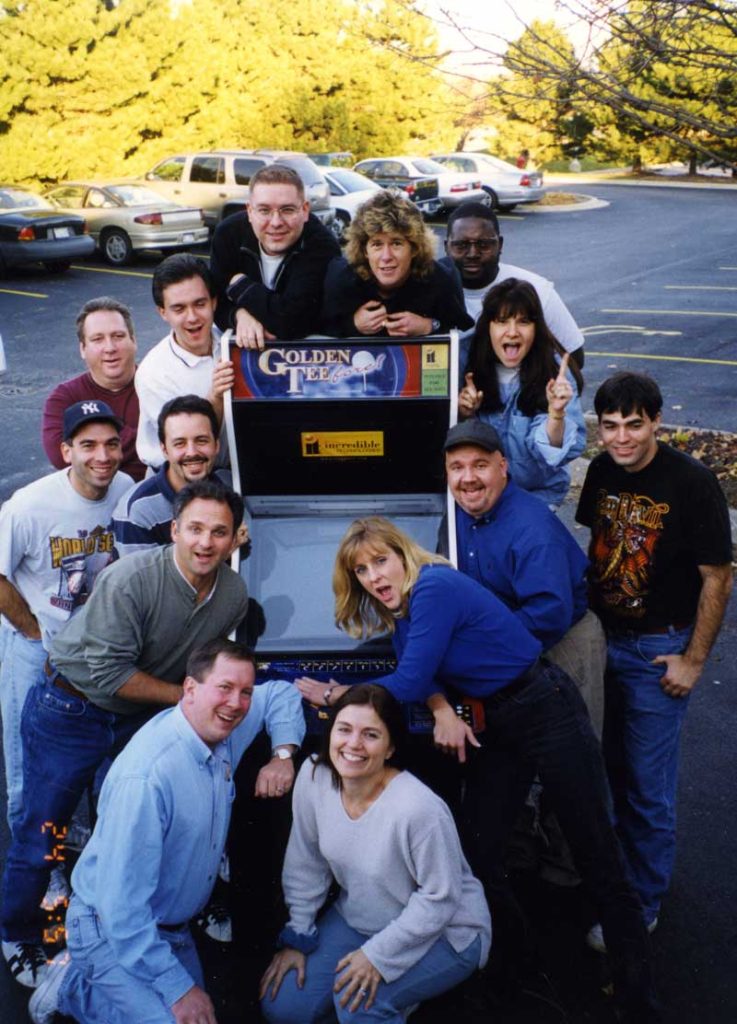
By the late 1980s, IT had established itself as the proper heir to the Chicago amusement-game tradition started by Bally, Williams and Midway. Several of the company’s arcade games became legends that survive to this day, such as Silver Strike Bowling, PowerPutt Golf, and the product that defines the amusement side of IT’s business to this day, Golden Tee Golf.
Those amusement products continued to evolve throughout the 1990s—notably, Golden Tee 3D, launched in 1995, was the first multi-player, interconnected gaming system with tournament capabilities.
By the early 2000s, Incredible Technologies had grown into the largest U.S. manufacturer of coin-operated amusement games, but Hodgson and Ditton were looking for new challenges. Ditton’s thoughts turned to the casino slot machine, and his engineer’s mind began exploring what goes into creating a slot game.
How to Make a Slot Machine
In 2006, with the Golden Tee bonanza still strong after 17 years, Hodgson and Ditton began in earnest in their quest to produce a casino slot machine. “We wanted to try something new and different and impossible to do, so why not take on multibillion-dollar companies?” laughs Ditton.
One would assume that IT would bring in slot-sector veterans, mathematicians and engineers to guide them in applying their amusement expertise to the casino world. One would be wrong.
“We just sort of hacked it out,” Ditton says. “That’s pretty much how we did everything—we would just say, ‘Let’s do it,’ and we did it.”
Instead of experts, Ditton brought in… YouTube videos. “Through YouTube videos, I was able to map out popular games, and attempt to re-create the reel sets and analyze how the math was done,” he says. “Luckily back then, the reels were very short, with a couple of hundred characters in a reel. It was all about the math.”
Much trial and error ensued, but by 2010, the company released the Magic Touch series of poker, keno and slot games. Two years later, the company arrived at its first Global Gaming Expo—with its first successful slot, the game Crazy Money.
The benefit IT’s slots had was a user-friendly interface, thanks to the company’s finely tuned sense of how to appeal to players in an amusement capacity. But the math needed more work.
 Ditton kept working at it. He analyzed more games, studied the features, and evaluated the math of popular games. “I had a program that could analyze the math of slot games,” he says. “It would run 50,000 games at a time, look at the results, and try to determine what players would like. It would sort of give its opinion on whether the math was good or not.
“And it worked out pretty well, because as soon as that program was done, we started having success in 2017 with a wide variety of games.”
“When we started using the math tool, that was a step taken to really understand the mystery behind game math back in the day, in our own way,” comments Dan
Schrementi, the 21-year Incredible Technologies veteran who began on the amusement side, but is now the company’s president of gaming.
“But meanwhile, on the other side, we were studying the market, which was less complex with fewer competitors back then. The features, the color schemes, the theme types, what’s working, what’s not working—that’s a part of the business that I focused on back in the day.
“But in the past 10 years, that’s changed greatly. Product management is a weapon that every company doing great in gaming has excelled at. We’ve invested in product management, which is really just the role that sits between sales and game development—while still empowering game development to be creative and take risks.”
Playing the Crowd
By the beginning of this decade, IT had established itself as a significant player in the U.S. slot market, and a company fully equipped to compete with the best in the industry. Its success can be traced to a laser focus on games and game features that have proven themselves successful in the market.
This was, in fact, a requirement set early on by Hodgson. “Elaine’s mantra was, we’re not going to take any game to G2E that didn’t have testing to show it was already a proven success,” Ditton says.
“I really want to know if a game’s going to do well before I put it out in a casino,” Hodgson says. “We have always tried to test games before we put them out, and we’ve always tried to follow on with similar themes or math that have worked.”
Ditton says it’s a philosophy that can be traced to the company’s coin-op origins. “That’s the way it’s been for coin-op forever,” he says. “Guys got a game together, threw it in the pickup truck, took it to a bar, and sat there and had a beer. You can’t throw them in a pickup truck anymore, but we still go out and test them. Elaine was insistent—if it wasn’t making it at the casino, there was no point in us taking it to the trade show.”
For the past two years, Schrementi has worked on revamping the company’s slot development “playbook,” working in new game mechanics like pot collection features, hold-and-spin bonuses and other popular features, applying them not only to new games, but to hit franchises like Crazy Money.
The product plan demonstrates IT’s maturation as a slot supplier—a supplier that commands a 3-5 percent market share.
“The industry adopts you in phases,” he says. “In that first phase, you’re the new up-and-comer. You’re viewed a little differently; you’re allowed to fail a little differently. You’re allowed to try different things. You’re cut different slack.
 “But when you’re a competitor that’s got 3-5 percent of a floor, you’ve got to keep that floor alive, the same way a company that has 20 percent of the floor keeps it alive. Customers in return are willing to buy more games from you each year if you can give them confidence that there’s stability in your roadmap.”
Schrementi adds that IT has also tried to keep the best parts of being a smaller, up-and-coming company. “In the beginning, it wasn’t about stability; it was about shaking things up and being totally disruptive, which is exciting. There’s a bit of that injected into what we do today. We call it surprising innovation.”
What makes the relatively quick success in the slot market by Incredible Technologies even more impressive is that the growth was all organic, achieved through trial and error and research.
“By the time it was the late 2010s and we had games that were working,” Schrementi says, “everybody thought, ‘Oh, you must have hired a bunch of game designers and salespeople from everywhere.’ But no, we learned the way Incredible Technologies does, which is grinding it out and taking big risks and learning from mistakes—and in the end, being a little company that puts a dent in big industries.
“It’s a different phase now—we are a gaming company. We still learn from our mistakes, but the types of mistakes we make now are more based around trying to be a differentiator in a business that we truly understand.”
Celebrating IT
Incredible Technologies celebrates two milestones this year—the 35th anniversary of Golden Tee Golf and the 40th anniversary in July of IT itself.
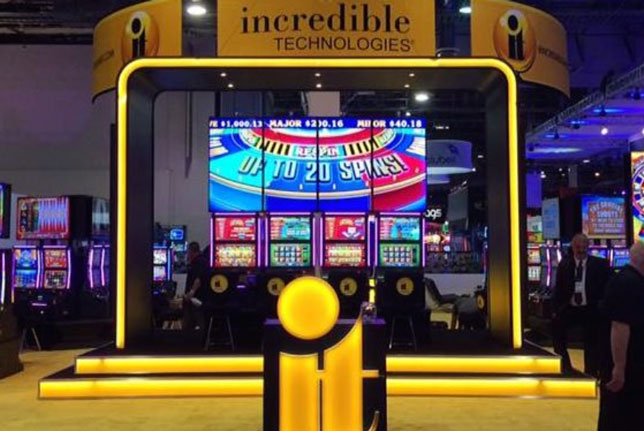
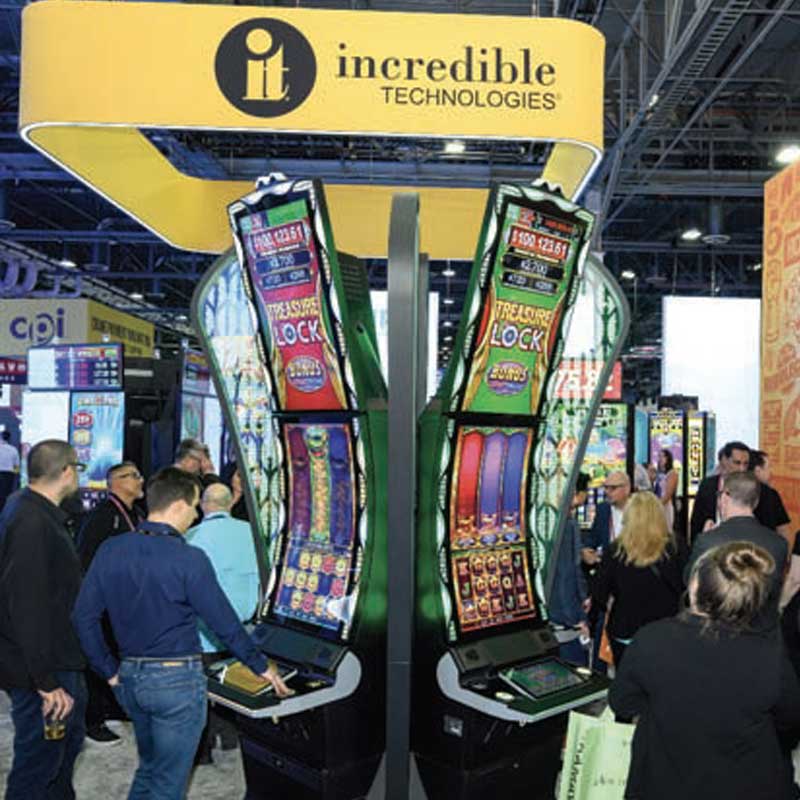
IT marked both anniversaries in its booth at G2E last month. The booth was adorned with photos and memorabilia marking the milestones of its 40 years in operation. Central to the booth was a replica Chicago sports bar—equipped, naturally, with two Golden Tee Golf machines, a classic one and a modern one.
Hodgson says the celebration is not limited to the amusement side of the business. The gaming industry has embraced Golden Tee Golf in many ways, from purchasing them for arcades to staging massive Golden Tee tournament events at casinos (the most recent was the World Championship at the Palms).
 “We’re one of the few companies that have been able to make a pop culture icon that has lasted for 35 years,” Hodgson says, “and we’re a small company that has done that. We evolved it from a simple game with pretty primitive graphics to what it is today. We made it a community game, and lots of people played it, and became a community. We put in a dollar bill acceptor, which was more money than people usually put in a game, but you could play it longer. We were first to have a credit card that we use for ID and payment. Now we use nearfield communication to help us have people play.
“We made contests and online tournaments so that people can win money by playing against people across the country. We have utilized advertising in the game. We’ve done different game mechanics.
“But in the end, it’s always a great simulation of a golf game that makes you feel like a great golfer, even if you’re not!”
Most of these advancements have appeared in the casino industry in one way or another, which bodes well for IT as it combines the innovations begun with Golden Tee with the features in the new slot roadmap.
“Our good gaming customers want to know the people who make Golden Tee,” says Schrementi. “We used to hide it from them, but we learned they want to be closer to this side of our business. We have slot bundle deals where they can get Golden Tees for their arcades.”
As far as the beginning of the next 40 years for Incredible Technologies goes, Schrementi says his team will remain focused on maintaining its 3-5 percent market share by constantly molding the product roadmap.
“We’re staying true to the game plan here, which is a fair-share-based approach to sales,” he says. “We’re not asking for 10 percent of a floor; we’re not pretending we could become that much bigger in size than 3-5 percent market share—but we will remain a very successful small private company that focuses on high-quality products rather than high quantity.”
“A lot of things about us have not changed in 40 years,” says Hodgson. “We’ve always wanted to make games that people want to play, and have modified that to making games that people will pay to play. We always wanted to have a company where we wanted to work, where we treat people with respect and reward their success.
“When just Richard and I were doing it, we had a good life, but it was never about the money. It was about being creative and making a difference in the industries that we were serving.”
It’s the Chicago way.