Gotham’s Big Gamble

After years of lobbying, millions of dollars spent and countless twists and turns, the downstate New York casino race came to a conclusion—perhaps mercifully so—on December 15. The New York State Gaming Commission (NYSGC) that day unanimously approved commercial licenses for all three of the remaining finalists: Bally’s Bronx, Resorts World NYC and Metropolitan Park.
The $500 million licenses came with a key condition: Recipients must sign agreements with third parties to monitor and enforce the litany of community benefits that each pledged over the course of the process. These agreements must run for at least five years from the date of licensure, and applicants must report progress quarterly.
Such a condition falls in line with guidance offered by the state’s Gaming Facility Location Board (GFLB), which recommended the finalists for licensure on December 1. Before that ruling, the applicants’ Community Advisory Committees had also stressed the need to formalize community agreements, which were a significant component of the selection process.
“We look forward to seeing the jobs, economic development, infrastructure and gaming revenue come to fruition.”
—Brian O’Dwyer, NYSGC Chairman
In the end, the three winners proved victorious in a field that was once as wide as 11 potential applicants. Four bidders voluntarily withdrew—Hudson’s Bay Co., the Las Vegas Sands Corp., Wynn Resorts and MGM Resorts International—while the other four were eliminated in the community advisory stage.
“To all three who have been granted this conditional license, congratulations on behalf of the state of New York,” said NYSGC Chairman Brian O’Dwyer. “We look forward to seeing the jobs, economic development, infrastructure and gaming revenue come to fruition.”
Big Plans for the Big Apple
With licenses in tow, here’s what the winners have planned:
Bally’s will look to build a $4 billion integrated resort at a golf course it owns in the Bronx near Ferry Point. In addition to licensing and construction costs, the company also owes an additional $115 million to the Trump Organization, the course’s former owner, as part of the site’s purchase agreement from 2023. Neither of the other licensees face such additional costs.
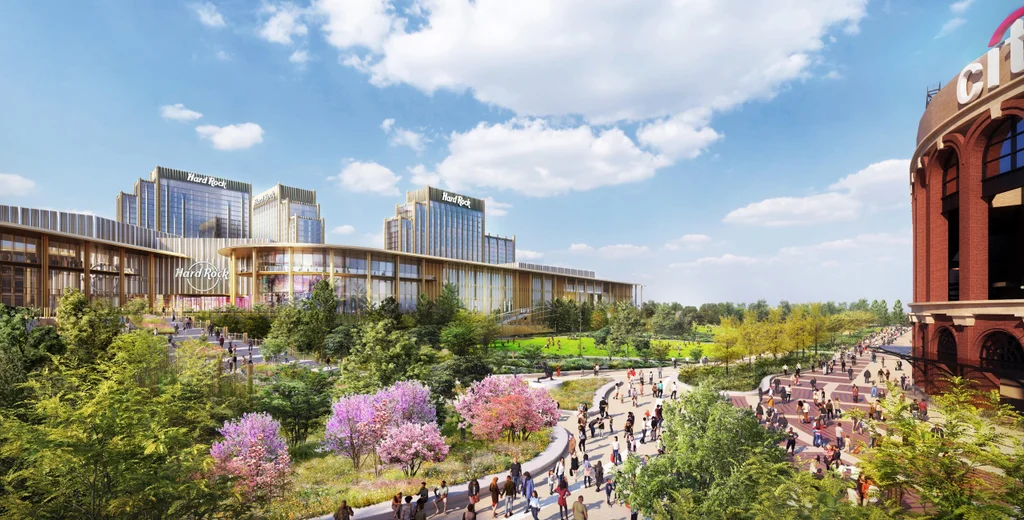
Metropolitan Park is to be a sprawling $8 billion mixed-use complex adjacent to the New York Mets’ Citi Field stadium in Queens. It’s a joint venture between Hard Rock International and Mets owner Steve Cohen. The project avoided political hiccups over rezoning as well as a last-minute legal challenge from the U.S. Tennis Association.
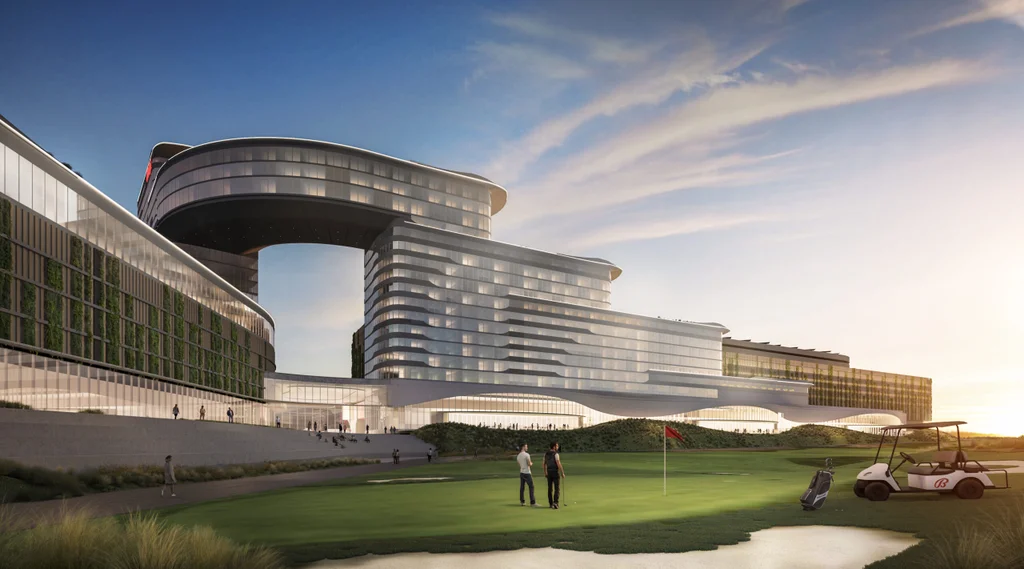
Resorts World plans an expansive $5.5 billion renovation and expansion of its existing video lottery terminal facility, also in Queens. The company was easily the most aggressive bidder in its licensing efforts, proposing tax rates of 56 percent and 30 percent for slots and table games, respectively.
Bally’s and Metropolitan Park are both slated to open in 2030, whereas Resorts World plans to open the first phase of its expanded casino this year. The operator originally projected a July launch but bumped that up to March as bidding intensified. It is unclear whether such a timeline is attainable given regulatory clearances and other considerations.
Navigating the threat of competition became a bigger concern as the process went on, given that two of the three projects are in Queens. All the Manhattan bids were eliminated from contention and MGM and Sands pulled their Yonkers and Long Island bids, leaving Queens and the Bronx as the winners in the downstate race.
Resorts World’s New York Prophecy
The combination of fast speed to market and volunteering a high tax rate made Resorts World a frontrunner from the beginning. Its eventual licensure was perhaps least surprising among the field.
In a statement, Robert DeSalvio, president of Genting Americas East, thanked gaming commissioners for the go-ahead. “We look forward to opening within months as New York City’s first full commercial casino,” he said.
The property will have a significant first-mover advantage. If it meets its announced casino launch date, it will be the only downstate licensee for at least three full years, and perhaps four.
But Resorts World’s parent company, Malaysian giant Genting Bhd, has two loose ends to tend to in the meantime. Those are the planned $561 million sale of its Resorts World Catskills property to Sullivan County in upstate New York as well as its efforts to privatize its Genting Malaysia subsidiary. The Catskills sale was delayed to 2026 as the latter process unfolded.
The biggest question related to Resorts World’s downstate bid revolved around suitability. Resorts World Las Vegas, Genting’s Nevada casino, was fined $10.5 million last year for substantial anti-money laundering violations.
Resorts World did not disclose to New York officials the details of that incident or other fines it received, which was a concern for the GFLB. But the NYSGC concluded that nothing in Resorts World’s application or background check was prohibitive for licensure.
Bally’s Comes Out of Nowhere
While Resorts World was a favorite, Bally’s Bronx was the opposite, representing the biggest surprise of the three winners. A successful New York bid now adds to a growing list of significant projects the operator is involved in, with the others in Chicago, Las Vegas and Australia.
Its $1.8 billion Chicago casino is to open in the fourth quarter of 2026, and its majority takeover of Australian operator Star Entertainment was approved in November. A proposed Las Vegas Strip casino complex is moving ahead but is still in preliminary stages.
Perhaps no one supported Bally’s New York casino fortunes more than outgoing NYC Mayor Eric Adams. Adams stepped in twice to aid the project’s rezoning efforts with New York City Council, once by lowering a vote threshold and the second time by vetoing another vote altogether. He later withdrew from the city’s November mayoral election.
“Having grown up in the city, it’s an honor and privilege to be selected by the Gaming Commission.”
—Soo Kim, chairman, Bally’s Corp., on the company’s unexpected Bronx victory
The project’s location is notable as Bally’s Bronx, if fully built, would represent the largest private investment in the borough’s history. While other applicants flocked to high-profile locations such as Times Square and Citi Field, Bally’s went in the opposite direction, attempting to bring new opportunities to an otherwise disadvantaged borough. The company’s extensive local and minority-led hiring and diversity commitments proved to be big factors in the state’s considerations.
Costs will be closely monitored—the highly leveraged company has taken on substantial debt. It has financed multiple transactions with the help of its biggest lending partner, Gaming and Leisure Properties. While the GFLB called Bally’s a “non-investment-grade entity,” that concern did not deter the state commission making the final decision.
“Having grown up in the city, it’s an honor and privilege to be selected by the Gaming Commission to receive a license,” Bally’s Chairman Soo Kim said in a statement. “Our team has worked closely with community leaders, union partners and local stakeholders to build a project that delivers real jobs, lasting economic benefits and a world-class entertainment destination for the Bronx.”
Met Park Hits a Home Run
Like Resorts World, Metropolitan Park had long been viewed as a leading candidate for a New York casino license. Its promise to transform otherwise vacant parking lots into a year-round entertainment destination was a key point in its success.
The backing from Mets owner Steve Cohen, one of the richest men in the world with an estimated net worth of $23 billion, also made it arguably the most secure project cost-wise. Cohen is a significant donor to the state’s Democratic Party and has long been connected to New York Governor Kathy Hochul.
“Now, we are going to be able to deliver the sports and entertainment district that our fans have been asking for.”
—Steve Cohen, Mets owner and backer of Metropolitan Park casino in Queens
Yet it was local politics that almost derailed the $8 billion dream. State Senator Jessica Ramos, whose district includes much of the site, refused to sponsor rezoning legislation. Her opposition could have tanked the bid, but Cohen and company skirted this roadblock by enlisting Senator John Liu to carry the legislation instead. Liu and Ramos’ public disagreement over the maneuver was one of the political lowlights of the licensing process.
The U.S. Tennis Association also created intrigue by filing a last-minute lawsuit over lease obligations tied to the land. This was averted through a new agreement with the city, stakeholders said.
“Since the day I bought the team, the community and Mets fans have made it clear to me that we can and should do better with the area around the ballpark,” Cohen said in a statement. “Now, we are going to be able to deliver the sports and entertainment district that our fans have been asking for.”
Cohen’s casino partner, Seminole-owned Hard Rock International, enjoys a monopoly on casinos and online sports betting in Florida and is constructing a Las Vegas Strip resort on the site of the former Mirage with an opening pegged for 2027.
Hard Rock CEO Jim Allen said in a statement his company is “excited to build on our long record of delivering world-class entertainment experiences here in Queens.”
So What Happens Now?
With the dust settled on the licensing race, Resorts World’s eventual first-phase opening in 2026 will be the only big development in the process for some time. It will be at least four years until all three licensees are operational, and that is only if construction timelines hold true. In the meantime, there are several questions and uncertainties left unanswered.
The performance projections for the downstate New York region were stratospheric, almost hyperbolic. The GFLB ultimately predicted that the three casinos could generate $7 billion in gaming tax revenue and $5.9 billion in other tax revenue in the 10-year period from 2027to 2036, the bulk of which would come once all three are operating.
That said, the state’s regulatory environment coupled with the absence of a Manhattan venue might put a damper on those expectations.
New York is tied for the highest online sports betting tax rate in the U.S. (51 percent) and the incoming casinos will also face significant levies on their revenue. Resorts World will pay 56 percent and 30 percent for slots and table games, respectively, while Bally’s will pay 30 percent and 10 percent and Metropolitan Park will pay 25 percent and 10 percent. For comparison, nearby Atlantic City casinos face an 8 percent tax rate on gross revenue, and Nevada casinos pay 6.75 percent.
Gene Johnson, executive vice president at consultancy Victor Strategies, partnered with Bally’s for its market analysis. The GFLB noted that Bally’s projections were the most conservative when compared to the other finalists and the board’s internal analysis.
While the applicants’ market studies are redacted, information gleaned from other application materials showed that Bally’s expects around $1 billion in annual gross gaming revenue, compared to $2.7 billion-$3.1 billion at maturity for Resorts World. Metropolitan Park’s application only lists its “high” projection of $3.9 billion in revenue, which factored in just one casino license to be issued instead of all three.
For Johnson, downstate New York represented “the mother lode” in terms of feasibility thanks to the densest population clusters in the country. But the heavy tax burdens, both in New York and increasingly in other jurisdictions around the country, are no small matter to contend with moving forward.
“We have to remember that gambling is a sin industry, and we operate at the pleasure of the powers that be,” Johnson says. “You’re seeing more and more efforts to squeeze tax revenue out of gambling operations, and New York is no longer extreme—they’re becoming typical.”
The elimination of Manhattan in favor of two Queens bids and one in the Bronx may also impact performance, given that Manhattan is New York’s premier borough by household income, according to data from the Furman Center at New York University; Queens and the Bronx rank third and fifth, respectively.
Having three properties somewhat clustered in the outer boroughs may not be the exact scenario stakeholders envisioned, or wanted. However, this grouping “might exert more gravity as a collective attraction” than isolated properties spread throughout the region, Johnson said.
“You’re seeing more and more efforts to squeeze tax revenue out of gambling operations, and New York is no longer extreme.”
—Gene Johnson, Victor Strategies, on the Big Apple’s proposed sky-high tax rate
New York’s Metropolitan Transportation Authority will be the most eager recipient of the casinos’ windfall, having budgeted a total of $1.8 billion in licensing and tax revenue from 2026 through 2029.
This need, coupled with the fact that the state as a whole faces a cumulative budget gap of $34.3 billion for the same period, proved impossible to ignore in regulators’ decision to award all three available licenses. The question now becomes whether the winners, who have made it elsewhere, can make it in the Big Apple.