At MGM China, ‘It’s All About Focus on Customers’

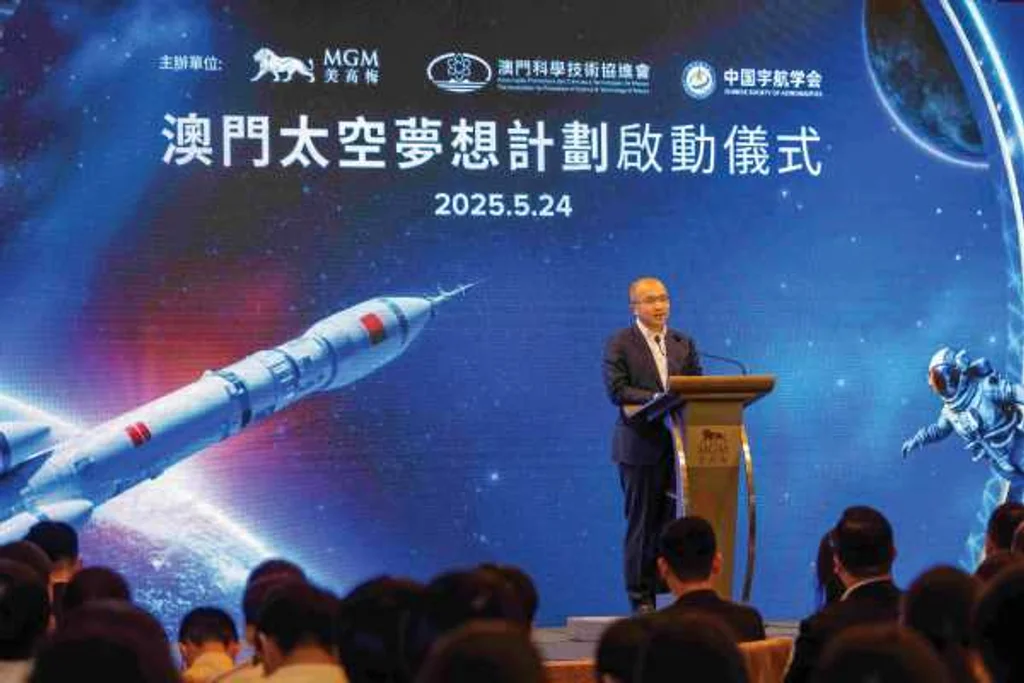
MGM China President and Executive Director Kenneth Feng has more keys than the front desk at an MGM hotel.
“The key is whether your product drives customers to spend time there.”
“The key is the entire team doing small things with great passion.”
“The key is innovation, but innovation so customers can have a fun time.”
“The key is to keep your casino F&B at a high level.”
“For all of the industry, the key is premium direct.”
“The key differential is in understanding the customer and continuing to adapt as customers continue to evolve.”
Feng’s keys, shared throughout a five-hour walking tour of MGM China’s integrated resorts in downtown Macau and Cotai, have helped unlock the company’s previously dormant potential. The Hong Kong-listed company, majority-owned by Las Vegas giant MGM Resorts International, has risen from consistently last in Macau market share to third behind Sands China and Galaxy Entertainment.
Each Point Matters
MGM’s Macau market share was 7.9 percent in 2018, the year MGM Cotai opened. It grew to 9.5 percent in 2019, and it currently hovers just below 16 percent.
“In a $30 billion market, 1 percent is a huge difference,” Feng says. MGM achieves that market share with 12.5 percent of Macau’s gaming tables after receiving an additional 200 tables in its new 10-year concession from January 1, 2023.
“Our company culture is all about focus on customers,” says Feng. “It’s a customer-oriented business, not an investment-oriented business anymore.”
“Kenny is a high-energy dynamo,” says Matthew Ossolinski, who runs the Macau Gaming Fund III. (Nearly everyone in Macau gaming calls Feng “Kenny.”) “Kenny moves quickly and demands the same from his team and vendors.”
JP Morgan Head of Asia Gaming/Leisure Research DS Kim cites MGM China’s “best in class execution” driving EBITDA of $1.l6 billion last year and $304 million in Q1, some 50 percent above pre-Covid levels versus Macau’s gaming industry average of 20 percent below.
“MGM looks to have focused on revamping their business during Covid more than other operators,” Seaport Research Partners Senior Analyst Vitaly Umansky says. “The company revamped its casino floors and enhanced its smart digital table capabilities, and knows how to effectively benefit from this technology in terms of both operations and CRM management.”
“A lot of things they do stand out,” adds Bay City Ventures Managing Director Joji Kokuryo. “MGM Cotai is most improved from its opening. They excel at gaming floor optimization and reading the market.”
Morgan Stanley Asia equity analyst Praveen Choudhary writes of MGM China’s first quarter: “GGR (as well as mass) market share were generally flattish QoQ, positive considering the competitive intensity” as all rival concessionaires except Wynn Macau ramp up new properties.
New Team on Top
Feng’s jingling keys herald a makeover at MGM that began during the Covid pandemic. In February 2020, longtime MGM Chairman and CEO Jim Murren announced he would step down from those posts and as chairman of MGM China. In May 2020, MGM China President and CEO Grant Bowie announced he would retire.
When the dust cleared as the pandemic deepened, Las Vegas fixture Bill Hornbuckle, MGM’s president and COO under Murren, replaced him as CEO and became co-chairperson of MGM China. Pansy Ho, partner in the joint venture that bought MGM’s gaming concession at an undervalued $200 million from her father, longtime Macau casino monopolist Stanley Ho, and currently controlling 22.49 percent of MGM China, advanced from co-chair to chairperson.
In June 2020, Ho named Feng and Hubert Wang as presidents to replace Bowie. Wang received the additional title of COO with responsibility for hospitality and casino operations. Feng had served as chief strategic officer since transferring to MGM China full time a year earlier and sat on its board. He continued in those positions and replaced Wang as chief financial officer. (MGM China currently lists Senior Vice President of Finance Vivian Chan as acting CFO.)
‘Two Guys from the Mainland’
Ho’s announcement drew snickers among Macau’s chattering class. Feng had visited Macau regularly since joining MGM in 2001, fresh from earning a master’s in finance at Columbia University.
 He played major roles in the development of MGM Macau and MGM’s mainland hotel partnership with Diaoyutai State Guesthouse, the hospitality arm of the Chinese government. Wang joined MGM China as CFO in 2011 and ran hospitality from 2019. But few outside the company had ever heard of Feng or Wang, often dismissed as “two guys from the mainland.”
Moreover, during Bowie’s tenure, the whispers were that whatever was wrong with MGM in Macau was Pansy Ho’s fault, from closing MGM Macau’s popular Lion Bar to opening delays at MGM Cotai to events and exhibitions that supposedly violated local traditions, tastes or taboos.
No one’s laughing now. “Pansy is a great visionary, a real leader in this industry and this region as well,” Feng says. “She understands Macau quite well.”
Betting While Bleeding
With travel at a virtual standstill due to Covid and with concessionaires politically constrained from shedding local workers, particularly during the concession retendering process, operators bled cash. Nevertheless, MGM China’s new leadership chose to invest $150 million in its properties.
“At the time, I had already invested $5 billion,” Feng explains, citing the combined cost of MGM China’s integrated resorts. “If this (investment) doesn’t work, the entire $5 billion doesn’t work. In case the pandemic doesn’t end, then all the money will be gone. So compared to the overall size, what we did was quite manageable.”
Feng praises Ho and Hornbuckle for giving management “a lot of autonomy, a lot of flexibility, so that we can make decisions fast.”
The most evident changes took place on MGM’s casino floors. “The key is you need to keep customers on the casino floor for a little bit longer,” Feng says.
MGM’s 50-member in-house design team completely revamped the Cotai gaming space under Feng’s guiding design principle: “It’s not about what your designers like, it’s what customers like.”
Their work transformed MGM Cotai’s original dark, narrow gaming corridor into a bright, inviting space. Renovations removed private gaming rooms, stages and platforms, relocated tables, rerouted foot traffic and changed the color scheme, emphasizing sunny hues, including MGM corporate orange.
In Cotai and on the peninsula, casino carpets—“the easiest way to impress people,” Feng says—became lighter-colored and thicker. Management changed table felts from blue to cream and amped up lighting. “We have the brightest and lightest casinos in the market.”
Good and Good for You
Across its gaming floors, MGM serves free boba tea, the popular Taiwan-born concoction of iced tea, milk, sugar and tapioca pearls also known as bubble tea.
Feng points out name-brand milk cartons displayed next to a serving counter. “Just because it’s free doesn’t mean it shouldn’t be high quality. You have to let customers feel they are being respected,” he says, noting MGM’s $2 million yearly boba spending.
Tasty Treats counters featuring ice cream and pastries require MGM loyalty program membership and points. “What’s important is that we have a chef here to show it’s fresh,” Feng says. Members can also use points for haircuts and massages in the Cotai gaming area.
“My office is the casino floor,” Feng says, regularly exchanging messages and photos with team members at all hours. “At 4 a.m., you can have 500 to 600 people on the casino floor.”
‘Be Great at Small Things’
“A lot of small things are what add up to a winning customer experience,” says Feng. “It used to be all you had to do was open the doors and make sure they stayed open. In the future it will be much more competitive. We need the entire team to be great at small things.”
As Feng sits down at a premium gaming area free buffet offering regional Chinese specialties, he explains, “Customers are not all from the biggest cities. When they see their regional food, they are excited.”
The buffet includes moon cakes with the Chinese character for “win” stamped on top. “One of our people thought of that,” Feng beams. “I believe everyone has potential if you let them develop it. They have to have freedom and not fear if they make mistakes. Otherwise, you get no good ideas.”
Post-Covid, MGM Macau has become the top property on the peninsula in terms of GGR and market share of $1.47 billion and 6.5 percent, respectively, in 2024, according to the company.
Closing the Luxury Gap
During Covid, MGM built 28 Emerald Villas at MGM Cotai. “You go to the mainland, and all the top hotels are there,” Feng says. “When they come here, they see something special.” With sand art and diamond-shaped aquarium centerpieces, these award-winning accommodations combine Chinese heritage with modern design and comfort.
“Luxury has a gap with customers.” Feng says. “We want them to say, ‘Your design makes me feel welcome.’” He believes that for post-pandemic customers, rather than beauty “it’s all about, ‘Are you making me happier?’”
MGM Cotai also has the Mansion, a 27-key Moroccan-themed hotel within a hotel—a “showoff piece,” Feng says. The largest suite, measuring 6,135 square feet, has a piano requested by a guest. “For a $5 billion investment, a piano is a small piece.”
Feng recalls a guest who wanted an organic banana with breakfast. “There weren’t any organic bananas in Macau then, so every morning we sent someone on the ferry to (high-end grocer) CitySuper in Hong Kong for an organic banana.”
Suite Returns
MGM takes such extraordinary steps for reasons beyond pure hospitality. EBITDA for villa guests is 10 times that for standard-room customers, Feng says, adding that MGM recouped its Emerald Villas $70 million cost in less than a year.
Within its premium mass-focused strategy—“60 to 70 percent of EBITDA is premium mass,” Feng says—MGM China is adding more high-end accommodations, 28 villas at MGM Macau this year and 60 suites in Cotai by Q1 2026. The first 10 villas on the peninsula opened ahead of May Golden Week and were heavily in demand. “People love staying there,” Feng says.
New premium guest rooms utilize former VIP areas but also consolidate standard rooms into fewer keys, furthering the premiumization of Macau. MGM Cotai’s new suites will reduce overall key count by 119 to 1,298.
Premiumization may be good business, but it runs contrary to Macau authorities’ goals to diversify away from VIP gaming to mass tourism, a conversion requiring more accommodations and more attractions. Feng “wouldn’t rule out” adding a third hotel tower at MGM Cotai; its podium was constructed to allow it.
Feng acknowledges diversification “is the only way that will make the gaming industry sustainable and grow steadily.” He cites Pansy Ho as “the driver” of MGM China’s non-gaming efforts. “She’s trying to do a lot of things for arts and culture, to bring Hong Kong, Macau, mainland China and international (parties) together to have more exchanges. She’s a very good ambassador in this area.”
Following the New Road
Poly MGM Museum opened last November at MGM Macau in collaboration with China’s state-owed Poly Culture Group. The inaugural exhibition on the Maritime Silk Road showcases 200-plus items from 20 international museums. The nearly 21,500-square-foot gallery utilizes advanced technologies to enhance views of artifacts.
“This building doesn’t help profits, but it helps Macau,” Feng says. He notes that the museum won MGM mention on China’s national network CCTV, rare for a casino operator.
In December, MGM Cotai debuted preeminent Chinese filmmaker Zhang Yimou’s Macau 2049, a multimedia spectacular highlighting China’s cultural heritage. The resident show pairs Zhang, who directed Raise the Red Lantern and the opening and closing ceremonies of the 2008 Beijing Olympics, with what MGM calls “Asia’s first dynamic theater” featuring the world’s largest indoor 4K LED display and newly upgraded immersive sound.
“A resident show is always challenging,” Feng says. “But for us, we want to make our business stand out among the six operators.”
MGM would not elaborate on the projects’ cost, saying only that they are part of its $2.1 billion commitment to non-gaming development under its new concession agreement.
“I just showed you how we take care of our customers, how we make our money,” Feng says, sitting down to dinner after walking the properties. “On the other hand, MGM is really spending on these non-gaming efforts. Sometimes it doesn’t have too much return, but MGM has to go on working on it.”