
Asia’s Crowded House

Alejandro Tengco is concerned.
The chairman and CEO of the Philippine Amusement and Gaming Corp. presides over a fast-growing market. In 2024, Philippines gaming broke records for gross revenue, hauling in $7.16 billion. Tengco credited iGaming, which grew 165 percent year-on-year to $2.7 billion—another record.
But that level of growth could soon come to an end.
More than a thousand miles away, Thailand is being positioned as Asian gaming’s next megamarket. Thai lawmakers have proposed five “entertainment complexes” with casinos that, by some estimates, could generate $9 billion a year. CLSA analysts have put the figure even higher, at $15 billion.
With that kind of potential, the big guns of Macau are considering a Thailand casino bid, and two—Melco Resorts & Entertainment and Galaxy Entertainment Group—have already opened offices in Bangkok. Melco boss Lawrence Ho is reportedly looking to sell his Philippine resort, City of Dreams Manila, to free up capital for Thailand.
“Competition is about to intensify,” Tengco told the Manila Standard in February, considering the potential in Thailand, and also Japan, which will open its first integrated resort (IR) in 2030.
“If casinos in Thailand and Japan become fully operational,” he fretted, “the Philippine market could be left behind.” For one thing, he noted, fewer than 6 million people visited the Philippines last year, versus 35 million in Thailand.
“Why would I go to the Philippines to gamble,” Tengco asked, “when I’m already in Thailand?”
Proactive Reinvestment
The expanding industry has resulted in Asia’s established jurisdictions, including Macau and Singapore, hustling to safeguard their investments.
Macau Chief Executive Sam Hou Fai continues his push to diversify an economy that historically has been too reliant on gaming. In 2019, casinos contributed more than half of gross domestic product in the Chinese special administrative region (SAR). But a year later, when the pandemic closed borders, revenue went off a cliff, dropping 78.4 percent year-on-year.
Lesson learned.
In 2022, when the existing casino concessions expired, Macau not only cut the license terms in half, from 20 years to 10, but also ordered the six concessionaires to invest $12.5 billion in infrastructure and non-gaming attractions. Macau’s economy “cannot remain unscathed,” Sam noted, “especially as competition in tourism and gaming from neighboring cities intensifies and looms.”
The chief executive’s concern is justified. But the SAR, the only place in the People’s Republic where casinos are legal, “will be very hard to beat, just because of its proximity to China,” says Brendan Bussmann, managing partner of B Global Advisors in Nevada. “Macau will always be Macau.”
 Singapore also is responding proactively. Marina Bay Sands, the market leader, just completed a $1.75 billion renovation, part of a total $9 billion upgrade mandated by its concession with the city. Patrick Dumont, chairman and CEO of parent Las Vegas Sands, says the expansion will grow the casino resort’s “economic, employment and visitorship contributions in the years ahead.”
MBS’ rival in the market, Resorts World Sentosa, plans a $6.8 billion redevelopment including a “waterfront lifestyle complex” with two luxury hotels. Parent Genting Singapore says a 290-foot light sculpture will “revitalize Singapore’s skyline,” which is now dominated by MBS’ Moshe Safdie-designed resort.
RWS’ casino license could hinge on the success of that commitment. Last November, gaming regulators renewed the license for two years instead of three, after the property’s tourism performance was deemed unsatisfactory.
Thailand: Japan Part II?
For all the uproar around Thailand, is it more sound and fury than potential?
In 2018, when the Japan parliament first legalized IRs, analysts called it “the next holy grail” of gaming, with potential revenues as high as $40 billion a year. Then Covid hit, investor enthusiasm tanked, and so did the market. It was 2023 before the government crawled across the finish line, awarding just one of three gaming licenses to MGM Resorts and its partner, Orix Corp. The team is building an $8 billion IR, MGM Osaka, in Japan’s “second city.”
Japan’s Casino Regulatory Commission could reopen bidding for the remaining licenses this year. Will the interest be there? Steve Gallaway, managing partner at Global Market Advisors, says MGM will be the bellwether. If Osaka succeeds, “there will be a push for additional development.”
Industry commentator Muhammad Cohen isn’t so sure. “With the way the world has changed,” he has written, “unless Tokyo or Hokkaido become available [as IR locations], no one will take a chance, given the required investment. The ROI just won’t be there.
“I’m afraid the issue is moot at this point.”
Bussmann believes Japan “still has a bright opportunity ahead. But it needs to go back and understand why many companies left the market out of frustration with the regulatory framework.
“If they can change that before they launch the next round, there’s opportunity to meet all of the goals sought by [late prime minister] Shinzo Abe.”
The Importance of Locals
Inspire South Korea, once controlled by Mohegan Gaming & Entertainment (MGE), opened in February 2024 and was a hit out of the box.
Within months, the “Las Vegas of Korea” pushed the Connecticut tribal operator to its best-ever quarter. MGE President and CEO Ray Pineault called the Incheon resort “one of our proudest achievements” and an “important driver for our growth in the present and future.” He said its proximity to Incheon International Airport made it “a major hub for international guests.”
But high opening costs and low table hold were its undoing, causing losses of more than $104 million. Barely a year after Inspire opened, MGE was out and lender Bain Capital seized control.
The Mohegans “got the ball in the end zone and didn’t really score,” observes Bussmann. He adds, “It will always be a challenge until they open up to locals. You need that constant visitor. Otherwise, you’re always worrying about airflow coming in and out.”
Japan is also limiting gaming by locals, imposing a 6,000 yen ($57) entry fee on resident gamblers and capping monthly visitation. It expects Chinese high rollers to do the heavy lifting. But with Beijing’s crackdown on capital flight and cross-border gambling, the big-spending VIP demographic has virtually disappeared.
Thailand could make the same mistake.
In response to public concerns about gambling addiction, lawmakers have proposed limiting casino entry to residents with a minimum of 50 million baht ($1.48 million) in the bank. That would bar all but the richest residents from gambling, and there aren’t many of those to begin with— Finance Minister Pichai Chunhavajira has stated “there are only 10,000 Thai accounts with at least 50 million baht.”
That financial barrier could create a “foreigner-only regime like South Korea’s,” gaming analyst Daniel Cheng told the South China Morning Post. At least one prospective suitor, Genting, has said it would hesitate to invest in a market that caters only to foreigners.
Ben Lee, managing partner at Macau consultancy IGamiX, calls Thailand “a juggernaut in terms of a holiday destination. Add gaming to that heady mix, and the market will explode.” Dozens of casinos are already clustered on its border with Myanmar, Laos and Cambodia, he notes, “all targeting Thai players.”
But if those players can’t play at home, will foreign gamblers be enough to support a billion-dollar industry? Maybe. Thailand is on track to welcome 40 million visitors this year. And the government has already identified four tourism hotspots to host entertainment complexes: Chiang Mai, Chonburi, Phuket and the capital city of Bangkok.
UAE In Sight
The United Arab Emirates (UAE), located on the western edge of Asia, will open its first IR in 2027. Wynn Resorts CEO Craig Billings says it could be a gusher.
In a recent interview with CNBC’s Jim Cramer, he said gaming at Wynn Al Marjan Island, due to open in 2027, could generate $5 billion to $8 billion a year at maturity.
“To put that in perspective,” Billings said, “the Las Vegas Strip (generates) a little over $6 billion.”
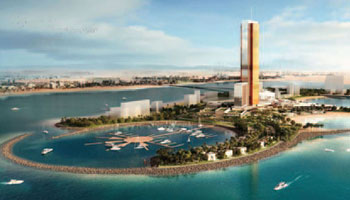 The Middle East’s first IR will feature a 1,500-room hotel, 22 private villas, meeting and convention space, more than 20 restaurants and lounges, and a 225,000-square-foot casino—all within 45 minutes of Dubai International Airport. Wynn and its partners, Marjan LLC and RAK Hospitality Holding, have a comfortable lead in the market, with an exclusive, renewable 15-year casino license.
Bussmann calls the UAE “the perfect jurisdiction, because within an eight-hour flight, you’re hitting London to Shanghai. There’s no other market in the world that does that.”
Lee, however, calls it “a mystery market, an Islamic country surrounded by other Islamic countries.
“Some say the UAE could be a hedonist’s refuge for the citizens of neighboring countries, like Sun City was in South Africa at one stage. They opine that the large number of richly garbed women from the neighboring countries will be a huge potential market, particularly for slots.
“Others point towards the large number of Indian passengers flying the circa 60 daily flights between India and the Emirates as a base for the grind-mass business.” However, Lee cautions, “the majority of these visitors are blue-collar or low-level workers supporting the construction and tourism industries.”
The UAE hosts a large community of expatriates who could be potential gamblers, Lee adds. “But the more interesting sub-segment of the expats are online gaming bosses who have sought refuge in the UAE. This sub-group has a demonstrated penchant for gambling and the ability to sustain it, from previous experience in Cambodia and the Philippines.”
All Eyes on Thailand
MGM boss Bill Hornbuckle has called Thailand “an amazing marketplace” that would be “cheap to build—35 cents to 40 cents on the dollar—and even cheaper to operate. … I think the margin in that business would be pretty extensive.”
Melco’s Ho has described the market as “a generational opportunity.”
As this magazine went to press, lawmakers in the Buddhist kingdom had yet to legalize casino resorts. And public opposition continued to mount.
 Meanwhile, China is keeping a watchful eye on emerging destinations and continues to forbid its citizens from gambling outside the country, even where gambling is legal. And South Korea continues to fall short because of its foreigners-only policy.
Along with Melco, Galaxy and Genting, three gaming operators have been floated as potential contenders in Thailand: Las Vegas Sands, MGM Resorts and Wynn Resorts.
Macau incumbents could be the ones to beat, says Lee. They are “the most aggressive and successful in developing entertainment that works for the Asian market. Their far-ranging global footprint also denotes their ambition and appetite for new markets.”
Thailand “has fabulous potential to be one of Asia’s leading markets, competing with Singapore, Manila and the UAE,” says Bussmann. “It has the opportunity to craft a strict regulatory framework that allows for maximum investment and job creation that will also impact tourism. But until that’s determined and finalized, you won’t fully know where the market potential can be.
“I’m still in a wait-and-see on Thailand,” he says. “They have one opportunity to get this right.”