The Future of Cashless

Society is increasingly digitalized, and consumers today are more likely to reach for their phone than their wallet to make a payment. But years on from the first cashless gaming solutions hitting the market, talk around these products remains of their potential, rather than their widespread adoption.
This is particularly apparent in tribal gaming. Speaking at G2E in 2022, Tim Cotton, IT audit manager for the National Indian Gaming Commission, made a bold prediction, saying that he expected 60 percent of tribal casinos to offer cashless gaming by 2025.
Fast forward a year to G2E in October 2023, when Kevin Zenishek, director of table games at Northern Quest Resort & Casino, told delegates that around 5 percent of tribal operators had adopted cashless, predicting a slow but steady uptick in the coming years.
What’s slowing down the uptake?
Why Casinos Can’t Quit Cash
The brick-and-mortar gaming industry can’t quite quit cash. Some suggest banknotes and chips are simply part of the experience. Others suggest the properties need to upgrade their systems to integrate cashless technology. Some even argue the industry is waiting for the product to be refined, after early cashless rollouts were beset by challenges. Let’s face it: An operator with a premium customer base does not want to offset that with a substandard product.
Yet cash continues to be phased out in other walks of life. Capital One research claimed in March 2025 that just under half (47.8 percent) of U.S. consumers make no cash purchases in an average week.
Why, then, are consumers more likely to head to the ATM before visiting a casino? Let’s consider Covid-19, widely predicted to be the black swan event that initiated permanent changes in consumer behavior.
During the pandemic, cashless was talked up as a way of bringing new, younger demographics into casinos and help properties recover after lockdown. It was also talked up as a way of providing a safer way to pay for masked-up consumers wary of touching too many surfaces.
The casino consumer has skewed younger post-pandemic, according to the American Gaming Association’s American Attitudes Toward Gaming 2024 study. Released last August, the annual survey highlighted the average age of a casino consumer skewed younger in 2024, at 41.9 years old, compared to 49.6 years old in 2019. Consumer behaviors and habits have largely snapped back to what they were pre-pandemic, however.
In the meantime, society continues to shy away from cash. People can order taxis or coffees seamlessly on their phones. In seven U.S. states, they can even play slots on their smartphones.
There’s a sense that cashless play becoming the norm feels almost predestined. Consumers only need a phone to travel, eat, drink—and with the wave of gaming expansion since 2018, even gamble—the conditions are there, and thanks to providers such as Marker Trax and Koin, the technology is there too.
Does that mean in 2025, cashless solutions are ultimately updating the on-property experience to provide the player base with what they want?
‘Players Expect Digital-First Experiences’
“As we consider commercial versus tribal casinos, casino operators, regardless of jurisdiction, understand that their players expect digital-first experiences,” says Patrick Schmit, vice president of product integration and business development for digital payments specialist Koin—the sister company of Marker Trax, which offers a digital alternative to lines of credit in casinos. “That means mobile payments, seamless transactions, and fast access to funds.”
Put simply, it’s aligning with broader consumer behavior, adds Gary Larkin, president of Koin. “Most consumers are accustomed to using digital wallets, tap-to-pay solutions and mobile-first banking experiences,” he explains. “By integrating similar cashless methods into the casino floor, tribal operators can meet and, in many cases, exceed player expectations.”

It goes beyond simply fulfilling expectations, Schmit continues. “Here’s the thing: Going cashless isn’t just good for players,” he says. “It also helps casinos run smoother in this digital age. It’s a win-win that’s transforming the gaming floor, one transaction at a time.”
He notes that operators are constantly looking for innovations to improve their operational efficiency, in a way that remains compliant with state regulations and enhances the guest experience. Cashless cuts cash handling costs, reduces human error, speeds up transactions, and—through Marker Trax— reduces the risks and costs of traditional credit programs. Marker Trax’s compliant technology ensures cashless credit can be issued and paid back right at the game, minimizing the ability of players to walk away with the funds. “Cashless does this and more,” Schmit says.
It’s a bold claim, but one that Mark Morton, senior vice president of sales for Marker Trax and Koin, believes the two companies achieve by providing an integrated digital payments ecosystem for the end user.
How It Works
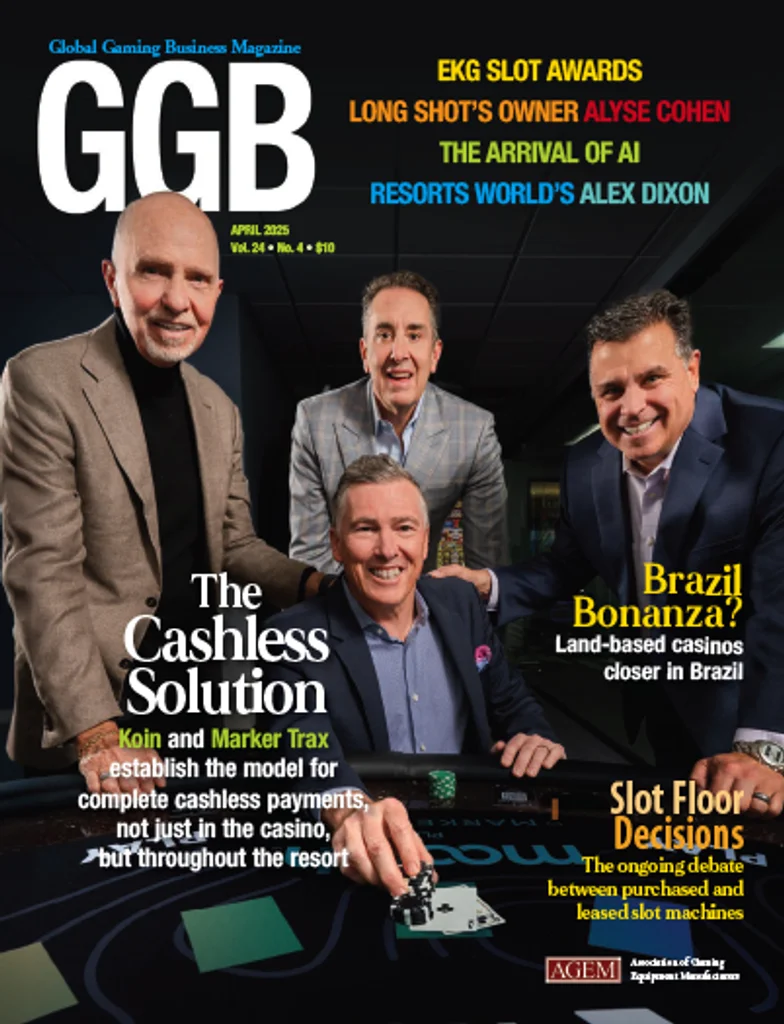
“Think of Koin and Marker Trax as your casino’s dynamic duo,” Morton says. Koin is a digital payments provider through which players can load funds from multiple sources, spending across gaming and non-gaming venues.

“Marker Trax replaces physical markers in properties to reduce the risk of issuing credit, with applications submitted through an app and decisions issued within minutes. The funds are immediately available to play and replay at the customer’s favorite machine or table.”
In tandem, the two products turn what used to be a time-consuming process into “something that feels as natural as using your phone to order coffee,” Morton says.
“Seamless” is an adjective regularly bounced around in discussions around cashless, but by creating an ecosystem powering every step of the customer journey, Koin and Marker Trax aim to live up to that expectation.
Addressing Cashless Challenges
However, some researchers have raised concerns about cashless play removing the guardrails for consumers. For example, in the U.K. Gambling Commission’s research on allowing cashless play in casinos, it warns operators of the need to add friction into the process, due to the risk of players spending more than they can afford.
Despite these concerns, Larkin believes cashless play offers new safeguards rather than simply removing the guardrails. “Cashless also provides better tracking for responsible gaming initiatives, and can reduce the cost and risk associated with cash handling while supporting their commitment to a safe gaming environment for their guests.”
That seamless experience is complemented by a highly secure system. After all, digitalization raises new concerns. A cashless pilot scheme powered by Aristocrat in New South Wales, across 144 poker machines in the Australian state, attracted hackers, forcing the supplier to cancel the trial.
That doesn’t concern Marker Trax President Charlie Skinner. Both Koin and Marker Trax’s solutions have been engineered for security, complete transparency and responsible gaming compliance, he says. This is aided by its partnership with Fortune 1000 fintech giant Euronet, a global behemoth processing billions of transactions across 170 markets each year. According to Skinner, Koin and Marker Trax are therefore underpinned by an infrastructure “as secure as the world’s leading financial institutions.”

“Picture a digital vault with multiple layers of protection, constant monitoring, and real-time verification systems,” Larkin adds. “Every transaction, transfer and dollar moves through a sophisticated network of security protocols, giving both players and operators unprecedented peace of mind.
“With Euronet’s three decades of experience in securing financial transactions for major banks and retailers worldwide, our platform stands as a testament to what happens when gaming innovation meets proven financial security.”
How Koin and Marker Trax are Building a Cashless Future for Casinos
The teams at Marker Trax and Koin paint a compelling picture of cashless gaming. Yet adoption continues to move slowly.
Considering tribal casinos are unlikely to hit a 60 percent adoption rate in 2025, as Cotton predicted back in 2022, there’s more work to be done to accelerate that progress. Therefore, it’s important to cultivate the early adopters effectively, to help cashless solutions really take hold and proliferate across tribal and commercial casinos.
To achieve this, it’s a matter of close collaboration between the suppliers and the casinos. “We work with the operator to motivate these early adopters to understand all the benefits and convenience of playing cashless,” Morton says.
It’s a case of turning these early adopters into advocates for the product, influencing others to grow the cashless consumer base.
And it’s proving effective, he adds. “Both products have grown organically through player word of mouth,” Morton continues. “Casino operators have also shown tremendous enthusiasm and support, helping to boost the popularity of both products.”
And crucially, Koin and Marker Trax have created a closed loop for cashless transactions. Now they are looking to increase the size of that ecosystem. That means it will expand digital payments beyond the gaming floor and throughout the resort, bringing hospitality, retail and entertainment into the loop.
“The ability to provide a fully digital, property-wide financial ecosystem is a natural next step,” Larkin says. New gaming verticals further strengthen its hand. “At the same time, Marker Trax will be expanding to table games and online sports wagering in the near future.”
Next, Marker Trax and Koin will look to better leverage artificial intelligence and data analytics to offer more personalized incentives to consumers, robust underwriting and real-time funding options for players.
This means that while cashless is proving a slower burn than many may have expected in the pandemic doldrums, Larkin is confident Marker Trax and Koin can spur future growth and adoption.
“The combination of Marker Trax and Koin provides a scalable, adaptable framework that can grow along with the industry, ensuring we remain at the forefront of the cashless transformation in gaming,” he says.