Cross-Platform Wonder


It was a great start to 2024 for global gaming supplier Light & Wonder. The quarter that ended March 31 was the 12th consecutive quarter of year-over-year revenue growth, with strong cash flow and a healthy balance sheet.
While gaming machine sales led the way with a 30 percent year-on-year increase, all of L&W’s business units reported double-digit growth. The company’s Nasdaq stock price has responded, exceeding recent analyst targets of $100 per share by late June (it was $103.87 at the time of this writing).
Additionally, in May 2023, Light & Wonder undertook a secondary listing on the Australian Securities Exchange (ASX), in addition to its primary Nasdaq listing. Since it began trading on the ASX, the stock has seen a 55 percent share price return and was added to the ASX 200 in October of last year.
Many analysts expect it to go significantly higher. “Light & Wonder is still a bargain right now,” wrote Simply Wall Street at the end of April. “Our valuation model shows that the intrinsic value for the stock is $127.60, which is above what the market is valuing the company at the moment.”
The fact that all of L&W’s business units are contributing to the strong earnings is a direct result of how the larger business has been structured since 2022, when the former Scientific Games shed its eponymous lottery division and sports betting platform. Rechristened Light & Wonder that year, the company refocused on its core business, the creation of high-performing game content.
The company formatted its three business units as engines to deliver that content to all available channels—brick-and-mortar casinos, with games exploiting famous legacy brands Bally, WMS and Shuffle Master; online casinos, through the former SG Digital; and social casinos through its free-to-play SciPlay division. While machine sales are still at the core of the company’s success, L&W’s digital division continues to grow, not only through its own formidable game library but through content distribution deals with third parties, the latest being Bragg Gaming Group.
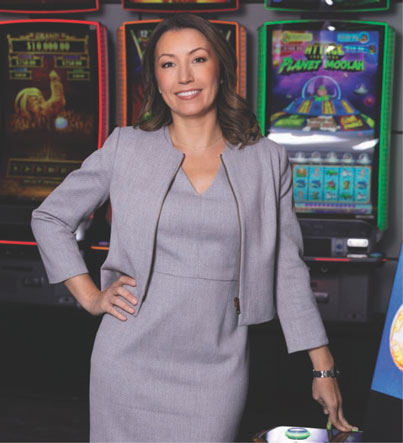
, Light & Wonder’s chief executive officer of gaming, is part of a team of top L&W executives that planned, executed and achieved the transformation of the company from Scientific Games into Light & Wonder.
“In the last two years, we’ve really been in full execution mode on our strategy,” says Lane. “After we ran our strategic review process, we identified the parts of the business that belong together, which centered around the strategy of developing the world’s best gaming content. As we say at Light & Wonder, it’s all about the games.”
This laser focus on content has been driven by a new commitment to research & development. “We’ve considerably ramped R&D investment,” she says, “and quite frankly, investment in our end-to-end organization, and we’re starting to see commercial proof points of the turnaround in full effect—which includes growing market share in Australia and North America across our gaming operations business and our game sale business.”
Simon Johnson, managing director of international gaming at Light & Wonder, adds, “International markets are enormously important to Light & Wonder, and we have a large physical presence in these regions with game designers who know what our customers expect and want.”
Crossing the Channels
Light & Wonder’s overall growth can be traced directly to its investment in R&D. “We have 15-plus land-based studios, across ANZ (Australia/New Zealand), India, the U.K. and North America,” says Nathan Drane, chief product officer of gaming at L&W. “The reason I say ‘15-plus’ is that we’re growing as we speak.”
The most recent additions include a New Zealand studio, a Sydney-based studio under developer Emma Charles and a Las Vegas studio under veteran game creator Ted Hase. According to Drane, L&W’s studio team was recently augmented by additional veteran talent, including Kelsy
Foster, who previously headed content studios at IGT for more than 20 years. L&W is building out a studio in Reno to be headed by Foster.

“We’re proud of not only adding studios, but also investing in the existing studio network that we have,” says Drane, “and that’s manifested itself in a few different ways. One is growing our studios to support new markets. We were one of the first to enter the historical horse racing (HHR) market.
“We don’t do that lightly. When we enter a new market, we make sure we have dedicated resources to support that. We’ve been growing the resources around areas like HHR, VLT, and even the ANZ market. It’s highly important that we continue to grow internal teams as well as add external teams.”
The R&D growth includes the other channels in which L&W operates, notably online, in both for-money and social sites.
“We have an internal (digital) team that’s been built up over a number of years,” Drane says. “We have a lot of expertise in taking games to iGaming from our land-based portfolio, but also building dedicated games for that market.
“We have studios in the U.K. and also in Las Vegas, producing both port games and dedicated content. And we’ve made a number of strategic acquisitions of studios in the iGaming space—truly proven studios like Lightning Box and Elk Studios that have added depth to our iGaming portfolio and dedicated iGaming content.
“We have a massive portfolio of products, not only within land-based gaming but also online and social. We really pride ourselves on the scale and diversity of our studios, and the number of products, end to end, that are in our business.”
The content pouring from those studios for land-based placement has one other distinct advantage at L&W—a continuous stream of new hardware. “What we’re most proud of is the diversity we’ve seen in the last 12 months across the hardware portfolio, which truly shows the balance and the depth of our roadmap,” Drane says. “We’ve added two more cabinets already this year, and we keep a constant eye on refreshing the hardware life cycle and making sure we’ve got the best games on each cabinet.”

He cites April 2024 as an example, when L&W had five No. 1 performing cabinets in the monthly Eilers-Fantini performance report, “from dual-screen, through portrait, through stepper,” adding that the cabinets are logging that high performance in diverse market segments, including VLT, HHR and Class II as well as Class III. “One of the major benefits of having a diverse portfolio is that we’re exposed to a number of markets,” Drane says. “They have different growth rates, but that exposure gives us confidence that we’re well positioned to capitalize on the growth. We’ve re-entered markets where we’ve been dormant for years like the stepper market, where we now have the No. 1 cabinet.”

Other markets where the company continues to see growth include the Georgia coin-operated amusement machines, or COAMs, and Loto Québec, which L&W will enter later this year. “All of that product diversity adds exposure, and we’re very well positioned to capitalize on that growth,” says Niaz Nejad, managing director, Americas-gaming. “Our continued expansion into adjacent markets allows us to innovate and bring fresh, engaging content to players. It’s an area we continue to invest in, and we have game talent immersed there to understand what our customers most want to bring these important games to life.”
Nejad spent most of her gaming career on the operator side leading AGLC (the Alberta Gaming, Liquor and Cannabis Commission) before joining Light & Wonder earlier this year.
Cross-Platform World
Light & Wonder’s expansion across divisions comes as the casino industry in general is moving toward a time when all the various distribution channels will be interchangeable.
“Cross-platform” or “omnichannel” may be the latest industry buzzwords, but the truth is that merger of channels is already happening—not only with content that moves seamlessly between online and physical casinos, but with loyalty programs that link online and brick-and-mortar play for rewards, and even online participation in live table games in casinos.
Light & Wonder is uniquely positioned to take advantage of this marriage of channels. Its table game division has been a top performer for decades, not only in felt tables but in utility products, dating back to legacy company Shuffle Master. Its systems division also has topped the industry for decades, with technology present not only on the slot floor, but in the pit in the form of progressives—including the first wide-area table progressive—and online in both the slot and live-dealer table areas.
“In systems, we not only have new products coming online, but this provides a great opportunity to bundle across slots, systems and tables, which is a huge competitive advantage for Light & Wonder,” says Lane. She says this year’s L&W booth at Global Gaming Expo will “demonstrate the power of cross-platform, and how you cultivate the player journey through different channels, enabled by our systems.”
Lane notes that the cross-platform experience was envisioned by the L&W team at the outset of new leadership taking control.
 “From day one, we were thinking about the strategy, and what assets really belong together,” she says. “Cross-platform content and games were always at the center of our thinking. And we’ve really just scratched the surface. There’s a lot more we can do, and we aim to demonstrate that over time. It’s really about meeting the player where they are.”
Johnson adds, “We can envisage our path to deliver some really exciting goals, and that’s truly energized the entire business. It has given us a real sense of excitement, a real sense of momentum, a real sense of belief, belonging and of being a valued part of that journey.”
Much of that belief revolves around a culture that many attribute to CEO Matt Wilson and Executive Chairman Jamie Odell. “This is just very much a people-first culture,” says Nejad.
“This one-team mentality means it doesn’t matter what part of the business you’re in or what part of the globe you may represent; we really do come together as one Light & Wonder culture. I’ve only been with the team six months (she was most recently head of marketing for the Americas at Aristocrat), but that was apparent the minute you walk into the building. It’s a beautiful culture that Jamie, Matt, Siobhan and the entire team have put in place.”
“We’re really excited to continue to execute on our end-to-end strategy,” says Lane. “In 2022, we made a commitment to the market of achieving a $1.4 billion EBITDA target by the end of 2025, and we feel very, very confident in our ability to achieve that target.”
Lane’s confidence goes back to the team Light & Wonder has put in place. “We just have great, high-performing talent here at Light & Wonder,” she says. “We’re results-driven. We’re here to win. We’re motivated to win.”
Rapid Rise
A conversation with Matt Wilson, Chief Executive Officer, Light & Wonder
 Matt Wilson joined the industry as an intern with Aristocrat Technologies in 2004. Twenty years later, he’s running one of the largest gaming content providers, Light & Wonder. He joined the company after his long history with Aristocrat in 2020 as the president of the gaming division, just at the start of the pandemic. He was appointed CEO of L&W in 2022 when it divested its lottery division and the name Scientific Games. Today, L&W is one of the fastest growing gaming suppliers both online and on land. Wilson spoke with GGB Publisher Roger Gros from his office in Las Vegas via Zoom in June.
GGB: During your time with Aristocrat, you worked in almost every area of the company. How did that help you when you landed at Light & Wonder?
Wilson: When you get into the industry, you figure out what you’re uniquely good at. I spent some time in sales, spent some time in product management. I ran the global recurring revenue business for a period. At L&W, I came here to run a transformation of the gaming business, which I then handed the reins to Siobhan Lane to continue, and she’s doing a fantastic job. I took the full-time group CEO assignment in August of ’22, and it’s been a hell of a ride. If someone had told me the company would turn into what it is today when I first arrived here, I’m not sure I would have believed that. It’s been quite incredible.
We did a podcast right after the name change. People were a little surprised at the name in the beginning, but now it really seems to fit your company. I guess that was the plan all along.
Yes, I think the name change came with a lot of consternation. What we were really trying to do was break ties with the past, to be honest with you. We wanted to be a completely new company. Our organization came together through huge amounts of famous companies in the industry—Bally, WMS, Shuffle Master and NYX. We wanted to say that Light & Wonder is really about the future. We went through thousands of names before we landed on Light & Wonder. It felt bold and unique, and all the things that we were trying to become as a company.
With the separation from Scientific Games, Light & Wonder is a pure gaming company. How did that change come about?
It came together somewhat in the form of necessity. Our business was built around M&A, lots of organizations being put together and a huge amount of leverage on the business, particularly coming out of Covid. As we went through the transformation, we did a strategic review and wondered what we could do to get this company in better financial shape, and get the leverage under control. So we divested lottery and our sports platform business, OpenBet, and used the proceeds of that to repair the balance sheet.
How did that change the way you approach your job?
What we have left in our portfolio is a large land-based gaming business run across every geography globally. It’s an amazing business, and really growing nicely. Then we have the social casino business, which is SciPlay, which is built off this idea of building great content and taking it into the social casino channel. The same content we built for the land-based, we take into social casino. And then the third leg of the stool is this amazing hypergrowth business called iGaming, which is expanding really quickly across the U.S. As CEO, my real focus is set the vision, create the team, make sure we’re executing. So it doesn’t really change my job in a large capacity. The one thing that we do every day is we wake up obsessed about games and making the best games in the industry.
When you and Jamie Odell were at Aristocrat, you were able to develop and instill a very special corporate culture. How did you do that with your L&W employees and show your customers that you are serious about it?
It’s one of the things that really attracted me to this job. A big part of being a CEO is building the right team and building the right culture. Our team wants to be on a mission and on a journey together. I’ve been fortunate to have that in almost every role that I’ve had in my career, and it’s something I’m really drawn to. It’s like this idea of delivering big visions and big grand things collectively. I grew up playing sports. I played cricket and rugby and (other) things I wasn’t particularly good at, but I loved the idea of working collectively as a team. It’s what I’m all about, and we’ve been able to attract and retain an amazing team here.
How much of a crossover is there between the content developed on your games, whether they are slot machines, social casino games or iGaming?
This has been another big part of the transformation. These operating businesses were very independent and were not very well integrated. Now we’re all working collectively to build the world’s greatest games and take them across all those channels. So we’ve got Siobahn who runs the land-based gaming business. We’ve got Josh Wilson who runs our SciPlay business, which is an awesome business growing the fastest out of its peer set in the industry. And then we’ve got Dylan Slaney based in the U.K., who runs our iGaming business. So those three teams really now work hand in glove to take the great games that we make across all these three channels. The vast majority of games that we build are going cross-channel. Our vision is to be the leading cross-channel gaming company in the world.